
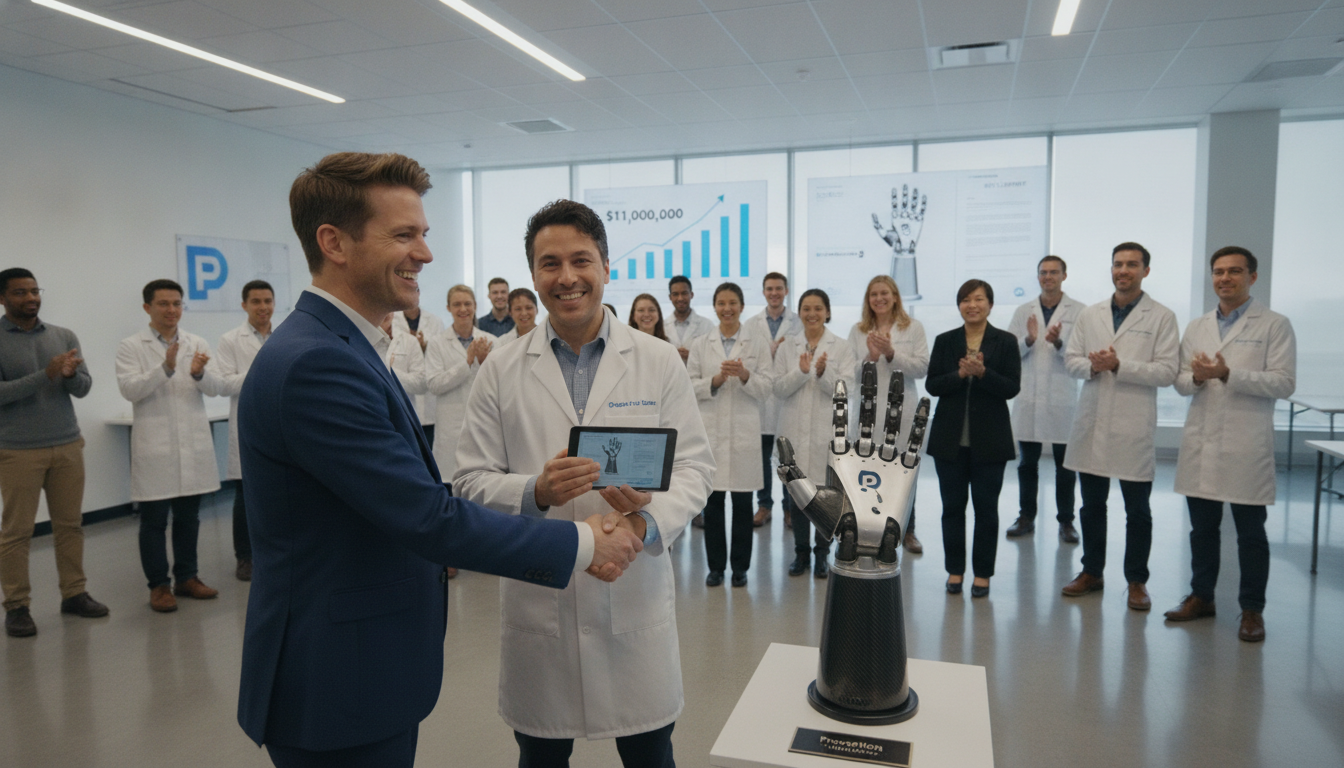
Proception robotic hand startup raises $11M seed, ships first units after Tesla lawsuit dismissed
Proception robotic hand maker secured an $11 million seed round and began shipping its first high-dexterity hands after settling a trade-secrets dispute with Tesla, the company said Monday.
Proception announced the financing led by First Round Capital, with participation from Y Combinator and BoxGroup, as it ships an initial batch of sensor-packed hands to researchers and robotics firms. The startup’s founder, Jay Li, who previously worked on Tesla’s Optimus program, said the settlement cleared the way to focus on scaling hardware and data collection for dexterous manipulation.
Funding and early shipments
Proception said the $11 million seed round will support production and data efforts as it opens orders beyond early research customers.
The company is shipping its first units to laboratories and robotics companies that want off-the-shelf dexterous hands instead of developing their own. Proception aims to be the primary supplier for firms that need advanced manipulation capabilities without investing heavily in bespoke hand design.
Founder frames litigation as a test
Jay Li, who served as a technical lead on a major humanoid robotics program before founding Proception, described the recent legal battle with his former employer as a pressure test for the startup. He said the experience validated the team’s resolve and that facing litigation made them more determined to deliver a product that meets demanding industrial and research needs.
The lawsuit, which alleged misuse of trade secrets, was dismissed earlier this month after months of legal exchanges, according to the company. Proception declined to report further details of the settlement, and the former employer did not provide comment through Proception.
Glove-based data capture and sensor skin
At the heart of Proception’s approach is a sensor-laden glove that captures fine human hand interactions without requiring a robot to be present. Human operators wear the glove and a headset to record nuanced manipulation data that can be used to train models and inform robotic control.
That same sensor array doubles as the “skin” on Proception’s hand, which the company says offers 22 degrees of freedom and multiple joints per finger to enable a wide range of dexterous motions. Proception argues this combination of detailed human data and high-fidelity hardware produces task-specific training examples that are both richer and more scalable than teleoperation alone.
Why investors backed hardware plus data
First Round partner Bill Trenchard, who led the investment, said Proception’s integrated strategy—developing both the mechanical hand and the data pipeline—was central to the firm’s decision to lead the round. Investors described dexterous manipulation as a critical component for humanoid robots to become broadly useful.
Backers told Proception they saw a path to producing one of the most sophisticated hands on the market today and to building the datasets needed to support advanced control models. Several investors also highlighted Li’s leadership through the legal dispute as a positive signal for the team’s ability to execute under pressure.
Positioning in a crowded robotics landscape
Proception enters a robotics market flush with capital and attention but still searching for reliable solutions to the last-mile problem of manipulation. Industry figures and researchers have repeatedly noted that producing hands that match human versatility remains a significant technical hurdle.
Proception’s focus on scalable human-sourced data is intended to accelerate progress by allowing more parallel collection efforts than robot-in-the-loop teleoperation typically permits. The company believes this data-centric route could shorten timelines for useful, human-like dexterity compared with approaches that emphasize hardware alone.
Proception also anticipates demand from companies that prefer to integrate an existing high-dexterity hand rather than rebuild the complex systems required to achieve similar performance. The startup’s strategy positions it as a component supplier for broader humanoid and robotic platforms.
Potential industry fallout and future prospects
While Proception has settled the recent dispute, the episode underscores tensions that can arise when engineers leave large robotics programs to start independent ventures. Li said he expects larger industry players may eventually seek collaboration or technical support as the market matures and the need for advanced hands grows.
The seed funding and early shipments give Proception runway to expand manufacturing, refine sensor integration, and scale its data-collection network. If the company can pair its hardware with robust datasets and models, it may accelerate the deployment of dexterous manipulation across research labs and industrial sites.
Proception will use the capital to increase production and to broaden its data efforts while continuing to market its sensor-equipped hands to researchers and robotics companies aiming to speed development of humanlike manipulation.
