
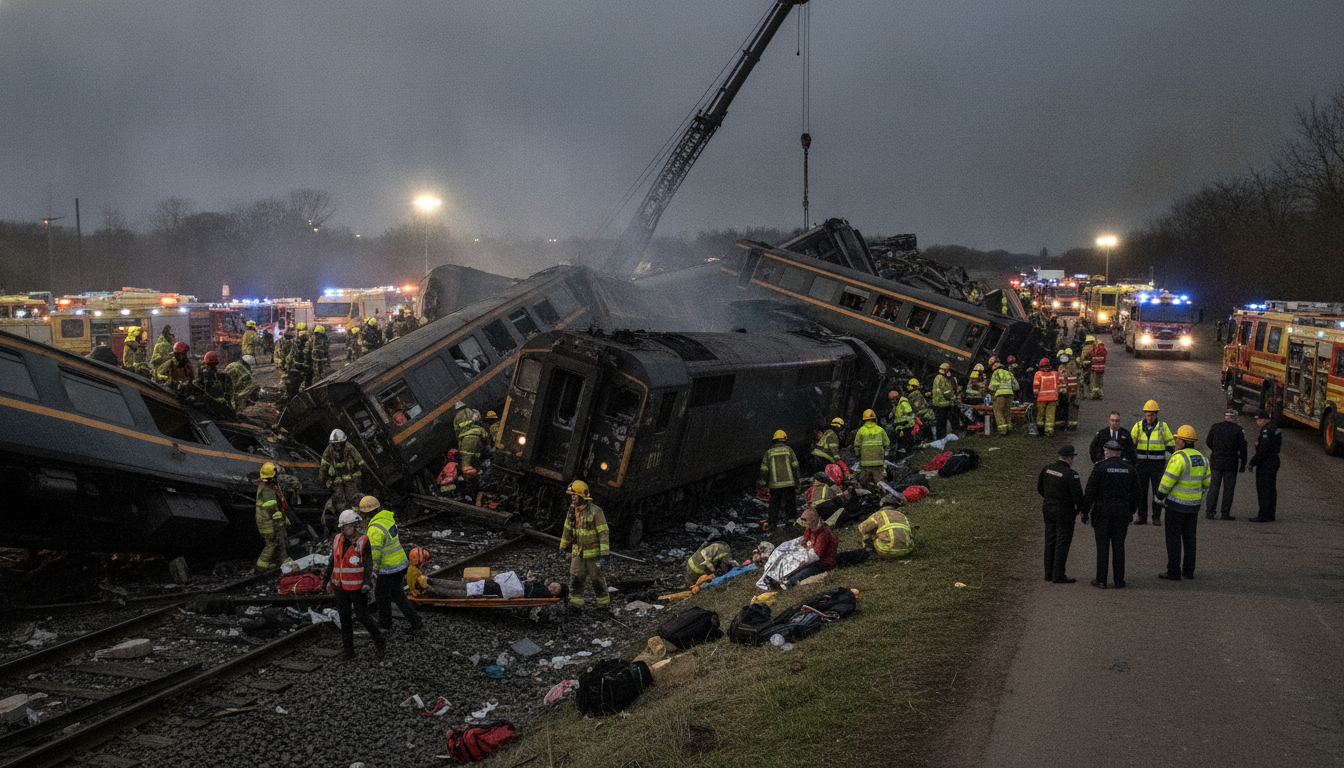
Bedford train crash kills driver; 28 hospitalised and nine in critical condition
Bedford train crash: One driver killed and 28 hospitalised after two London-bound trains collided; British authorities and investigators opened a full probe.
The Bedford train crash on Friday night left one train driver dead and dozens injured after two passenger services collided on the same track north of London. Emergency services treated more than 80 people at the scene, and authorities said 28 remained in hospital the following morning, with nine in critical condition. British Transport Police and the Rail Accident Investigation Branch have begun a joint inquiry while Transport Secretary Heidi Alexander urged caution about causes.
Casualties and hospital updates
As of Saturday morning officials reported that more than 80 people had received medical attention following the collision near Bedford, about 56 miles (90 kilometres) north of London. The East of England Ambulance Service said 11 people had sustained very serious injuries, 32 had serious wounds and a further 56 suffered minor injuries.
Police confirmed that one of the train drivers died at the scene, and authorities described the incident as a tragic loss for the railway community. King Charles issued a statement expressing that he was “greatly saddened” by the death and sent condolences to the driver’s family and to those recovering in hospital.
Emergency response and rescue operations
Multiple ambulance crews and specialist rescue teams were deployed to the collision site on Friday night, with more than 20 ambulances and several hazardous area response units attending. Six air ambulances also responded, and East Midlands Railway personnel worked alongside emergency services to support passengers and first responders.
On-scene commanders said resources were mobilised quickly to prioritise life-saving treatment and to make the area safe for investigative teams. Local hospitals were readied to receive casualties, and clinicians continued to assess and treat patients through Saturday as the investigation progressed.
Operator reaction and support for inquiry
East Midlands Railway, which operates both services involved in the collision, confirmed the two trains were London-bound when they struck one another. Will Rogers, EMR’s managing director, described the incident as “a profoundly sad day for the railway community” and said the operator was supporting families and colleagues affected by the crash.
EMR said it was cooperating fully with the Rail Accident Investigation Branch and British Transport Police and that staff welfare measures had been put in place for employees and witnesses. The operator also pledged to assist investigators with data and crew information to help establish what happened.
Investigative teams and government response
British Transport Police said specialist investigators were working alongside the RAIB to gather evidence and reconstruct the sequence of events that led to the collision. Chief Constable Lucy D’Orsi confirmed that detectives and specialists were at the scene and that enquiries were focused on establishing the facts before drawing conclusions.
Transport Secretary Heidi Alexander cautioned that it was too early to speculate on causes and promised a “thorough investigation” to ensure lessons would be learnt. Officials have not yet indicated whether signalling or infrastructure failures played a role, and the RAIB’s detailed technical work is expected to take time.
Operational impact and safety questions
East Midlands Railway’s confirmation that both trains were on the same track has prompted immediate questions about signalling, track operations and train dispatch protocols on the route. Rail industry bodies typically review operating practices and technical systems after serious incidents, and investigators will examine equipment logs, signal data and crew communications.
While investigators proceed, passengers on routes that use the affected corridor faced disruption as services were adjusted to allow emergency access and scene examination. Rail operators and safety regulators are likely to outline interim measures if any systemic issues are identified during the initial stages of the probe.
The collision has drawn attention to rail safety and incident response procedures, and unions and rail staff groups are expected to seek further detail about working conditions and signalling arrangements as the inquiry develops. Any recommendations from the RAIB could influence wider operational rules across the network.
Emergency services, operators and investigators will continue to provide updates as more information becomes available. The focus remains on care for the injured, support for the bereaved and a comprehensive technical review to determine the sequence of events that led to the Bedford train crash.
