
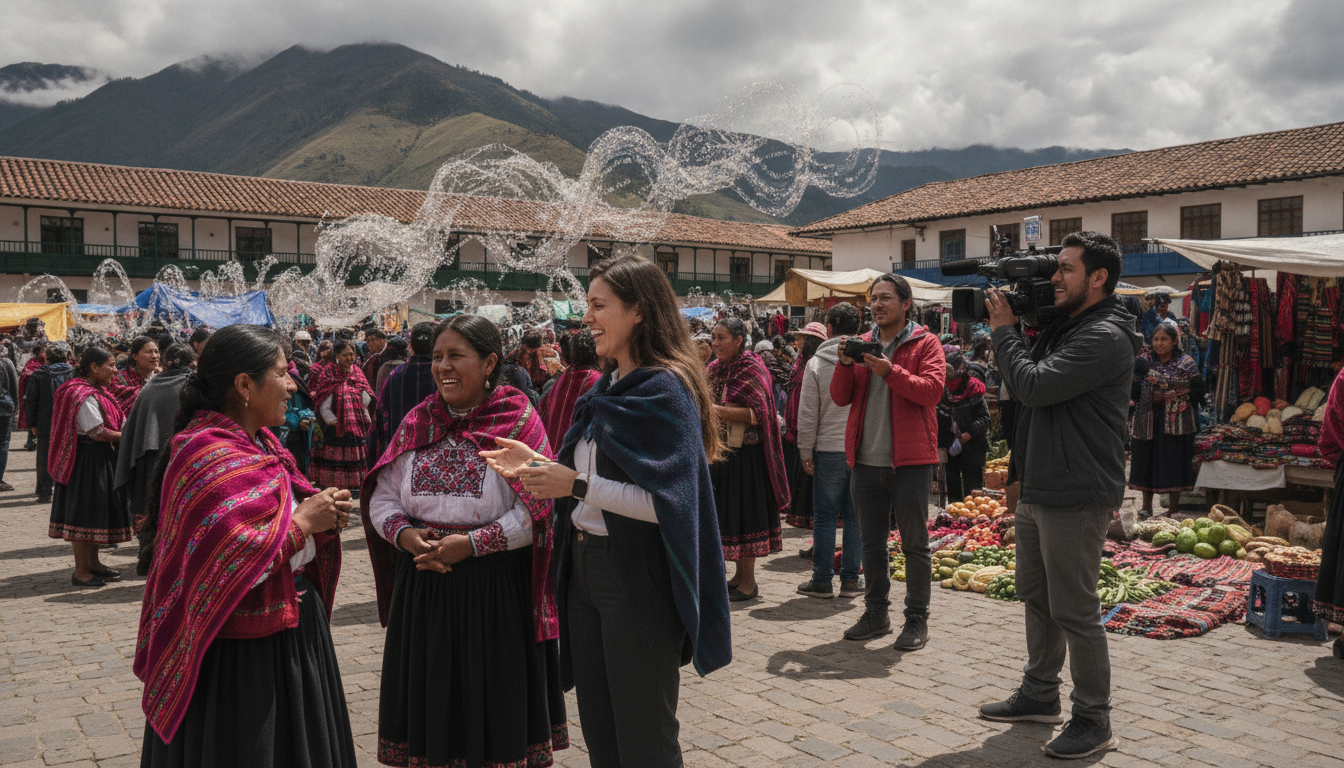
Andean Voices: Spanish and Kichwa Intertwine Across Ecuador’s Highlands
Across Ecuador’s Andes, from Quito to remote highland towns, speakers fuse Spanish with Kichwa in daily conversation, radio, music and cultural festivals.
For residents of Quito and surrounding Andean communities, everyday speech increasingly reflects a blended linguistic landscape in which Spanish and Kichwa coexist and interlace. Kichwa, the Ecuadorian variety of Quechua spoken in the highlands since the time of Inca settlement, appears in market negotiations, family talk and public announcements alongside Spanish. The result is a living bilingualism that locals describe as practical, expressive and central to regional identity.
Spanish-Kichwa Speech in the Capital and Highlands
In Quito, street vendors, students and city workers routinely move between Spanish and Kichwa within a single conversation, signaling belonging to both urban and indigenous worlds. Outside the capital, in smaller towns and rural communities, Kichwa often remains the primary language of the household, with Spanish used for commerce, administration and formal schooling. This urban-rural continuum produces a range of bilingual practices rather than a single uniform dialect, and speakers adapt their mix of languages to context and audience.
Sociolinguists and community members note that the interplay between the two tongues is not one-sided; instead it reflects mutual influence. Spanish contributes new vocabulary and structures, while Kichwa exerts an enduring presence in syntax, place names and cultural expressions. For many speakers the blended usage is less about language loss and more about creative negotiation of modern life.
Patterns of Code-Switching and Lexical Mixing
Linguistic observers describe frequent code-switching—rapid alternation between Spanish and Kichwa—as a normal conversational strategy. People shift languages for emphasis, to convey cultural nuance, or to address specific listeners, and these shifts can occur at the level of words, phrases or entire sentences. Loanwords travel in both directions, with Spanish terms adapted into Kichwa speech and Kichwa terms inserted into Spanish conversations to express concepts rooted in indigenous life.
This mixing has produced recognizable lexical hybrids and pronunciation patterns in markets, family discourse and urban slang. Speakers often use Kichwa kinship and agricultural terms alongside Spanish verbs and technical vocabulary, creating hybrid expressions that serve communicative and identity functions. The resulting speech forms are dynamic and plural, reflecting generations of contact.
Youth Culture and the Kichwa Revival
Young people in the highlands are prominent actors in the contemporary visibility of Kichwa, using the language on social media, in music and at cultural events. For many youth, combining Spanish and Kichwa signals pride in indigenous roots while engaging with nationwide trends and global platforms. Creative practitioners—musicians, poets and digital creators—are intentionally inserting Kichwa into modern artistic forms to make the language audible to wider audiences.
This intergenerational shift counters older stigmas that once pushed Kichwa into the private sphere. As youth foreground bilingual repertoires in public spaces, language practices that once marked marginality now contribute to a renewed cultural esteem. The trend is uneven across regions, but where it takes hold it changes how both languages are perceived and used.
Education, Media and Growing Visibility
Bilingual programs in schools and community-led radio initiatives have increased Kichwa’s visibility in recent years, bringing the language into classrooms and local broadcast schedules. Teachers and cultural organizations have pushed for curricula that reflect students’ linguistic realities, while community media provides a forum for news, storytelling and music in Kichwa. In urban areas, signage and public events sometimes incorporate Kichwa alongside Spanish, signaling institutional recognition at a local level.
Media exposure has also amplified demand for Kichwa-language content online and on the air, creating new opportunities for speakers to share stories and retain linguistic skills. While access to such resources remains unequal, especially in remote areas, community broadcasters and grassroots programs play a key role in sustaining daily use.
Obstacles to Transmission and Community Responses
Despite renewed interest, Kichwa faces obstacles common to minority languages: migration to cities, economic pressures, and lingering social prejudice that can discourage public use. Families under pressure to integrate economically may prioritize Spanish for perceived advantages in education and employment, accelerating shifts in language use across generations.
Communities and cultural organizations are responding with targeted initiatives: language workshops, intergenerational storytelling projects, and local festivals that foreground Kichwa music and ritual. These efforts aim both to document linguistic knowledge and to create living contexts—homes, schools, media—where Kichwa is practiced with pride rather than hidden.
The adoption of digital tools has opened new pathways for documentation and teaching, enabling remote communities to exchange resources and for young speakers to produce content that ties language use to contemporary life. Such grassroots strategies are emerging as crucial complements to formal policy measures.
For many in Ecuador’s highlands, the blended speech heard on streets and in plazas is not a sign of erosion but of adaptability: a pragmatic bilingualism that preserves indigenous foundations while engaging with the wider Spanish-speaking world. As Kichwa continues to find new domains of use, speakers are reshaping both languages to meet the needs of shared public life.
