
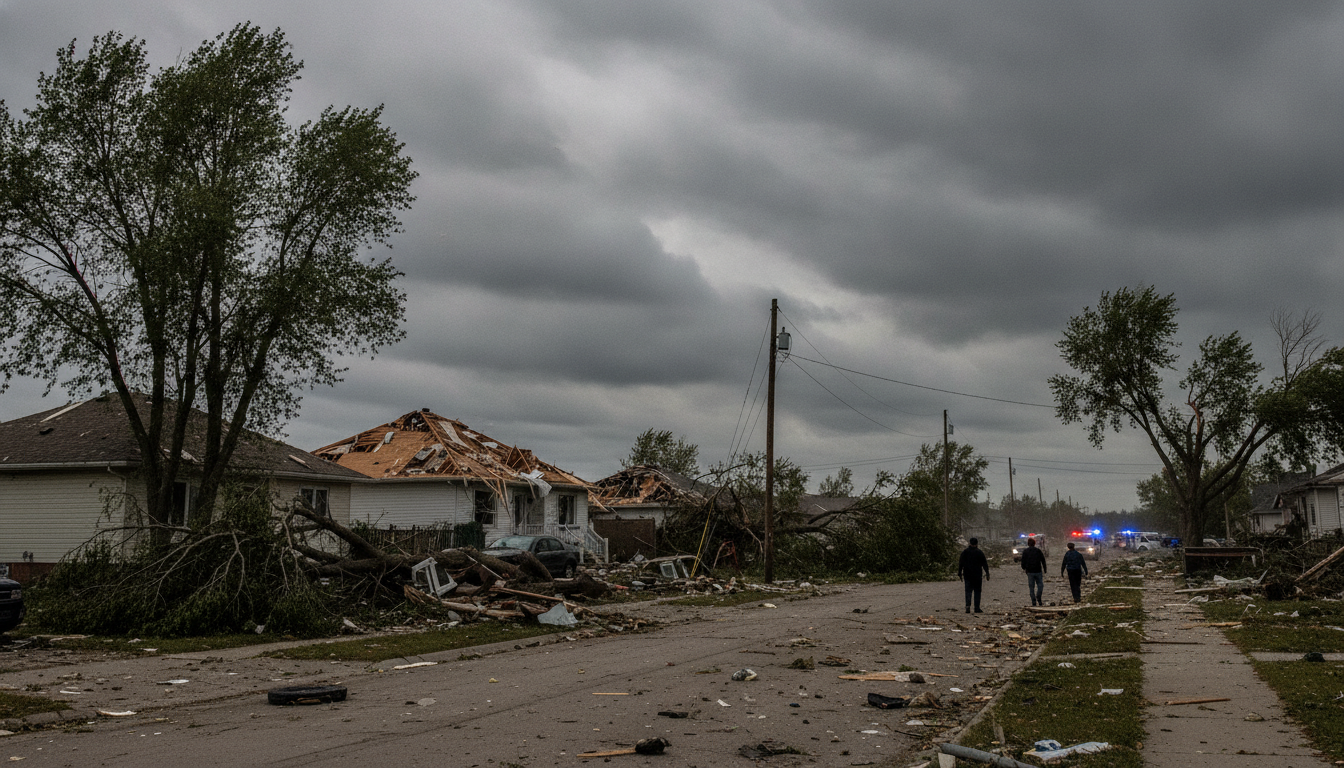
Girouxville tornado rips roofs and topples trees in northwestern Alberta village
Girouxville tornado damages homes and uproots trees in northwest Alberta; emergency crews and Environment Canada respond as residents begin clean-up.
The Girouxville tornado struck the village on Monday evening, ripping roofs from houses, uprooting trees and cutting power across the tight-knit community. Emergency responders and local officials reported substantial structural damage and widespread utility outages as crews moved quickly to assess safety and begin recovery. The event, which touched down without prior public warning, has left many residents shaken but, so far, without any reported fatalities. Local authorities and national monitoring teams are preparing surveys to map the track and severity of the storm.
Tornado touchdown and immediate impact
The funnel cloud moved into Girouxville shortly after 8 p.m., according to municipal emergency leadership, and its passage lasted only minutes but caused concentrated damage. Wind forces were strong enough to remove entire sections of roofing, shift a trailer off its pilings and hurl debris into power lines and meters. Power poles were uprooted in several locations, creating hazards for residents and complicating early response work.
Fire chief Marcel Maure, who also serves as director of emergency management for the Municipal District of Smoky River, described a rapid sequence of events that began with a darkening sky and ended with crews responding to multiple reports of destruction. Maure said that many residents were at home watching the storm and had little time to seek further shelter before their properties were struck. He emphasized that the primary objective during the initial response phase was ensuring no one remained trapped and that injuries were addressed.
Local foreman Ryley Mullen reported that the storm’s damage path was narrow and uneven, with some houses severely damaged while adjacent buildings remained largely intact. Neighbourhood volunteers and emergency personnel began door-to-door checks and made initial safety assessments once it was deemed safe to move about. Residents described hearing sudden, intense wind and seeing debris flying across yards, prompting an immediate scramble to account for family members and pets.
Power, utilities and infrastructure damage
Downed power lines and damaged poles left much of the village without electricity, presenting immediate logistical challenges for responders and households. Utility crews were on scene to evaluate the extent of electrical damage and to isolate hazards, but restoration work was slowed where poles had been snapped or gas meters were struck by debris. Officials warned residents to stay clear of fallen lines and to report any gas smells immediately.
Beyond the electrical network, the tornado caused localized damage to outbuildings, sheds and farm infrastructure, with reports of sheds displaced onto rooftops and grain storage affected in nearby areas. Some homes were shifted on their foundations, increasing concerns about structural integrity and the potential for longer-term displacement. Roads in and out of the village were initially restricted to emergency traffic in order to facilitate damage assessments and to limit exposure to hazards from scattered debris.
Municipal crews, supported by volunteers and neighboring jurisdictions, established a priority list for repairs that focused on restoring safe access, securing damaged structures and re-establishing critical utilities. The municipal district also began compiling a register of severely damaged properties to facilitate insurance claims and potential provincial supports. Officials cautioned that full restoration of services could take several days, depending on the availability of specialized crews and parts.
Casualties, injuries and public safety
Despite the intensity of the storm, municipal officials reported no fatalities and only a handful of minor injuries associated with cleanup activities. Fire chief Maure said that most injuries were minor lacerations sustained while residents moved debris, and that immediate first aid was administered by local emergency personnel. The lack of major injuries was credited to a combination of quick community action and, in some cases, the nature of the damage path.
Responders emphasized that the risk of secondary injuries remains elevated while debris removal continues, particularly where unstable structures and downed power infrastructure are present. Residents were urged to wear protective clothing, avoid moving large structural elements without proper equipment, and to keep a safe distance from damaged gas meters. Municipal authorities set up checkpoints to direct residents to safe routes and to share guidance on triage and when to seek medical care.
Local health and emergency services coordinated to ensure that those needing medical attention could be transported safely to nearby facilities. Mental health supports were also discussed as a near-term need given the shock many residents reported after seeing damage to long-standing homes and community landmarks. Officials encouraged neighbours to check on one another and to report any vulnerable individuals who might require additional assistance.
Environment Canada and Northern Tornadoes Project response
Environment Canada confirmed that no public tornado watch or alert was issued prior to the storm’s touchdown in Girouxville, and described the event as an atypical development for the region. A meteorologist noted that the storm’s radar signature did not initially suggest tornadic potential, but that conditions evolved rapidly and a supercell intensified unexpectedly. The agency stressed its ongoing commitment to monitoring severe weather and to reviewing the sequence of observations that preceded the touchdown.
The Northern Tornadoes Project, an academic monitoring initiative, said it had received multiple reports of damage linked to the same storm system and that at least one tornado in the Peace River area had been confirmed by initial accounts. Project teams planned a field deployment to survey the corridor of damage, document evidence of tornadic winds and assign a preliminary intensity rating based on observed destruction. Those surveys typically involve photographing damage, mapping fallen trees and assessing structural failures.
Officials from both Environment Canada and the Northern Tornadoes Project indicated they will compare radar data, witness accounts and on-the-ground damage assessments to refine the timeline and characteristics of the event. The combined analysis will help determine whether the vortex met classification thresholds and will improve scientific understanding of why the warning system did not flag the threat beforehand. The agencies said findings would be shared with municipal partners and used to enhance future detection and public alerting.
Meteorological context and rare northern occurrence
Authorities have noted that tornado activity in northern Alberta is less common than in central and southern parts of the province, where storms more frequently develop in the foothills and track eastward. Meteorologists said that typical tornado-favourable conditions include ample moisture, atmospheric instability and significant wind shear, and that when those elements align in unexpected ways they can yield powerful localized storms even in regions that rarely see such events. This particular system combined those elements quickly, producing a supercell capable of tornadic development.
Forecasters cautioned that the region’s radar coverage and the rapid evolution of small-scale storm features can sometimes limit advance detection, especially for narrow, short-lived tornadoes. The meteorological community has been examining how to improve lead times and public warnings for atypical or fast-developing cells, including by refining algorithms and by enhancing ground-report networks. Local emergency managers said they rely on a combination of forecasts, radar interpretation and community reporting to respond swiftly when severe weather occurs.
Officials also placed the Girouxville incident in the context of a busier-than-usual season for the province, noting multiple confirmed tornadoes earlier in the year. They said climate variability can influence the frequency and distribution of severe storms and that continued monitoring is crucial to public safety planning across Alberta.
Community mobilization and local leadership
Within hours of the storm, neighbours were clearing pathways, securing damaged properties and coordinating offers of shelter for displaced families. Municipal and regional crews set up an operational centre to triage needs and to coordinate logistics for volunteers and visiting repair teams. Local leaders thanked residents for rapid action and for the collaborative approach to immediate recovery tasks.
Girouxville’s foreman described scenes at the community soccer field, where families and volunteers gathered to account for loved ones and to share information. Municipal leadership worked to ensure that those without power had access to warm shelter, battery charging and food supplies, and arranged for priority deliveries of essential items. The forestry minister and regional MLA toured the area and signalled that provincial resources could be mobilized to support the village’s recovery, while cautioning that assessments must first establish the scale of damage.
Non-profit organizations and neighbouring municipalities indicated readiness to assist with debris removal, temporary housing and donations. Municipal authorities urged residents to document damage carefully for insurance and potential disaster assistance applications, and to avoid hazardous areas until professional crews can secure them. Officials also announced plans for a public information session once initial safety and stabilization work is complete.
Next steps: surveys, recovery and support
Survey teams from provincial and national partners will work with local emergency managers to map the tornado path and to classify damage intensity. That work will inform requests for provincial supports and the prioritization of engineering assessments for homes that appear structurally compromised. Authorities also expect to issue public guidance on safe debris removal, salvage operations and how to engage with insurers and aid organizations.
Restoration of power and utility services will follow a staged approach that first removes immediate hazards and then sequences repairs to allow safe reconnection of homes. Structural engineers will be asked to evaluate homes that were shifted from their foundations or that suffered extensive roof loss, and temporary shoring or boarding may be recommended where collapse risk exists. Local schools and community facilities will be assessed for safe reopening in the days ahead.
Municipal officials urged residents to keep careful records of expenses and to photograph damage for claims processes. They also encouraged anyone with professional skills—plumbers, electricians, tradespeople—to register with the municipal recovery centre if they can assist. Mental health and social supports will be made available to any residents showing signs of trauma or acute stress, with outreach efforts prioritized where damage has left families displaced.
The final phase of recovery is expected to include rebuilding and community resilience planning, with officials noting that lessons learned about warning dissemination and rapid response could shape future preparedness measures. Public meetings and a coordinated after-action review are anticipated as the village moves from immediate response to reconstruction.
Local residents expressed pride in the community response even as they grappled with shock and loss. Volunteers described a steady flow of people arriving to help clear yards, salvage belongings and prepare temporary shelter. Municipal leaders acknowledged that recovery will take time and resources but said the village’s cohesion has been a stabilizing force during the difficult first days.
The event serves as a reminder of the potential for severe weather to strike with little notice and of the importance of community preparedness and robust monitoring. As Girouxville begins to rebuild, officials and residents alike are focused on immediate safety, careful documentation of damage, and the practical steps needed to restore daily life and infrastructure.
