
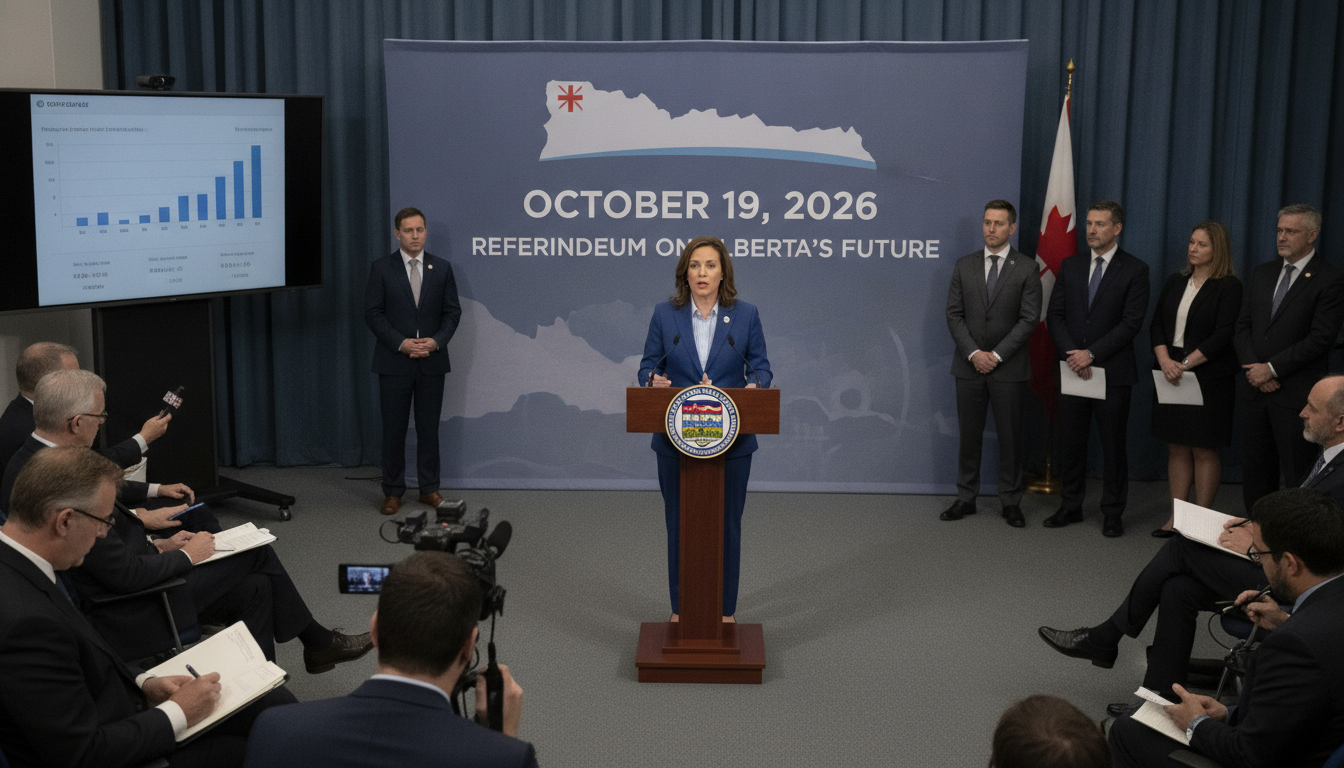
Alberta referendum on Oct. 19 to pose separation, immigration and constitutional questions
Alberta referendum on Oct. 19 will ask 10 questions, including a split separation question, five immigration items and four proposed constitutional amendments.
Referendum scheduled for Oct. 19 with 10 core questions
Albertans will vote on Oct. 19 in a province-wide referendum that includes 10 ballot questions and the possibility of an 11th if a petition passes verification.
The package ranges from a binary choice on remaining in Canada to clustered questions on immigration policy and proposed constitutional changes.
The government has framed the vote as decisive on provincial authority, while Elections Alberta is managing logistics for what officials describe as an unprecedented civic exercise.
Voters should expect a complex ballot and sizeable administrative activity across the province in the months leading up to the vote.
Separation question presented as two distinct options
The referendum contains a separation question split into two options rather than a single yes-or-no formulation.
Option A asks whether Alberta should remain a province of Canada; Option B asks whether the provincial government should begin the legal process to hold a binding referendum on separation.
Premier Danielle Smith announced the inclusion of the separation item in late May and has said the government will respect the results of the referendum questions.
If a plurality or majority backs Option B, the province would then move to initiate the constitutional and legal steps required for a binding secession referendum.
Five immigration measures propose new provincial controls
Five immigration-focused questions on the ballot would, if approved, give the Alberta government broad authority to reshape access to provincially funded services.
Proposals range from taking increased control over immigration levels and prioritizing economic migrants to limiting eligibility for health care and education to Canadian citizens, permanent residents and those with Alberta-approved status.
One ballot item seeks to impose a 12-month residency requirement for people with non-permanent status before they could qualify for provincially funded programs.
Another would permit charging a fee or premium for public health-care and education services for some non-permanent residents, while an additional question would require proof of citizenship to vote in provincial elections.
Four constitutional amendment proposals target federal powers
The referendum also asks Albertans whether the province should work with willing provinces to pursue four constitutional changes.
The proposals include shifting judicial appointments for provincial courts to provincial governments, abolishing the federal Senate, allowing provinces to opt out of certain federal programs without losing related funding, and giving provincial laws priority when jurisdictional conflicts arise.
The Smith government has publicly committed to campaigning in favour of both the immigration and constitutional questions.
If voters approve any of the constitutional proposals, the province would seek interprovincial cooperation to pursue formal amendments to the Constitution—an often lengthy and politically complex process.
Potential 11th question from anti-coal petition under review
An eleventh question could be added if Elections Alberta deems a petition submitted by musician and activist Corb Lund valid.
Lund filed signatures this week seeking to place an anti-coal-mining question on the same Oct. 19 ballot; its inclusion will depend on the agency’s verification of the petition.
If validated, the additional question would join a referendum already notable for its breadth and potential constitutional implications.
That possibility adds another layer to campaign planning and could affect turnout calculations in resource-affected regions.
Elections Alberta prepares workforce and budget for referendum
Elections Alberta has begun recruiting at least 60,000 workers to staff polling stations, process ballots and carry out administrative duties across the province.
Officials say the scale of hiring reflects the number of advance and election-day voting sites that will be required to serve a population dispersed over urban and rural areas.
The agency also notes that a finalized referendum budget will not be available until the fall, with detailed cost estimates to be released closer to the vote.
Organizers say they are preparing training, logistics and public information campaigns to help voters understand the multi-question ballot and their options.
Public awareness and clarity on the wording of each question will be critical in the weeks before Oct. 19.
Advocates and opposition groups on different sides of the issues have already signalled plans for active campaigning on separation, immigration limits and constitutional reform.
The October referendum will test the province’s appetite for major policy shifts and constitutional conversations, and its outcome could set Alberta on a path of legal and political initiatives that would take years to resolve.
