
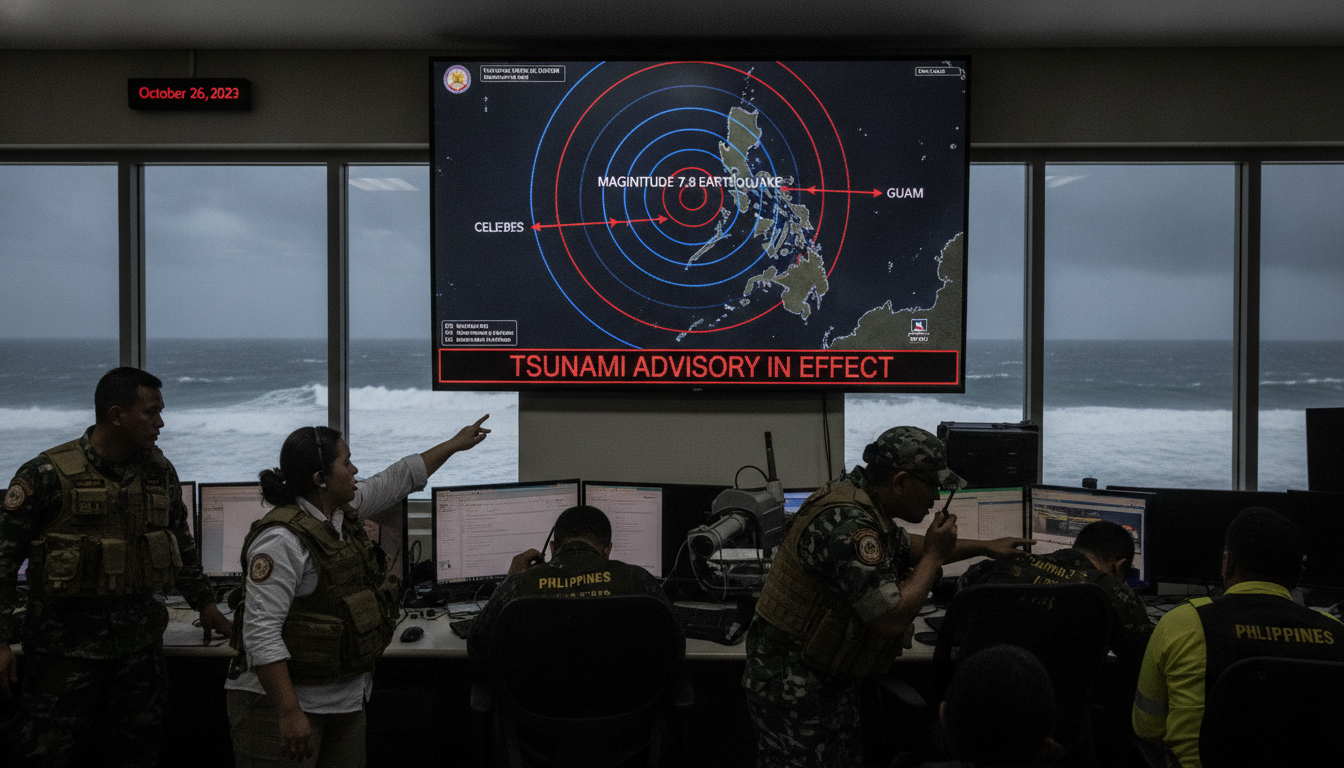
7.8-magnitude Celebes Sea earthquake near Burias, Philippines prompts tsunami advisories
A 7.8-magnitude Celebes Sea earthquake struck near Burias, Philippines, prompting tsunami advisories for the Philippines and Guam as aftershocks were monitored.
A strong earthquake with a preliminary magnitude of 7.8 struck the Celebes Sea at 7:37 a.m. Philippine time on Monday, the U.S. Geological Survey reported, approximately 15 miles southwest of Burias island. The quake triggered tsunami advisories for Philippine coastlines and Guam, while U.S. and Canadian Pacific shores were not considered at risk by the U.S. Tsunami Warning System. Authorities reported subsequent seismic activity in the same region, and officials warned residents in low-lying coastal areas to heed evacuation orders and stay away from exposed shorelines.
Epicentre and reported magnitude
The U.S. Geological Survey identified the epicentre of the Celebes Sea earthquake as being just southwest of Burias, with the initial magnitude listed at 7.8. The depth and fault mechanism are subject to further analysis, and seismologists cautioned that magnitude and shake-intensity estimates can be revised as additional data are processed. Early shake maps provided by monitoring agencies showed felt intensities radiating across parts of the central Philippines.
After the first assessment, seismologists noted a series of smaller earthquakes clustered near the epicentre. These are consistent with aftershocks that typically follow a major rupture as stress redistributes along the fault zone.
Tsunami advisories for the Philippines and Guam
The U.S. Tsunami Warning System issued advisories for the Philippines and Guam in the immediate aftermath, advising coastal communities to prepare for potential tsunami waves and dangerous currents. A tsunami advisory indicates that strong sea-level changes and currents are possible and that local authorities may order evacuations of vulnerable coastal zones. The agency explicitly stated there was no tsunami threat to the Pacific coastlines of the United States and Canada.
Officials emphasized the classic warning sign that precedes some tsunamis: an unusual and rapid retreat of seawater from the shore. Residents were urged not to return to the coastline to collect belongings or to watch the ocean, since the first wave may arrive within minutes to hours and successive waves can last for many hours.
Aftershocks and seismic activity
Seismologists reported multiple aftershocks in the hours following the initial temblor, noting that aftershocks can continue for days, weeks or even longer as the crust adjusts. The monitoring summary indicated aftershock data were current as of Monday, June 8 at 4:39 a.m. Eastern, and shake-intensity mapping had been prepared using available readings as of Sunday, June 7 at 7:56 p.m. Eastern. Experts cautioned that some aftershocks could be large and pose additional risks to already damaged structures.
Communities in affected provinces were told to expect fluctuating ground motion and to inspect buildings and critical infrastructure for damage before reoccupying them. Emergency managers typically maintain a heightened state of readiness when significant aftershock sequences are ongoing.
Local warnings and recommended precautions
Local authorities and disaster-response agencies advised residents in low-lying coastal areas to move inland or to higher ground until advisories are lifted. People were specifically warned about the danger of rip currents, strong tidal surges and coastal flooding that may follow seismic sea disturbances. Evacuation centres and emergency hotlines were activated in some municipalities to assist displaced residents and coordinate relief.
Emergency services urged households to secure essential supplies — water, food, medications and a battery-powered radio — and to prepare for possible power outages or communications disruptions. Public messaging reiterated that visible sea retreat is an immediate cue to evacuate and avoid the shoreline.
Potential impacts and response efforts
Assessments of damage and casualties were expected to begin at first light in affected coastal communities where shaking and tsunami effects were possible. Government agencies, local disaster offices and humanitarian partners typically mobilize search-and-rescue teams, medical support and rapid needs assessments following a major quake and any consequential tsunami activity. At this stage, authorities cautioned against speculation and asked the public to rely on verified information from official channels.
Infrastructure such as ports, coastal roads and utilities can be especially vulnerable to tsunami inundation and strong currents, and inspections will prioritize lifelines and facilities critical to relief operations. Population-density data used by responders help prioritize where to deploy search and emergency resources first.
Ongoing monitoring and public information
Seismic and tsunami monitoring organizations, including national and international centres, continued to update their advisories and maps as new data arrived. Officials noted that earthquake magnitudes and shake-severity maps are routinely revised as additional readings are processed, and that tsunami alerts can be upgraded, downgraded or cancelled based on wave observations. All times cited by monitoring agencies in initial bulletins were reported in Philippine time.
Residents in affected regions were asked to follow instructions from local authorities, avoid forwarding unverified social-media reports, and check official government and emergency-management outlets for the latest guidance and evacuation notices.
Authorities urged coastal communities to remain alert while data from tide gauges and coastal sensors are analyzed, and to expect further official bulletins as agencies refine their assessments and forecasts.
Canadian and international aid agencies said they were monitoring the situation and stood ready to provide assistance should requests for international support be made.
