
London Firm’s AI-Powered Simulation Promises Faster Engineering for Aerospace and Auto Suppliers
London AI firm offers AI-powered simulation that predicts physical behavior faster than legacy tools, serving Siemens, Stellantis and Applied Materials.
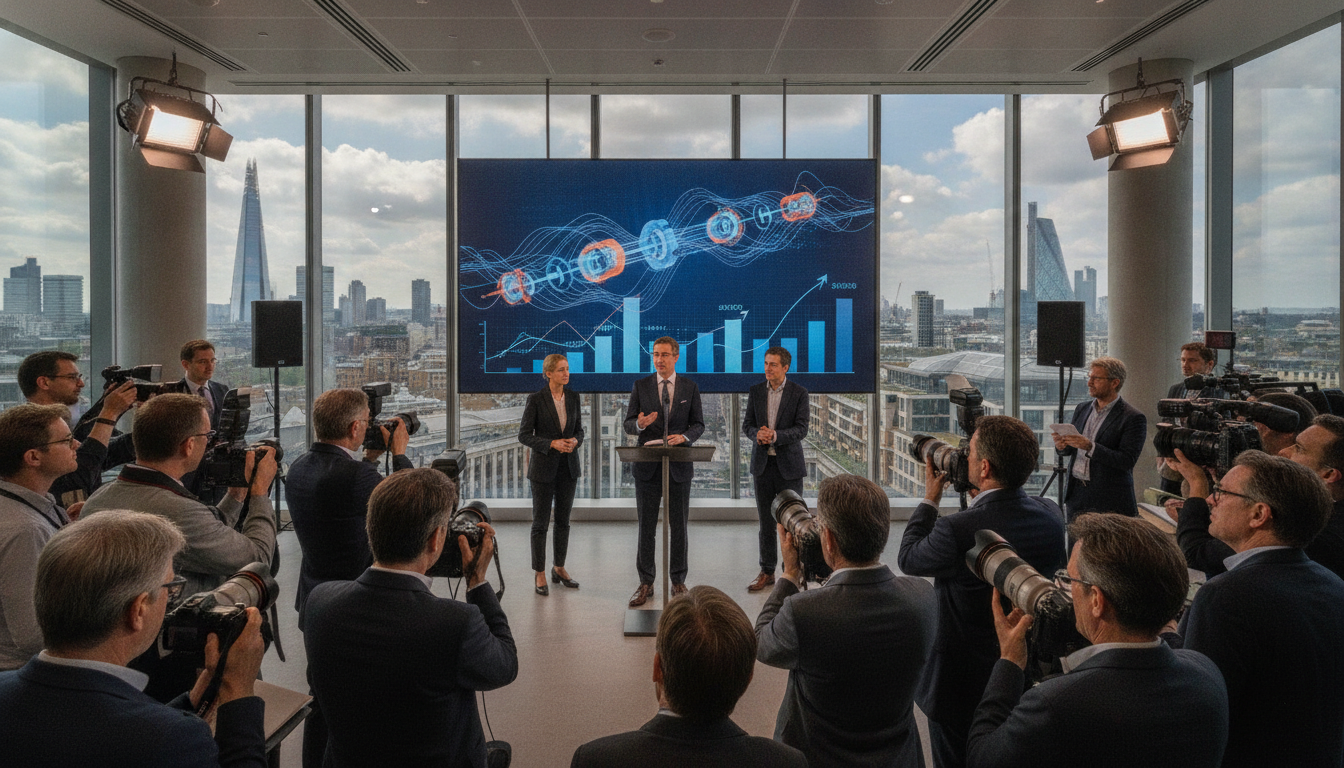
A London-based company is marketing an AI-powered simulation model that it says can predict the physical behavior of engineered parts far faster than conventional simulation software, and it has already attracted major aerospace and automotive suppliers. The startup’s technology is being pitched to manufacturers as a tool to speed design, testing and assembly workflows, with early commercial users including Applied Materials, Siemens and Stellantis. Company leadership reports annual revenue approaching $50 million, signaling early market traction for physics-informed machine learning in heavy industry.
AI-powered simulation model and performance claims
The company’s flagship product is an AI model trained to emulate the physical responses of components under real-world conditions, from stress and thermal loads to assembly tolerances. Executives assert the model produces results orders of magnitude faster than traditional finite-element or computational fluid dynamics simulations, reducing iteration time in product development cycles. The speed gains are presented as especially valuable for industries where prototyping costs are high and design windows are tight, such as aerospace and automotive manufacturing.
Named customers and early commercial traction
Several large corporates are already listed among the vendor’s clients, indicating a willingness by legacy manufacturers to pilot advanced machine-learning tools. Publicly known customers include Applied Materials, Siemens and Stellantis, each of which operates complex supply chains and engineering operations where faster simulation could translate into measurable savings. Customer pilots reportedly cover part design, virtual testing and assembly planning, suggesting the technology is being evaluated across multiple stages of the product lifecycle.
Revenue figures and executive comments
Company leadership has placed current revenue “near $50 million,” a sign that the firm has moved beyond purely experimental deployments toward recurring commercial engagements. Management frames the revenue run-rate as validation that the solution meets real operational needs and is being integrated into engineering toolchains. Investors and potential corporate partners are likely to scrutinize both the sustainability of that revenue and the path to broader enterprise adoption as the business scales.
Implications for aerospace and automotive engineering
If the performance claims hold up in broader use, the AI-powered simulation model could alter engineering workflows by allowing more designs to be virtually explored in the same calendar period. For aerospace suppliers, faster iteration can reduce costly physical prototypes and accelerate certification timelines, while automakers may use the technology to shorten development cycles for structural parts and assemblies. The ability to simulate assembly processes quickly also has implications for manufacturing planning, potentially reducing line changeover time and improving first-pass yield.
Technical validation and limitations
Independent validation and reproducibility will be critical to building trust in a tool that replaces long-established physics-based solvers. Engineering teams commonly require traceable results and conservative margins when parts enter safety-critical systems, and black-box models face scrutiny over explainability and edge-case behavior. Vendors will need to demonstrate that their AI-powered simulation can handle the full range of materials, geometries and load cases found in production, and provide integration points with existing computer-aided engineering software.
Market competition and adoption hurdles
The company enters a crowded field where established simulation software vendors, specialized startups and in-house engineering teams all compete for relevance. Traditional providers are already incorporating machine learning into pre- and post-processing steps, and large manufacturers often develop bespoke tools for their most critical applications. Overcoming organizational inertia, proving return on investment, and meeting regulatory or certification requirements are likely to be the main hurdles to widespread deployment in highly regulated sectors.
The emergence of faster, AI-driven physics modeling reflects a broader industry push to compress product development timelines and reduce costs, but widespread adoption will depend on rigorous testing, transparent performance metrics, and smooth integration with engineering ecosystems. As more pilots conclude and independent studies appear, manufacturers will be better positioned to judge whether AI-powered simulation can reliably replace or augment legacy solvers in mission-critical applications.
