
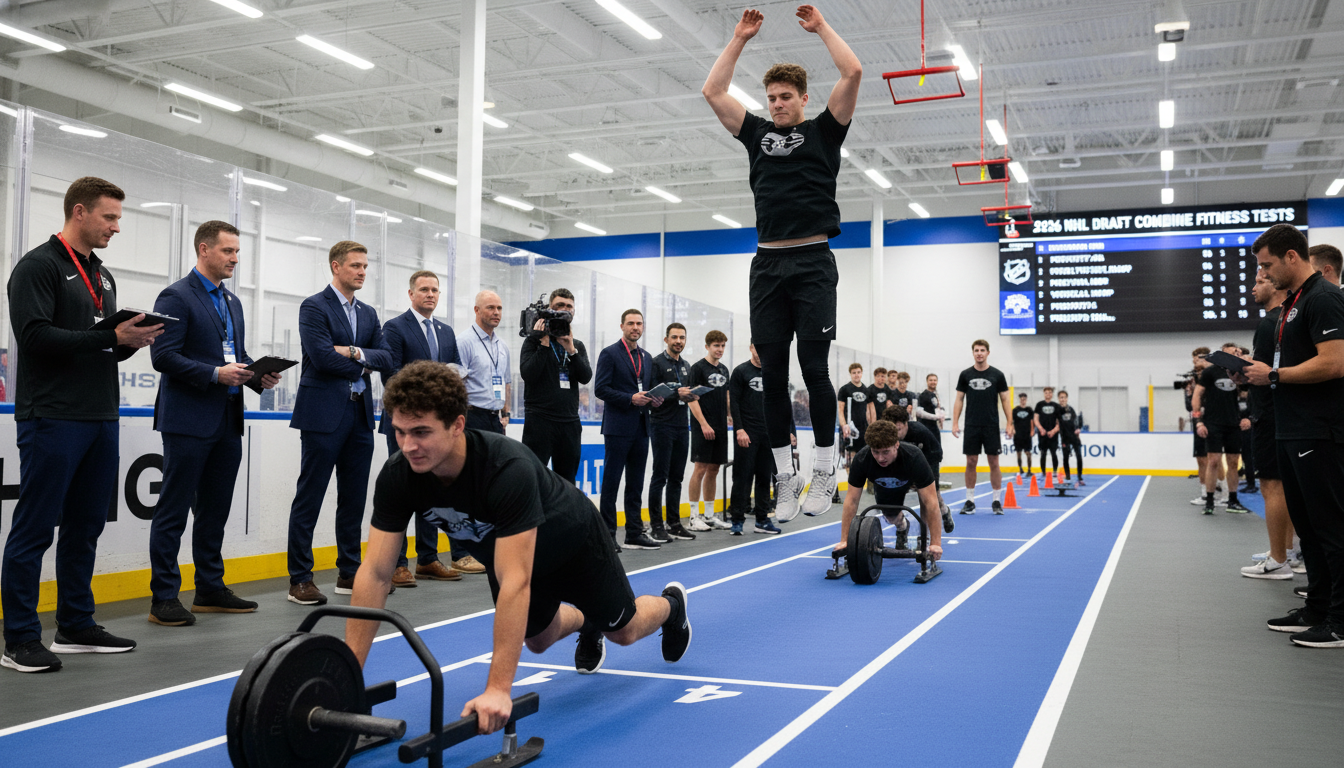
NHL Scouting Combine 2026: Prospect testing in Buffalo highlights power, speed and physiology
Prospects at the 2026 NHL Scouting Combine in Buffalo on June 6 underwent performance testing, with teams evaluating physiology, power and on‑ice translation ahead of the 2026 NHL Draft. The event combined lab‑grade measures such as VO2 assessment with sport‑specific protocols like force‑plate jumps and pro‑agility shuttles. All 32 NHL clubs met individually with prospects while medical, strength and conditioning, and skating staff logged objective results for each athlete.
Combine convenes in Buffalo and roster of evaluations
The combine was staged over a single day of on‑site testing and meetings, giving scouts and team officials a controlled baseline to compare draft‑eligible players. Prospects rotated through stations that captured anthropometrics, strength, speed, power and aerobic capacity in standardized formats established by NHL Central Scouting. Teams used the schedule to pair measurable results with video and scouting reports during private interviews and examinations.
Anthropometrics and grip: size still matters
Measurements began with height, weight and wingspan, recorded to precise increments to inform positional projection and reach. Grip strength was measured with a hand dynamometer on both hands to quantify upper‑body force and bilateral differences. Those simple measurements provide context for skating leverage, puck battles and stickhandling reach when combined with skating and strength data.
Jump station and force‑plate analysis of lower‑body power
Prospects completed vertical and no‑arm jumps on an AccuPower dual force‑plate system that captures three‑dimensional force vectors and high‑speed video. The system overlays left‑ and right‑leg force outputs to reveal asymmetries, timing and movement efficiency that can affect acceleration and injury risk. Teams and athletic trainers can review instantaneous feedback on jump height, rate of force development and force distribution between limbs.
Strength tests: bench press, isokinetic squat and pull‑ups
Upper‑body power was assessed using a bench‑press protocol at 50 percent of body weight for three maximal‑velocity repetitions, with devices recording bar velocity and watts per kilogram. Lower‑body capacity was quantified with isokinetic squat testing, which provides load‑relative metrics and torque data for both legs. Pull‑ups measured raw upper‑body endurance and technique under standard form requirements, offering simple comparative data across the draft class.
Anaerobic and aerobic profiling: Wingate and VO2 testing
The Wingate cycle ergometer test produced peak power output values (watts per kilogram) that indicate short‑burst anaerobic capacity and repeat sprint potential. Aerobic fitness was evaluated via maximal oxygen uptake testing, measuring VO2 to determine cardiovascular endurance and recovery ability during extended shifts. Together, these assessments help teams forecast how a player’s conditioning will translate to pro minutes and long‑term development.
Speed and agility: translating testing to on‑ice movement
The pro‑agility 5‑10‑5 shuttle tested lateral quickness, change‑of‑direction skill and whole‑body control, with prospects performing mirror sequences to the right and left. Standing long jump provided another lateral‑to‑linear power metric, useful for gauging first‑step explosiveness and drive. Teams interpret these field results against skating times and on‑ice drills to estimate how measured speed and agility will appear in game situations.
Data integration and medical review in team evaluations
Beyond raw numbers, clubs combined testing data with medical screens and video footage to form holistic player profiles ahead of the 2026 NHL Draft. Force‑plate asymmetries or VO2 outliers prompted follow‑up conversations with medical and performance staff, while consistent strengths across stations reinforced positional fits. NHL Central Scouting’s testing protocols and immediate feedback allowed teams to prioritize which prospects required further medical imaging or targeted development plans.
Graphics courtesy of Erika Vanderveer and testing information provided by NHL Central Scouting informed the event’s structure and the specific metrics captured at each station. The objective data collected in Buffalo will be folded into teams’ draft boards alongside scouting reports and interviews.
The combine offered every franchise a direct, standardized look at the physical and physiological profiles of the incoming draft class, giving decision makers measurable benchmarks as they prepare for the 2026 NHL Draft.
