
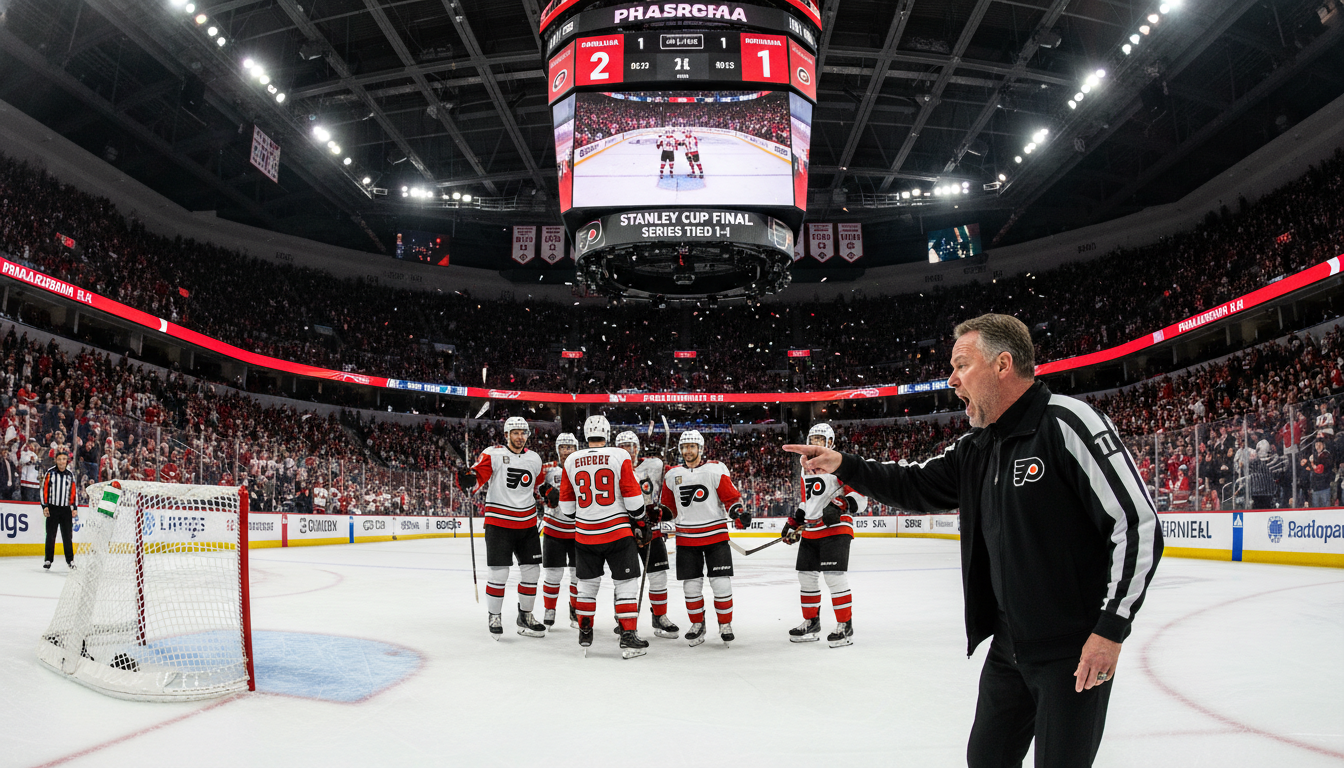
Tortorella challenge backfires as Hurricanes rally to beat Golden Knights in overtime
Tortorella’s coach’s challenge erased a late Vegas goal and set up a Carolina power play; Seth Jarvis scored in overtime as the Hurricanes won 3-2 to even the series.
The Tortorella challenge became the defining moment of a wild Game 2 at the Lenovo Center, where the Carolina Hurricanes rallied from a two-goal deficit to beat the Vegas Golden Knights 3-2 in overtime. Vegas led for most of the contest, but a disputed call with five minutes remaining and an ensuing penalty swung momentum decisively in Carolina’s favor. The result evened the Stanley Cup Final at one game apiece and handed the Golden Knights their first loss in eight outings.
Officials rule no-goal after puck under Andersen
The play that prompted the Tortorella challenge began when Ivan Barbashev drove the net and his wraparound attempt appeared to trickle under Vegas goalie Freddy Andersen. The on-ice official, positioned behind the cage, immediately signaled no-goal, ruling that a Vegas skater had interfered with the goaltender’s ability to control the puck. NHL director of officiating Stephen Walkom later explained the on-ice call, saying the referee believed the puck was beneath Andersen and that a visiting player had impeded the goalie’s ability to cover it.
The Golden Knights challenged the decision, but video review failed to produce the “clear and obvious” evidence required to overturn the call. That confirmation — or lack of it — remains at the center of debate after the game, with Vegas coach John Tortorella defending the decision to use the challenge but acknowledging the risk it carried. In a series that has been tight and emotional, the failed review quickly shifted the narrative in Carolina’s favor.
Penalty and quick Carolina power-play conversion
Following the unsuccessful challenge, Vegas was assessed a penalty that gave the Hurricanes a power-play opportunity, and they capitalized almost immediately. Jordan Staal redirected a shot 25 seconds into the power play, beating Andersen and putting Carolina ahead at a critical juncture of the third period. The sequence erased a late Vegas lead and forced the visitors onto their heels with time winding down.
Carolina’s power play looked composed and opportunistic on the goal, with forwards and defensemen collapsing to the net to create traffic and deflections. The rapid swing from a potential Vegas advantage to a Carolina lead underscored the fine margins of playoff hockey and highlighted how a single coaching decision can alter the flow of a final.
Late push from Vegas and Stone’s equalizer
Despite the setback, Vegas responded late in the third. Mark Stone, the Golden Knights captain, took advantage of a pulled goalie situation and converted a play with 1:21 remaining to knot the game at 2-2. Stone’s tying goal erased much of the sting from the earlier no-goal controversy and restored the parity that has characterized this series.
The sequence that led to Stone’s equalizer showcased Vegas’s resilience; after spending most of the night defending a slim edge, the home side rallied with urgency and traffic in front of the net. That late response ensured the contest would be decided in overtime and kept the momentum in doubt until the final horn.
Overtime winner and decisive moments
The extra period was brief but decisive. A penalty on Tomas Hertl in overtime handed Carolina another advantage and the Hurricanes made it count when Seth Jarvis finished a high-pressure sequence four minutes into sudden death. Jarvis’s winner capped an improbable comeback and sent the frenzied crowd at the Lenovo Center home stunned and elated in equal measure.
Momentum in overtime belonged to Carolina, whose forechecking and quick puck movement produced the game-clinching opportunity. Vegas’s special teams misfortune in the third and overtime proved costly, emphasizing the playoff premium on disciplined play and error-free execution.
Injury concerns and series implications for Vegas
The Golden Knights also left the game with injury worries after defenseman Brayden McNabb took a brutal slap shot to the face and exited in the first period. The injury forced Vegas to shuffle its defensive rotation and raised questions about McNabb’s availability for the remainder of the series. Teammates described the scene as frightening and acknowledged the challenge of replacing a veteran presence on the blue line.
The loss ended Vegas’s seven-game winning streak and sent the series back to Las Vegas tied at 1-1 for Game 3. Both teams will reassess personnel and tactics before the next matchup, with Carolina buoyed by a comeback and Vegas coping with the fallout of the failed Tortorella challenge and a looming injury report.
Both clubs now move to the next phase of the final with clear areas to address: Carolina will aim to sustain its momentum, while Vegas must balance urgency with discipline to avoid handing the Hurricanes more late-game opportunities. The Tortorella challenge will remain a focal point of postgame analysis, but the Hurricanes’ composure in critical moments and Jarvis’s overtime finish ultimately decided the night.
