
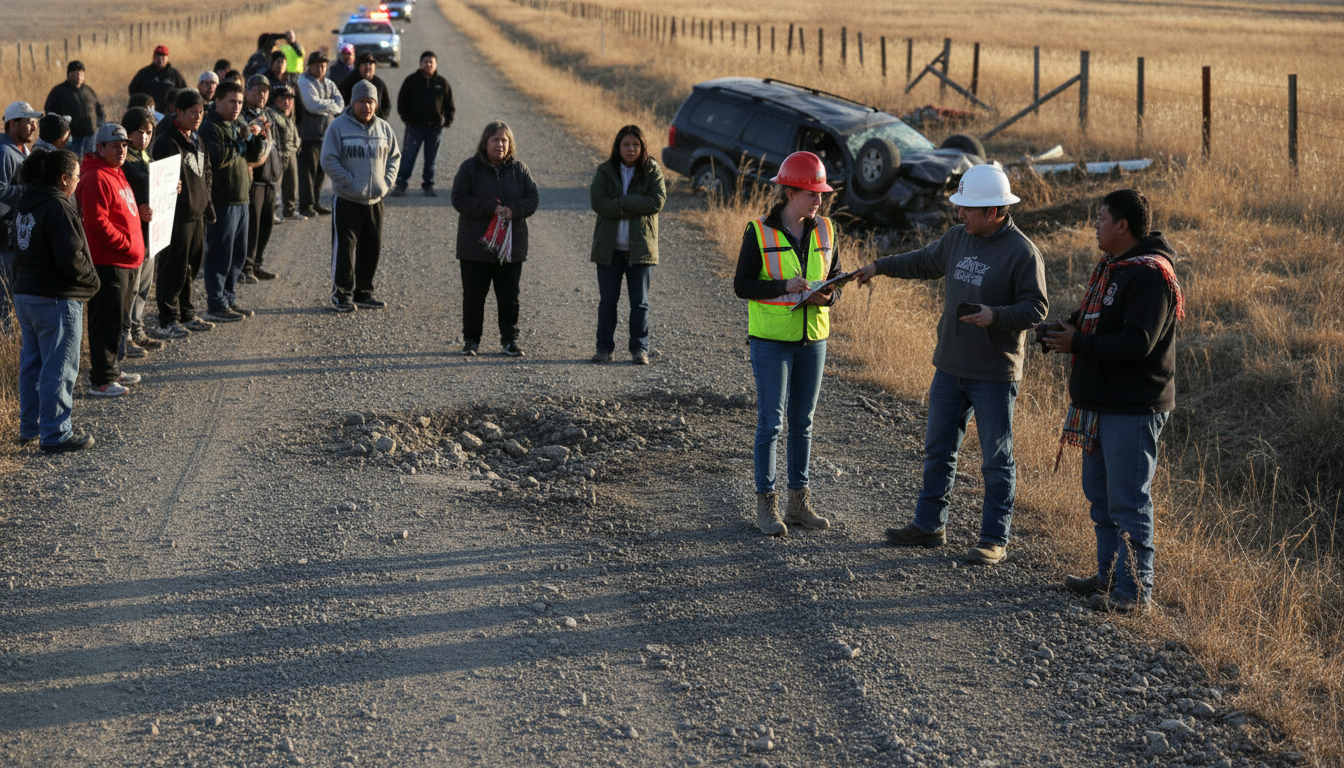
O’Chiese Road crash renews urgent calls to pave dangerous route after four killed
O’Chiese Road fatal crash that killed four renews calls for immediate paving and funding from federal, provincial and county governments to improve safety.
A deadly collision on O’Chiese Road has reignited demands from O’Chiese First Nation and Clearwater County for the unpaved route to be upgraded, after four people were killed and four others injured. The crash involved a minivan and an SUV on a 16.8-kilometre stretch of Township Road 42-5A that serves as the primary access between O’Chiese First Nation and Rocky Mountain House. Two children from O’Chiese and two adults from Rocky Mountain House were among the dead, while four people were taken to hospital with injuries. Local leaders and affected families said the deaths were preventable and renewed urgent pleas for the road to be paved and for improved safety measures to be put in place.
RCMP investigators continue to examine the cause of the collision and have not issued a determination on contributing factors. Community leaders and a recent engineering report commissioned by the nation point to road condition, limited cell service and emergency-access constraints as persistent risks. The crash has focused attention on long-standing gaps in funding and responsibility for the route that many residents say has been neglected for decades. Officials from Clearwater County, the province and federal representatives are being pressed for a clear timetable and funding plan.
Fatal collision on O’Chiese Road kills four
A collision on Township Road 42-5A, commonly called O’Chiese Road, left four people dead and four others injured, authorities said. Police identified the vehicles involved as a minivan and an SUV, and confirmed two adults were from Rocky Mountain House while the two children were from O’Chiese First Nation. Family members named one of the victims as taxi driver Dwayne Hammell; his daughter said paving the road would make his loss meaningful by preventing future tragedies. Residents described the scene and aftermath as a familiar heartbreak on a stretch of road they say is unfit for the traffic it carries.
The O’Chiese First Nation sits roughly 72 kilometres northwest of Rocky Mountain House and relies on this unpaved corridor as the most direct connection to services and schools. The road segment under discussion runs between Buster Creek Road and the boundary of the First Nation and is heavily used by residents, emergency services and workers in resource industries. Drivers and families said limited cell coverage along the route compounds the danger, slowing emergency response and increasing isolation. Community members said the latest crash underscores a pattern of fatalities and serious incidents on the route.
WSP report shows collision rate five times provincial average
A 2025 report prepared by WSP Canada for Clearwater County documents that the 16.8-kilometre section between Buster Creek Road and the O’Chiese boundary experiences a collision rate more than five times the provincial average. The analysis, commissioned by the First Nation, argues that heavy use by local residents and service vehicles combined with unpaved conditions creates disproportionate risk. The report also highlights that O’Chiese and other nearby communities are users rather than owners of the road, limiting their authority to secure upgrades. WSP’s findings were cited by community leaders as objective evidence that the route meets the threshold for major safety investment.
The report raises additional concerns beyond crash statistics, including the risk to emergency and essential services if access is compromised. It notes that delayed or prevented response times can have cascading impacts on health outcomes, economic opportunities and overall well-being. Officials and residents said the combination of high collision frequency, poor surface conditions and the route’s status as the only direct link for many travellers makes it a high priority candidate for paving. For many in the region, the data confirms what they have been saying for years—that the road’s danger is measurable and persistent.
Local leaders and families renew calls for paving
O’Chiese First Nation Chief Phyllis Whitford said the community has been lobbying for road improvements for two decades and that the latest deaths are "too many." Whitford has publicly argued that paving and regular maintenance would prevent loss of life, and she has pointed to the road’s role in daily life, from parents driving children to school to ambulances and commercial traffic. Family members of victims have echoed those pleas, framing paving as both a practical safety measure and a moral imperative. Shelly Hammell, daughter of one victim, said her father could save lives posthumously if paving proceeds.
Residents from neighbouring Sunchild First Nation described taking detours to avoid the unpaved stretch, adding travel time but reducing exposure to what they called a hazardous road. Darcy Goodrunning, a Sunchild resident, said he began driving an extra 12 kilometres daily to avoid the 42-5A section because of safety concerns. Local councillors and community groups say those informal behavioral changes underscore the route’s inadequacy and the daily trade-offs people make to keep themselves and their families safe. The growing chorus of voices from families, elected leaders and frontline workers is pressing for concrete timelines and committed funding.
Funding history and growing cost estimates
Efforts to quantify the cost of paving and related repairs go back more than a decade. A 2014 estimate contracted by Clearwater County put the cost of paving the road and repairing a nearby bridge at about $16.7 million. In the years since, prices for construction, materials and labour have risen; by 2026 the county estimated the total cost had grown to $26.4 million. Those escalating figures have complicated efforts to assemble the multi-level funding required for a project of this scale. Clearwater County Reeve Jordon Northcott asked the province in March 2026 to increase its commitment from roughly $8 million to more than $17 million to help address the shortfall.
A bridge leading into O’Chiese First Nation did receive federal support in 2024, with more than $12 million secured through the Disaster Mitigation and Adaptation Fund to address structural needs. However, no federal funding has been confirmed for the road surface itself, leaving a significant gap. The provincial commitment recorded in county documents carries a condition that Clearwater County must both match the allocation and secure equivalent federal funding. Those matching requirements have been a major impediment to moving the project from planning to construction.
Provincial conditions and federal funding gap
Transportation Minister Devin Dreeshen responded to county requests in a letter dated May 15, 2026, saying the province would reallocate funds set aside for the road unless Clearwater County secures matching federal funding. The minister’s stipulation has introduced a deadline dynamic: Whitford said the province indicated the county’s funding would be reallocated if the project does not begin by April 2028. Provincial officials have stated they will reconsider paving once matching funds from Ottawa are in place. The requirement for federal participation has become a central issue for the community’s advocacy strategy.
Provincial officials have at times signalled they may explore alternate funding models should Ottawa decline to participate, but those options have not been detailed publicly in recent communications. A spokesperson for the minister later said the ministry would again urge the federal transportation minister to provide funding for paving O’Chiese Road. Meanwhile, federal representatives had not provided comment by the time local media sought responses, according to community reporting. The back-and-forth among governments has left residents frustrated and uncertain about concrete next steps and timelines.
Community access, emergency response and next steps
Local officials and families have emphasized that the road’s condition affects far more than vehicle wear and tear; it has direct consequences for health, safety and economic activity. Limited cell service along the stretch reduces the ability to call for help quickly, and residents said that slow response times raise the risk of preventable deaths in emergencies. Employers in forestry, oil and gas, and other sectors also rely on the route to transport workers and supplies, amplifying the economic stakes of any closure or deterioration. The WSP report warned that constrained access could have lasting negative effects on community well-being if not addressed.
Yellowhead MP William Stevenson said paving the route would be prudent and that delays only increase costs and danger. Stevenson said he had raised the issue with multiple ministers and that rotating portfolios at the provincial and federal levels had complicated progress. He described a disjointed sense of responsibility among levels of government, with local officials hearing "that’s not my area" when seeking clarity. Representatives from O’Chiese First Nation are scheduled to travel to Ottawa next week to press their case directly with federal ministers and to seek a committed funding pathway.
The practical steps ahead include finalizing a multi-party funding agreement, firming a project start date before the April 2028 reallocation threshold, and contracting construction and engineering work. Community leaders said immediate interim measures—such as targeted grading, improved signage and emergency-response planning—should be implemented while longer-term funding is negotiated. Clearwater County documents show safety concerns made paving the busy road a priority for several years, but tribal leaders maintain the community has not been treated as a priority. As advocacy work moves to Ottawa, families and local officials said they will continue to press for a clear timeline and accountable commitments.
The collision that claimed four lives has crystallized longstanding local demands for infrastructure improvements and sharpened scrutiny of intergovernmental responsibilities. For residents of O’Chiese First Nation and neighbouring communities, the issue is both practical and personal: safe access to health care, schools and jobs depends on a dependable main road. Families who lost relatives in the recent crash said they want action that will prevent other communities from experiencing the same grief. With rising cost estimates, conditional provincial commitments and an outstanding federal funding gap, the path forward will require coordinated agreements and firm deadlines to translate advocacy into construction.
Immediate priorities for the community include securing matching funds from Ottawa, preserving the province’s current allocation by beginning project work before the April 2028 window, and implementing short-term safety measures along the unpaved stretch. Officials and advocates also called for improved cellular coverage and emergency communication strategies as part of a broader safety plan. The nation plans to bring its case to federal ministers in Ottawa next week and will continue local advocacy at county and provincial tables until funding and a construction schedule are secured.
Families directly affected by the loss have framed paving as a tangible legacy they hope will come from tragedy, and community leaders say their patience has run thin after decades of requests. The coming weeks will test whether multi-level governments can convert funding discussions into a firm plan that restores confidence in a road used daily by residents and service providers. For the people who live and work along Township Road 42-5A, the demand is straightforward: a safe, paved route that prevents further loss of life and ensures reliable access for generations to come.
