
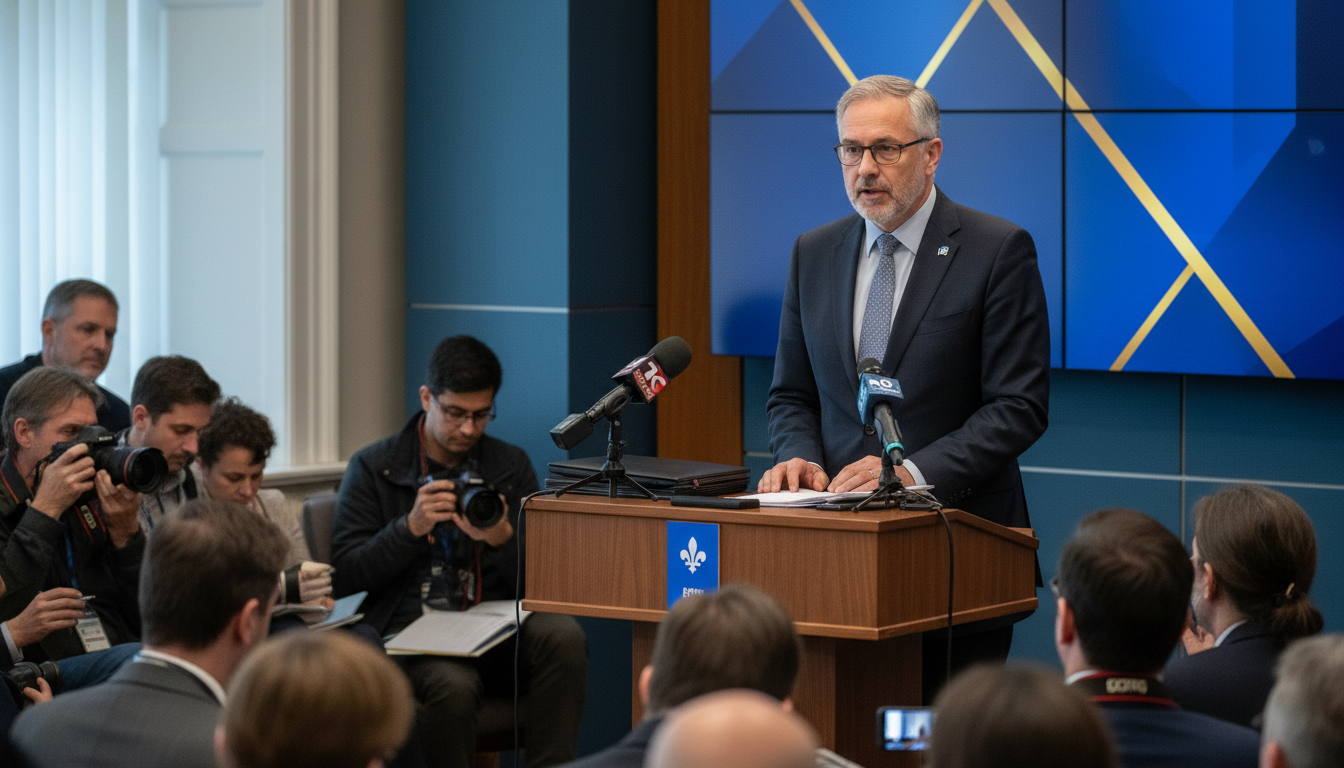
Quebec commissioner proposes French-language training loans to boost full-time francisation
Quebec commissioner Benoît Dubreuil urges French-language training loans up to $15,000 to boost full-time francisation and extend aid to Canadian residents.
Benoît Dubreuil, Quebec’s commissioner of the French language, is urging the provincial government to create a loan program to support full-time French-language training.
In a 110-page annual report filed June 3, 2026, Mr. Dubreuil recommends a system modeled on the province’s student financial aid to make intensive francisation more attractive.
Dubreuil’s loan proposal
The commissioner proposes a loan of up to $15,000 for participants enrolled in full-time francisation courses, to be added to existing financial assistance.
He argues that combining the proposed loan with the current $10,000 grant would allow full-time students to receive roughly $25,000 a year, which he says is comparable to earnings from 44 weeks at minimum wage.
Expected effect on full-time participation
Dubreuil’s calculations aim to remove a key barrier to intensive language learning: lost income during full-time study.
The report notes that learners who attend francisation full time progress substantially faster than part-time students, and that better financial support could accelerate integration into French-speaking workplaces.
Expansion of aid to Canadian-born residents
The commissioner also recommends widening eligibility so that Canadian-born residents who lack conversational French can access francisation financial aid.
He highlights roughly 310,000 Quebec residents aged 15 to 64 who consider themselves unable to sustain a conversation in French and who are currently under-represented in training programs.
Link to proposed Bill 101 extension
The report was released as the provincial government prepares new legislation to extend elements of Bill 101 to vocational training and adult education.
Transported in the same week the report appeared at the National Assembly, the draft legislation is expected to be tabled Thursday, June 4, 2026, and could change the regulatory context for francisation programs.
Budgetary and operational considerations
Introducing loans on the scale proposed would require provincial budget adjustments and program design to ensure repayment, forgiveness, or other delivery mechanisms.
Officials will need to weigh administrative costs, repayment terms, and the potential need for income-tested supports to ensure the loans benefit those most likely to undertake full-time study.
Labour-market and social implications
Proponents say paid or loan-backed leave to study could help employers by increasing the supply of French-speaking workers and by reducing long-term integration costs.
Critics may raise concerns about short-term labour shortages in certain sectors and the fiscal burden of expanding aid to a larger population, including Canadian-born residents.
The commissioner’s report also stresses that financial incentives should be paired with quality instruction and employer engagement to translate language gains into employment outcomes.
Dubreuil urges monitoring and evaluation frameworks to track progress for full-time learners and to adjust supports if expected gains in language proficiency do not materialize.
The proposal now moves to the political and administrative stages, where the government must decide whether to adopt a loan model, expand eligibility, or pursue alternative incentives.
As the National Assembly considers the planned Bill 101 expansion, ministers and stakeholders will assess how finance, training providers, and employers can coordinate to improve francisation uptake and outcomes.
