
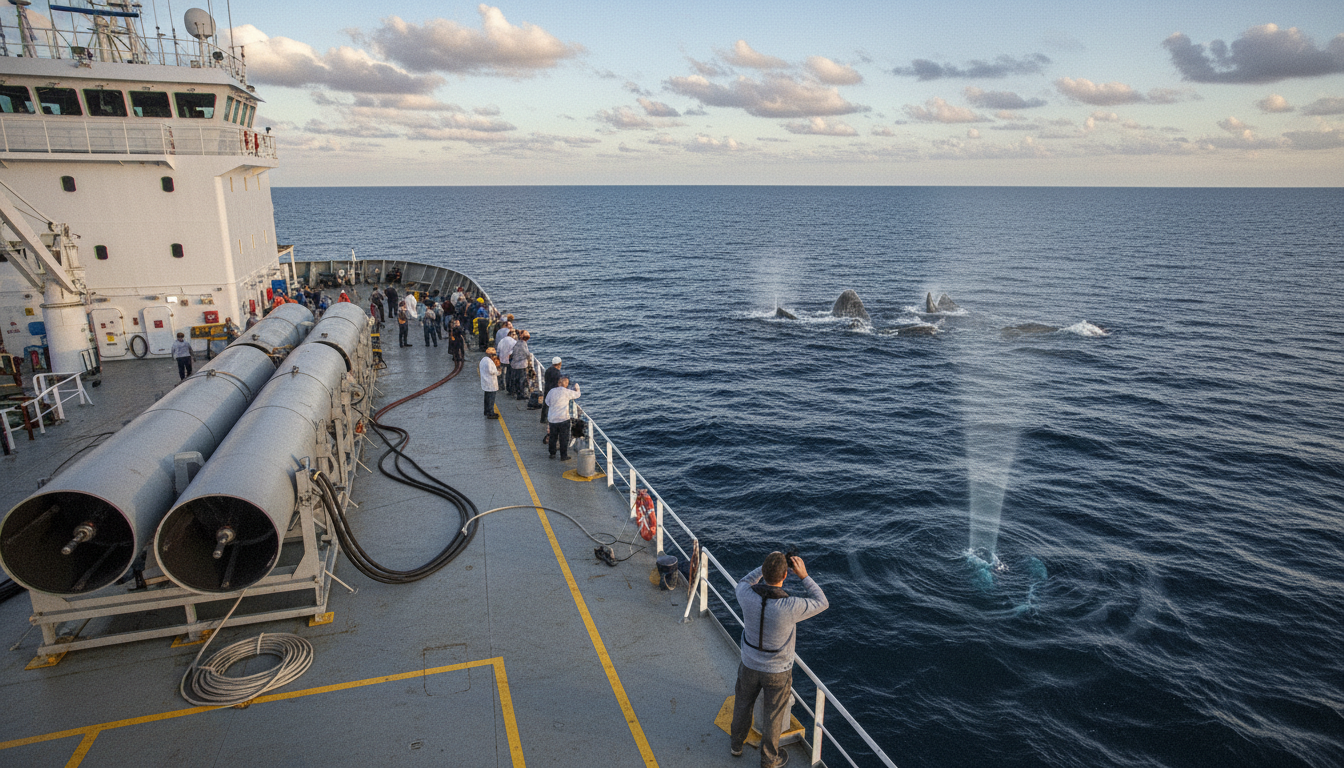
Gulf noise from air-gun blasts and shipping threatens Rice’s whales
Loud air-gun blasts and heavy shipping in the Gulf of Mexico are jeopardizing Rice’s whales by disrupting feeding, mating and causing chronic stress overall.
The Gulf of Mexico ranks among the loudest U.S. waters, and researchers warn that intense underwater noise is imperilling Rice’s whales’ ability to navigate, find food and reproduce. Scientists monitoring underwater acoustics identify seismic air-gun blasts as the single loudest contributor, while dense commercial shipping adds a persistent background roar. The combination of intermittent high-intensity blasts and continuous vessel noise is raising concern for the already vulnerable Rice’s whale population.
Underwater blasts dominate Gulf noise
Seismic air-gun surveys, used in oil and gas exploration, produce short, powerful pulses that travel long distances underwater. Measurements by acoustic monitoring teams show these blasts often exceed natural sound levels by wide margins, creating intermittent spikes that marine life must endure.
Those pulses can mask biologically important sounds, including prey movements and vocal signals between whales. When Rice’s whales cannot hear or be heard, their ability to locate food and coordinate mating behaviour may be significantly impaired.
Shipping traffic adds persistent background noise
In addition to seismic surveys, commercial shipping generates a steady, low-frequency hum throughout the Gulf of Mexico. Container ships, tankers and support vessels produce continuous noise that raises the ambient sound floor and reduces the range over which whales can detect softer signals.
This chronic background noise forces marine mammals to vocalize louder or longer to communicate, a behaviour known as the Lombard effect. Over time, such compensatory behaviour can increase energetic costs and reduce the efficiency of feeding and social interactions for Rice’s whales.
Rice’s whales face disrupted feeding and mating
Rice’s whales rely on acoustic cues to locate prey in murky or dark waters where sight is limited. Scientists caution that masked prey signals could lead to reduced foraging success, lower body condition and diminished reproductive output among affected individuals.
Mating success also depends on acoustic communication; courting calls and social signals are crucial for pairing and breeding. If those signals are drowned out or distorted by human-generated noise, the whales may struggle to find mates, exacerbating population decline.
Chronic acoustic stress threatens health
Beyond immediate disruption, prolonged exposure to elevated noise levels can impose chronic stress on whales. Chronic stress is linked to immunosuppression, reduced fertility and increased susceptibility to disease in many animal species, raising alarms for the long-term viability of Rice’s whales.
Repeated exposure to loud blasts may also cause temporary or permanent hearing impairment, further limiting an individual whale’s ability to forage and avoid hazards. Scientists describe these cumulative effects as a silent threat that can erode population resilience over years or decades.
How researchers measure and monitor noise
Marine acousticians deploy underwater hydrophone arrays to capture the soundscape of the Gulf, recording both sudden high-decibel events and persistent low-frequency noise. These instruments allow teams to quantify sound intensity, frequency content and temporal patterns that reveal how anthropogenic activity alters the acoustic environment.
Coupling acoustic data with sightings and health assessments of Rice’s whales provides a clearer picture of how noise correlates with behaviour and condition. Long-term monitoring is essential to detect trends, identify hotspots and evaluate the effectiveness of mitigation measures.
Policy options and conservation responses
Conservationists and some policymakers have proposed a range of measures to reduce acoustic impacts, including seasonal restrictions on air-gun surveys, limits on vessel speeds in key habitat areas, and designated quiet zones for sensitive periods. Mitigation tools such as soft-start procedures and real-time acoustic monitoring can also lower the immediate risk to marine life during operations.
Effective responses require coordination among industry, regulators and scientists to balance economic activity with species protection. For Rice’s whales—already limited in number and distribution—targeted management steps in the Gulf could slow or reverse noise-driven declines if implemented promptly and enforced robustly.
Despite the challenges, researchers say that reducing the intensity and frequency of anthropogenic noise in the Gulf of Mexico is achievable with current technologies and policy levers. Immediate action to curb the loudest sources, combined with sustained monitoring and adaptive management, offers the best chance to preserve Rice’s whales and the acoustic habitats they depend on.
