
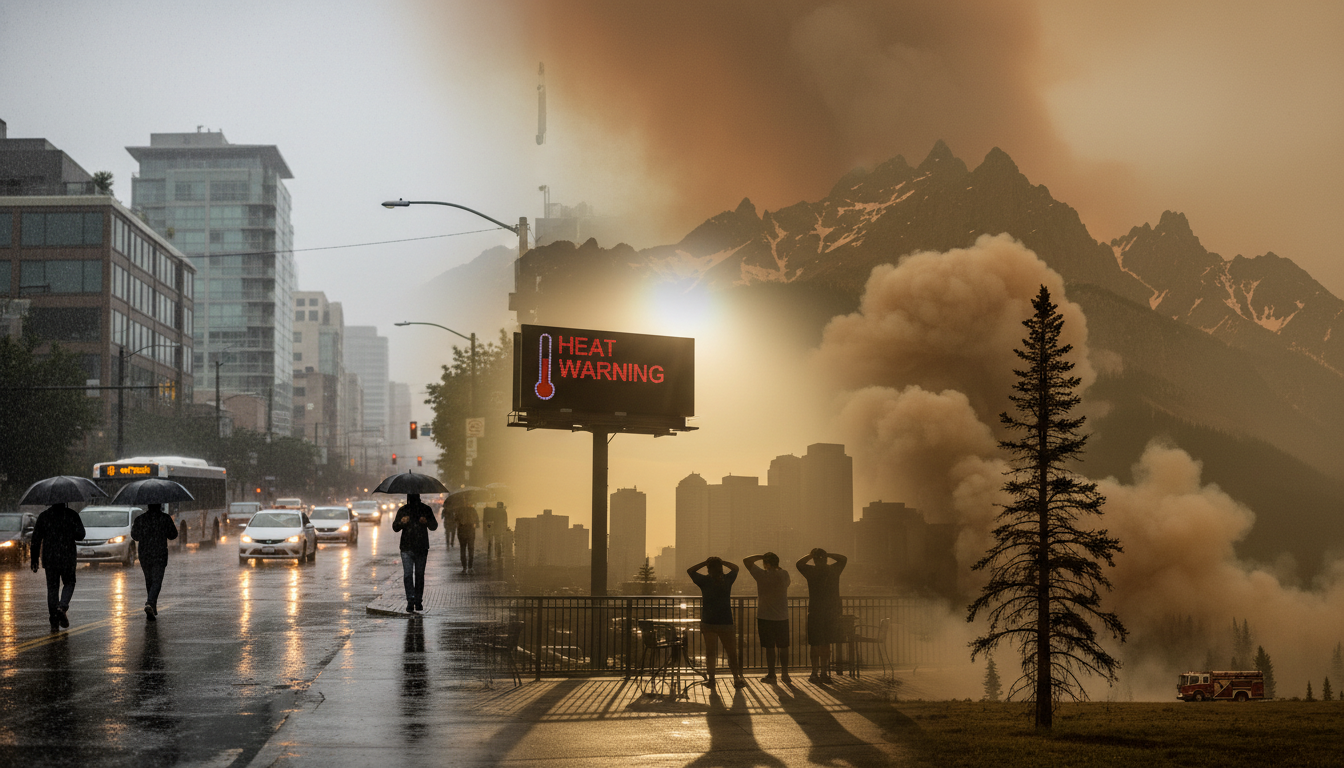
Weather warnings span B.C., Alberta and the Prairies as heavy rain, heat and wildfire smoke prompt alerts
Environment Canada issues weather warnings across multiple provinces on May 31, 2026, with heavy rain in B.C. and Alberta and heat and wildfire smoke affecting Saskatchewan and Manitoba.
Parts of eastern British Columbia and western Alberta faced heavy rainfall forecasts on Sunday, May 31, 2026, while large swaths of Saskatchewan and Manitoba were under heat and air-quality alerts tied to active wildfires. Environment Canada issued a series of weather warnings and special statements calling for preparedness as communities contend with risks ranging from flash flooding and debris flows to heat-related illness and smoke-related respiratory hazards.
Saskatchewan issues province-wide heat and air-quality alerts
Saskatchewan remained under multiple yellow heat warnings on May 31, 2026, with daytime highs expected to hover near 30 C in many areas. The heat advisory has heightened concerns for vulnerable residents, outdoor workers and firefighters who are already contending with active wildfires across the province.
Central Saskatchewan, including Prince Albert, was additionally placed under a yellow air-quality warning due to wildfire smoke moving through the region. Environment Canada warned that smoke concentrations and visibility could change rapidly, and advised people to limit time outdoors and consider rescheduling strenuous activities when air quality is reduced.
Officials emphasized that air conditions may vary over short distances and hour to hour, making localized monitoring important for those with pre-existing respiratory or cardiovascular conditions. The combination of elevated temperatures and smoky skies increases heat stress and respiratory risk, prompting public-health messaging to prioritize hydration, cooling and reduced outdoor exertion.
Lobstick fire near Prince Albert forces mandatory evacuation south of Shellbrook
The Lobstick fire, burning near the Prince Albert area, prompted a mandatory evacuation order for residents south of Shellbrook late last week as the blaze expanded. Saskatchewan’s Public Safety Agency reported that the fire had grown to about 19,000 hectares and that Type 1 firefighters were deployed to both flanks to contain the blaze.
Aircraft were used to steer and anchor the head of the fire into Callaghan Lake, according to public updates, and additional ground and air support were mobilized to protect threatened communities and infrastructure. The mandatory evacuation and ongoing suppression work underscore the acute local impacts of the wildfire season amid hot, dry conditions in parts of the province.
Communications from provincial public-safety officials urged evacuees to follow local evacuation orders and keep informed through official channels, noting that conditions can shift rapidly with changes in wind and fire behaviour. Evacuation centres and supports were activated in nearby centres to assist displaced residents while crews continued containment and property-protection efforts.
East Kootenay issues evacuation alert for debris flow and flood risk
In eastern British Columbia the Regional District of East Kootenay issued an evacuation alert for the Fairmont Creek area on May 31, 2026, citing an increased risk of debris flow and flooding. The alert asked residents to be ready to leave on short notice as heavy rainfall potential in the region raised concerns about slope stability and rapid runoff into waterways.
Environment Canada placed sections of East Kootenay, including areas around Yoho and Kootenay National Parks and the Elk Valley, under special weather statements with rainfall totals of 60 to 80 millimetres possible in some spots. Forecasts indicated lower totals farther west, closer to 40 millimetres, but officials stressed that heavy localized amounts could still produce hazardous conditions such as landslides and washouts.
Local authorities coordinated monitoring and road advisories while urging residents in susceptible valleys and creek corridors to review their emergency plans. The combination of saturated slopes, mountain terrain and stream channels increases the risk of rapid, damaging debris flows that can occur with little warning during intense rain events.
Western and central Alberta brace for prolonged heavy rainfall; higher elevations may see late-season snow
The western reaches of Alberta were facing a prolonged rainfall event through the early work week, with forecasts calling for 40 to 60 millimetres of rain or more by Tuesday, May 31, 2026. Environment Canada highlighted the potential for significant accumulation in valleys and low-lying areas, and warned that mountain and higher-elevation regions could see a late-season snowfall accumulation of 10 to 20 centimetres.
Central and eastern Alberta, including Edmonton, Red Deer and Calgary, were placed under yellow rainfall warnings as heavy rain was expected to continue through Wednesday. Forecast totals ranged from 50 to 100 millimetres across those regions, with localized amounts potentially exceeding 100 millimetres in strong bands of persistent precipitation.
Municipalities and provincial road authorities prepared for localized flooding, reduced visibility and potential water pooling on major routes. The rainfall threat prompted advisories for drivers to reduce speed, for property owners to clear drains where possible, and for those in flood-prone settings to remain alert to changing conditions and municipal direction.
Manitoba contends with heat warnings as temperatures climb into the low 30s
Manitoba faced a different challenge on the same day as heat warnings affected communities including Winnipeg, Thompson and Bissett. Environment Canada forecast daytime temperatures in the low 30s Celsius, prompting yellow heat warnings and public-health reminders to watch for signs of heat illness.
Forecasters expected temperatures to moderate across southern Manitoba by Monday, but officials advised residents to take precautions through the heat period by staying hydrated, seeking cool indoor spaces and checking on neighbours and vulnerable individuals. With wildfire smoke also present in parts of the region on certain days, combined heat and smoke exposure can compound health risks, particularly for children and older adults.
Public-health messaging stressed that those working or exercising outdoors should schedule strenuous activity for cooler parts of the day and take frequent breaks. Cooling centres and community supports are often made available during heat episodes, and residents were encouraged to contact local health or municipal services for information about available resources.
Local emergency measures and preparedness steps from public agencies
Across the affected provinces, emergency-management officials emphasized preparedness measures designed to reduce risk and speed response. Residents in evacuation-alert zones were urged to assemble go-bags, confirm family reunification plans and maintain situational awareness through official social media, local radio and municipal notification systems.
Health authorities issued guidance for people dealing with wildfire smoke, recommending limiting outdoor exertion, using indoor air-cleaning strategies where possible, and seeking medical advice for severe respiratory symptoms. For heat warnings, officials recommended frequent hydration, wearing light clothing, avoiding alcohol during high temperatures and checking on infants, older adults and those with chronic illnesses.
Transportation and public-works departments prepared for potential impacts by positioning pumps, sandbags and road crews where flooding or washouts were most likely. Utility companies and park authorities also monitored infrastructure and access points, pre-positioning resources to protect critical services and to facilitate rapid repairs if surfaces or slopes were undermined.
Forecast uncertainty and what to watch for in coming days
Environment Canada’s forecasts for the coming days emphasized localized variability in both precipitation and smoke concentrations, with conditions able to change quickly in a complex weather pattern over western and central Canada. Residents were advised to consult updated warnings and statements frequently, since hourly shifts in wind direction, rainfall intensity or fire behaviour could alter local impacts.
Rainfall totals in mountain-fed river basins and valley bottoms will be closely watched as runoff responses can develop rapidly, raising flood potential downstream of intense rain bands. Likewise, wildfire containment progress and fire-weather conditions will determine whether smoky conditions persist or dissipate for communities in the Prairies.
Emergency-management officials said that coordination between provincial agencies, regional districts and municipal services remains ongoing, and that the public should follow local direction on evacuations, road closures and sheltering. Preparedness measures taken in advance can reduce risk and improve response times if conditions deteriorate.
Communities are being reminded to keep pets and livestock in mind when planning for possible evacuation, and to secure important documents and critical equipment as conditions warrant. The interplay of heat, smoke and heavy rain this week represents a compound hazard scenario that requires layered responses from health, emergency and environmental agencies.
Sustained monitoring and updates from Environment Canada and local emergency authorities remain central to public safety as the situation evolves. The agency’s special weather statements and warnings issued on May 31, 2026, provide the most current guidance for areas under threat, and residents are advised to rely on those official bulletins for decision-making.
Moving forward, public officials asked communities to remain vigilant and prepared for shifting conditions that could bring new or escalating hazards. Emergency resources, shelters and municipal supports had been readied in multiple jurisdictions in anticipation of the continuing storm and wildfire impacts.
Despite the variations in regional threats — from heat and smoke on the Prairies to heavy rain and debris-flow risks in mountain valleys — the common thread for officials was the need for awareness, preparedness and adherence to official evacuation and health advisories. Residents should monitor local media and official provincial channels for updates and follow guidance to reduce risk to life and property as conditions change.
