
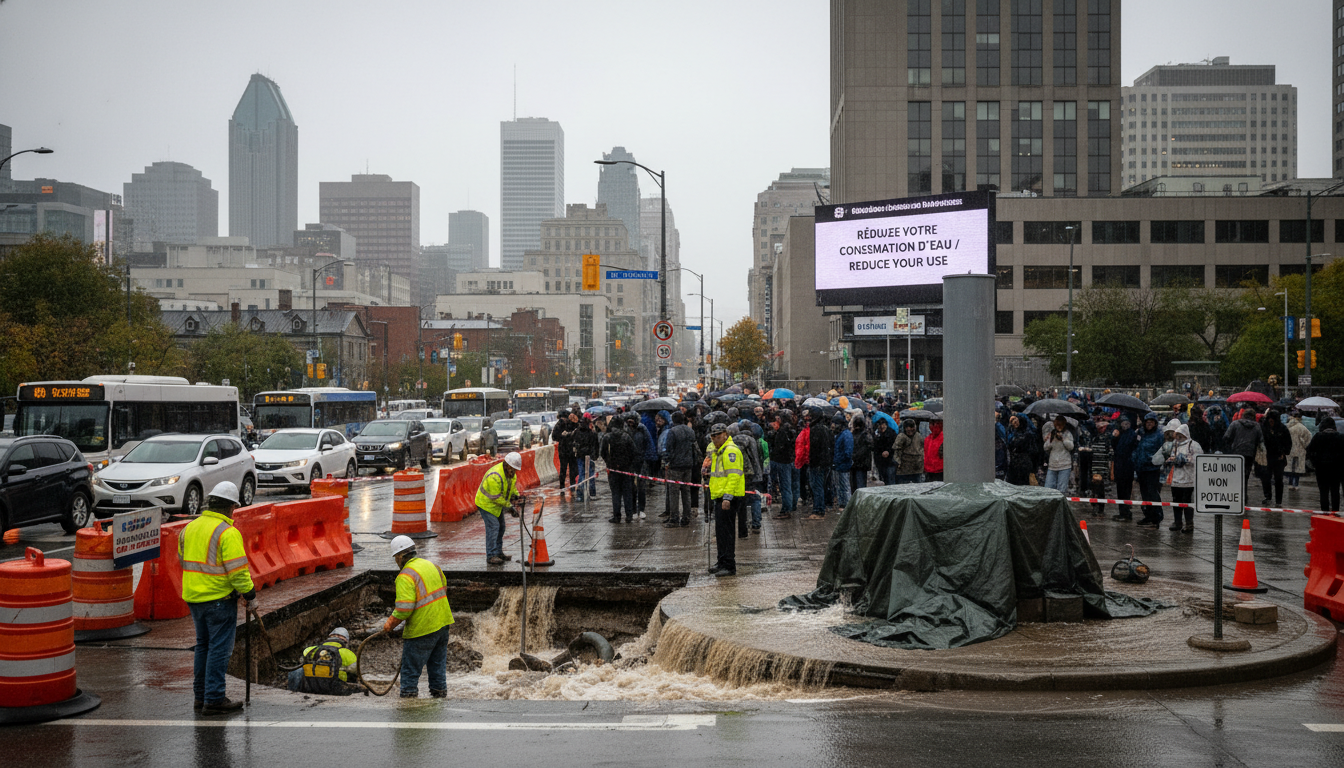
Montreal orders water reduction as urgent Atwater pipe repairs force citywide conservation
Montreal asks 1.2 million residents to cut water use ~7% as emergency repairs to an Atwater Avenue aqueduct begin; partial closure starts July 1, 2026.
Montreal has launched an urgent citywide water reduction campaign after engineers identified an “imminent risk” of failure in a major aqueduct pipe beneath Atwater Avenue, prompting officials to ask about 1.2 million residents to reduce their water consumption.
The city says the measure—framed as a temporary water reduction—aims to preserve system pressure and protect service while crews undertake complex repairs that will require a partial shutdown beginning July 1, 2026.
Scope and scale of the required water reduction
The water reduction request affects 16 boroughs and more than one million Montrealers, municipal officials said, with the objective to lower overall demand by roughly 7 percent.
Montreal’s Service de l’eau reports the city uses about 1.6 billion litres of water per day, and even modest per-household savings are expected to translate into substantial system relief across the network.
City engineers flagged the Atwater Avenue conduit as vulnerable after recent inspections, and the planned intervention follows two other major mains that are already offline elsewhere in the distribution system.
Officials have framed the effort as collective and temporary, saying the strictest conservation targets should ease once outdoor summer demand diminishes in the fall.
Timeline and technical steps for the Atwater repair
Work to stabilize the line began the weekend of May 29, 2026 with the repair of a control valve and preparatory measures that will allow crews to monitor the conduit while keeping it pressurized for emergency use.
The city says the 48‑inch main—approximately 1.2 metres in diameter—will be placed in a controlled “rinçage” state initially and then fully closed on July 1 to allow replacement of pipe sections.
Municipal planners would not give a definitive completion date but described the operation as extensive, likely extending through the summer months, with periodic updates to residents as phases of the work are completed.
Officials caution that the timeline depends on site conditions, the pace of pipe replacement, and coordination with other ongoing infrastructure projects.
Measures Montreal is imposing and recommending
To reach the 7 percent reduction target, Montreal has ordered and encouraged a range of immediate measures across the city and its boroughs.
These actions include suspending continuous flushing of mains, halting preventive rinsing and nonessential sewer cleaning, and postponing flow tests on fire hydrants except where safety requires them.
Public amenities and municipal services will also be scaled back where feasible: decorative fountains without water recirculation loops may be shut off, street washing and non‑essential outdoor cleaning are limited, and watering of public and private landscaping is strongly discouraged.
The city is urging rapid repair of network leaks and reminding residents to comply with the existing Regulation on the Use of Potable Water, which will be enforced more closely during the emergency period.
Pressure risks and potential impacts on services
City engineers warned that failing to lower demand could cause pressure drops across the distribution system, which would raise the risk of service interruptions and make it harder to isolate and repair damage.
Lower pressure could also affect the ability to fight fires in certain zones, a concern municipal officials say is being managed through prioritized hydrant maintenance and response planning.
For the general public, the city expects some visible impacts: fewer running decorative fountains and reduced irrigation for public green spaces, while municipal pools are not expected to be affected at this stage.
Residents are asked to avoid outdoor water use for cleaning and landscaping and to adopt everyday conservation behaviours such as shorter showers, delayed laundry cycles, and reducing unnecessary taps.
Political responses and questions of equity
City representatives say they were notified of the heightened risk late last week, and the emergency measures were presented at a press briefing that included mobility and infrastructure officials.
Opposition figures and some council members have called for clearer rules and asked whether large water users—businesses, institutions and construction sites—will face the same restrictions being asked of residents.
Ericka Alneus, chief of the official opposition, said the burden appears to fall largely on households and urged the city to spell out measures for commercial and institutional consumers.
Officials responded that controls will be tightened system‑wide and that enforcement emphasis could be adjusted if monitoring identifies concentrated high consumption in particular sectors.
The city is also prioritizing rapid repair of any new leaks and has instructed borough maintenance teams to accelerate work on network vulnerabilities to limit unnecessary losses.
Montreal stressed that the success of the operation will hinge on both the technical repair program and the public’s willingness to adopt immediate water‑saving practices.
Final paragraph
Montreal officials have pledged regular updates as the Atwater Avenue repairs progress and have reiterated that every resident’s conservation steps will reduce strain on the aqueduct network and help avoid wider service disruptions through the summer.
