
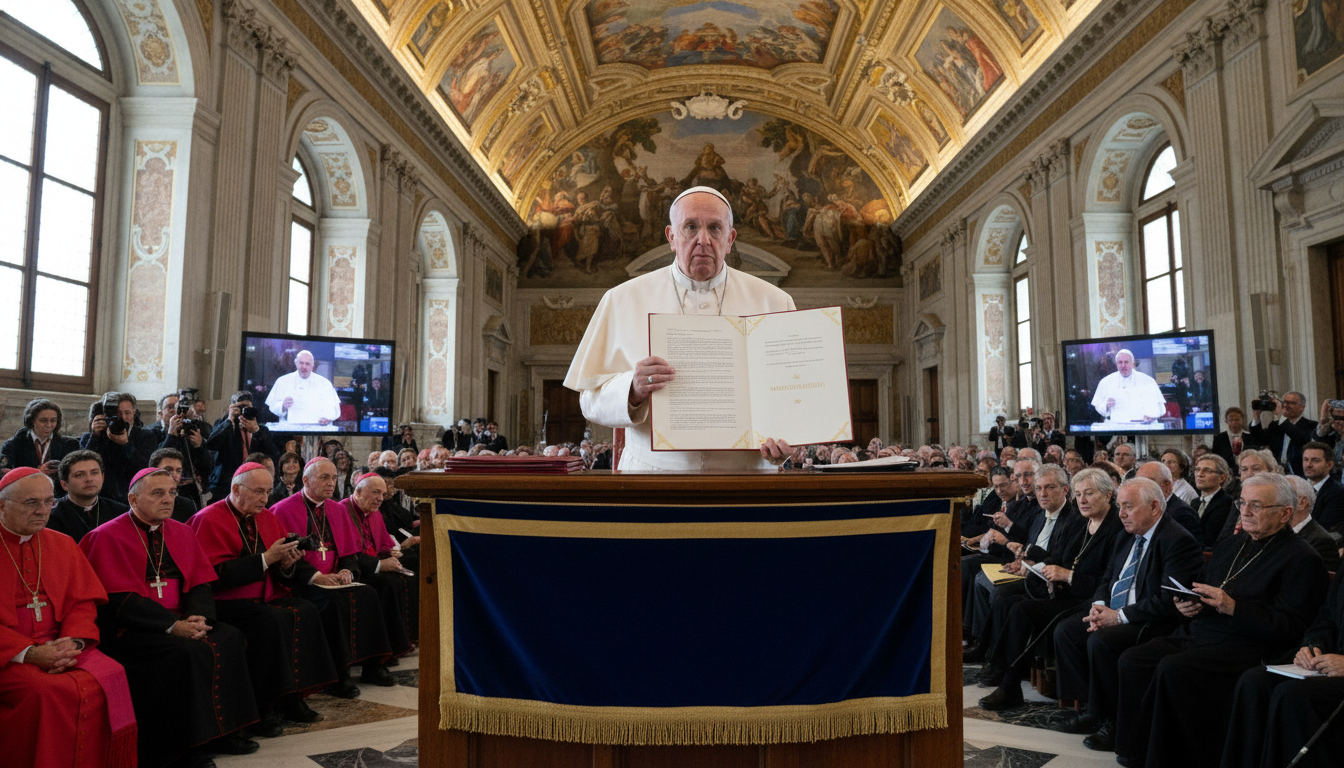
Pope Leo XIV Issues ‘Magnifica Humanitas’ Enclyclical Calling for Human-Centred Rules on AI
Pope Leo XIV’s encyclical "Magnifica Humanitas" confronts artificial intelligence, arguing for protections for workers, children and dignity as automation reshapes society.
Pope Leo XIV on Monday released "Magnifica Humanitas," an encyclical that frames artificial intelligence as a profound moral and social challenge requiring urgent attention. The 42,300-word document positions the Vatican as an active voice in debates about technology, arguing that AI cannot be treated as a substitute for human worth or moral agency. The text links present-day concerns about automation, data control and child welfare to longstanding Catholic social teaching about human dignity.
Pope links ‘Magnifica Humanitas’ to historical social teaching
The encyclical was signed on the anniversary of a landmark 19th-century teaching about labor, tying the new document to a tradition of responding to technological change. Pope Leo XIV chose his papal name to echo Pope Leo XIII and deliberately invoked earlier reflections on work and rights in an industrial age. By framing the current moment as analogous to past upheavals, the pope seeks to place AI debates within established moral categories rather than leaving them to technologists alone.
The choice of language and timing signals that the Vatican intends the encyclical to guide both Catholic institutions and public policymakers. "Magnifica Humanitas" appears intended as a road map for how the faithful and broader society should respond to rapid advances in machine learning and automation. The pope stresses continuity in principles even as he addresses new forms of risk.
Affirmation that artificial intelligence is not human
A central claim of the document is that AI, however sophisticated, remains categorically different from human persons. The pope acknowledges AI’s utility as a tool and its capacity to augment human capabilities, but repeatedly distinguishes computational systems from human consciousness and moral subjecthood. This rejection of any equivalence between machines and persons counters arguments by some technologists who have suggested AI might eventually possess emotions or moral capacity.
That distinction underpins many of the practical recommendations in the encyclical. By maintaining a clear boundary, the Vatican argues that rights, responsibilities and protections must be assigned with human beings at the centre of policy and law. The document insists that technological proficiency cannot replace ethical deliberation.
Call to protect workers amid accelerating automation
"Magnifica Humanitas" warns that AI-driven automation is already displacing entry-level positions and may transform white- and blue-collar employment alike. The pope urges governments, employers and international bodies to prioritize fair wages, job retraining and social safety nets as new technologies reshape labour markets. He frames these demands in the language of dignity, arguing that economic systems must not treat people as expendable inputs.
The encyclical highlights the need for active labour policies rather than passive adjustment to market forces. It endorses public investment in education and social supports to ensure that technological progress does not exacerbate inequality or marginalize entire communities.
Condemnation of digital-era exploitation and resource harms
The document also condemns practices it calls "new forms of slavery" within the digital economy, naming workers who perform low-paid content moderation, data labeling, and hazardous mineral extraction for tech hardware. Pope Leo XIV paints a picture of hidden human costs underpinning the digital services many rely on, calling for stronger protections for vulnerable workers and stricter oversight of supply chains.
Data ownership and the unequal bargaining power of platform companies receive attention as well. The encyclical urges regulation that protects personal data and prevents exploitative business models that externalize human and environmental harms. It frames such reforms as moral imperatives, not merely technical fixes.
Tower of Babel analogy cautions against uniform technological ambition
Throughout the encyclical, the pope returns to the biblical Tower of Babel as a cautionary image, warning against a monolithic technological culture that seeks universal dominance. He argues that efforts to standardize and commodify every aspect of life risk eroding cultural and religious diversity. In that sense, the document frames AI’s global spread as a sociocultural phenomenon as much as a technical one.
The pope calls for humility among technologists and policymakers, urging recognition of limits and the value of pluralism. He suggests that technological achievements should not be measured solely by efficiency or scale but by their capacity to enhance human flourishing across varied communities.
Practical recommendations for families, children, data and weapons
Beyond moral argument, "Magnifica Humanitas" offers concrete policy suggestions. The encyclical recommends stricter limits on unsupervised digital access for children, citing harms such as addiction and online abuse. It advocates clearer rules for data governance to protect privacy and individual rights, and urges international agreements to prevent the weaponization of AI.
The pope addresses pastoral concerns directly, emphasizing support for families and communities who will bear the immediate consequences of technological disruption. The practical orientation indicates a desire to influence legislators, educators and industry leaders as well as the faithful.
The release of "Magnifica Humanitas" marks a high-profile intervention in the global conversation over artificial intelligence, labour and ethics. Its combination of theological framing and policy prescriptions will likely shape public debate in the months ahead as governments and companies respond to the pope’s call to place human dignity at the centre of technological progress.
