
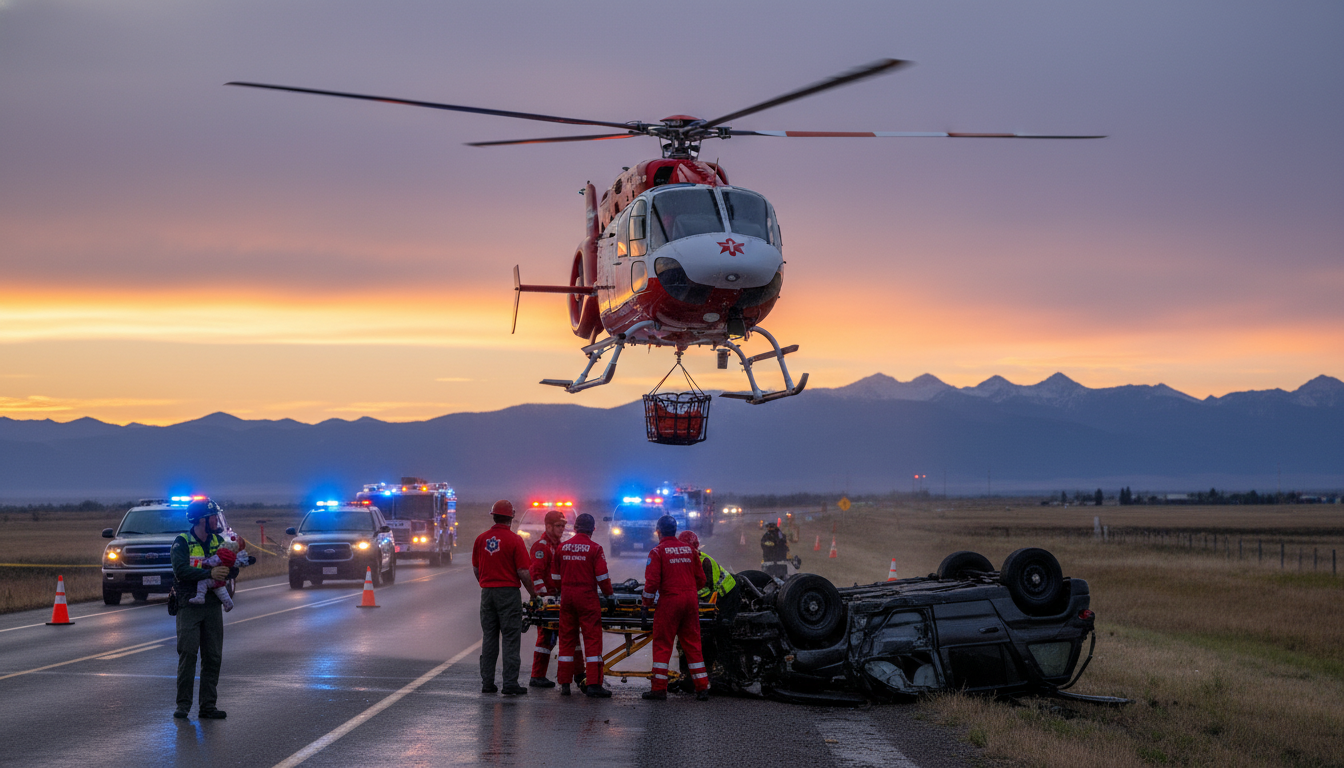
STARS air ambulance flies injured driver to Calgary after SUV crash; child taken to children’s hospital
STARS air ambulance transported an adult driver in serious, potentially life-threatening condition to Calgary after an SUV crash, while a young child was taken by ground ambulance to a children’s hospital in stable, non-life-threatening condition.
An adult driver was flown by STARS air ambulance to Calgary with serious, potentially life-threatening injuries following an SUV collision, authorities confirmed. A second patient, a young child, was transported by ground ambulance to a children’s hospital and was described as otherwise stable and not facing life-threatening injuries. The brief account from spokesperson Brideaux provided the key details as emergency crews worked at the scene.
Emergency response and airlift
Emergency crews, including ground ambulances and STARS air ambulance, converged on the crash site to stabilize patients and coordinate transport. The decision to call in STARS reflected the severity of the adult driver’s injuries and the need for rapid transfer to specialized care in Calgary. Ground ambulance crews transported the child to the pediatric facility while paramedics continued to manage patient care until the airlift.
STARS air ambulance teams are dispatched when crews determine patients need expedited transfer to major trauma centres, particularly when geography or the extent of injuries makes road transport impractical. In this incident, the helicopter transfer shortened transit time and provided advanced in-flight medical support en route to Calgary. Officials said the adult’s condition warranted the resources and speed that STARS offers.
Condition of the adult driver
Officials characterized the adult driver’s condition as serious and potentially life-threatening, prompting the air transfer to Calgary for urgent treatment. Medical responders provided on-scene care before the flight, focusing on stabilizing vital signs and preparing the patient for transfer. The use of an air ambulance typically signals that doctors and paramedics seek immediate access to advanced trauma or specialist services.
While authorities have not released the adult’s identity or exact medical diagnoses, the decision to fly the patient into Calgary indicates the injuries required a higher level of hospital care than available locally. Emergency officials declined to share further clinical details pending family notification and hospital updates.
Care for the child patient
The second patient, described as a young child, was taken by ground ambulance to a children’s hospital and was reported to be in stable, non-life-threatening condition. Paramedics provided initial assessment and treatment at the scene before the ground transport to ensure the child’s needs were managed en route. Authorities emphasized that the child’s injuries did not appear to present an immediate threat to life.
Medical teams at the receiving pediatric facility were prepared to continue evaluation and treatment, including imaging and observation as needed. Family members and support services are typically involved in care planning for pediatric patients; officials said they would provide updates through appropriate channels when available.
Statements from authorities and investigators
Spokesperson Brideaux summarized the immediate medical outcomes, noting the adult was flown to Calgary while the child was taken by road to a children’s hospital. Beyond that summary, officials have been withholding additional operational details as investigators work to determine the cause and circumstances of the collision. Police and emergency services remained at the scene for several hours conducting their inquiries.
Investigators generally examine vehicle positions, roadway conditions, witness accounts, and any available video or telemetry to reconstruct crashes. Authorities often ask witnesses or anyone with dash-cam or surveillance footage to come forward; at the time of the initial account, formal appeals and contact information had not been released publicly.
Traffic and community impact
The collision prompted emergency lane closures and likely caused travel delays in the area while crews attended to the injured and cleared the scene. Local officials typically coordinate traffic control during such responses to protect responders and manage flow until normal conditions are restored. Nearby residents and commuters were advised to expect disruptions while emergency activity was ongoing.
Community members often respond to serious crashes with expressions of concern, particularly when children are involved. Support networks and municipal resources for families may be mobilized following such events, with hospitals and local agencies providing information and assistance to those affected.
Emergency medical transport systems like STARS play a pivotal role in moving critically injured patients to specialized centres where surgical and intensive care resources are concentrated. In Alberta and other provinces, air ambulance services complement ground ambulances and are activated when time and access are critical to patient outcomes.
The investigation into the cause of the collision is ongoing, and authorities will release additional information as it becomes available. For now, the priority remains the recovery and care of the two patients and the preservation of evidence necessary to understand what happened and to prevent similar incidents in the future.
