
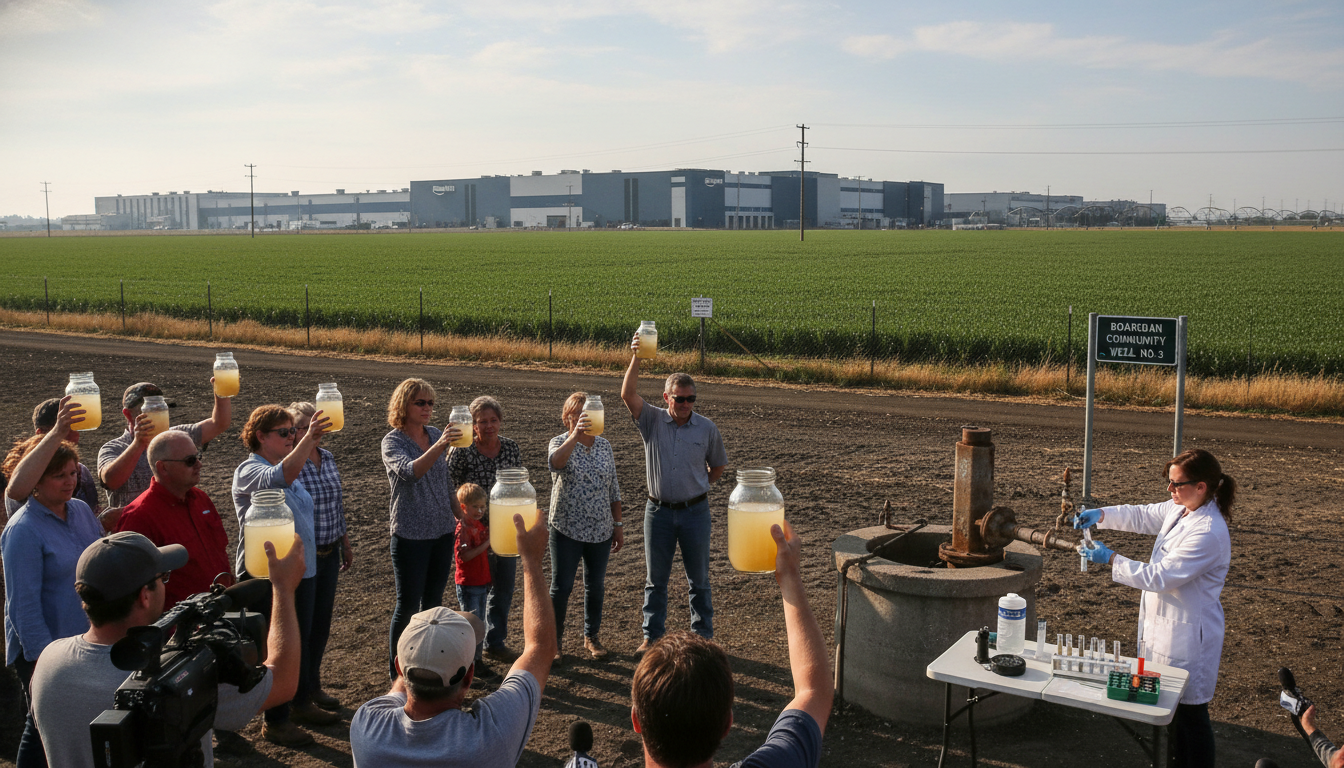
Nitrate contamination in Boardman, Oregon prompts door-to-door testing and $20.5M Amazon settlement
Boardman nitrate contamination sparks bilingual outreach, testing and a $20.5M settlement as residents and state agencies seek remedies for decades of polluted groundwater.
Boardman residents and community groups have launched bilingual door-to-door outreach and home testing in response to longstanding nitrate contamination in local wells, and to a recent $20.5 million settlement with Amazon related to groundwater claims. The campaign, led in part by Oregon Rural Action, aims to give households simple nitrate test strips and multilingual information so families can assess whether their water is safe. (opb.org)
Community canvass and bilingual testing
Community organizers described small meetings where volunteers practiced the outreach script in English and Spanish before heading into neighbourhoods to distribute test strips and explain results. Oregon Rural Action and partner public health agencies have focused on reaching Spanish-speaking households and other vulnerable residents who often rely on private wells. The state and local health departments have also distributed kits and coordinated follow-up for households with unsafe results. (oregon.gov)
Many residents say they discovered unsafe nitrate levels only after nonprofit groups or state canvassers provided testing, and organizers emphasize that early detection helps households access bottled water programs, filters, or deeper wells. The outreach includes demonstrations of color-changing strip tests and guidance about where to submit samples for laboratory confirmation. These practical steps are intended to reduce immediate exposure while longer-term cleanup plans are negotiated. (opb.org)
Decades-long rise in Lower Umatilla Basin nitrates
State monitoring has documented elevated nitrate concentrations in the Lower Umatilla Basin for more than three decades, prompting a formal Groundwater Management Area designation in the early 1990s. Agency sampling and trend analyses show a slow but persistent increase in nitrate levels across parts of Morrow and Umatilla counties. Regulators and researchers trace much of the contamination to decades of irrigated agriculture, livestock operations and food-processing wastewater applied to fields. (oregon.gov)
Local residents and public-health officials say the pattern of contamination has worsened in some areas as industrial and agricultural water management has intensified, leaving families dependent on private wells that now test above federal safety thresholds. The cumulative nature of nitrate loading means older contamination can continue to affect groundwater long after the original sources were applied. (opb.org)
Amazon agrees to $20.5 million settlement
In late March 2026 Amazon agreed to a $20.5 million settlement to resolve a class-action suit by northeast Oregon residents alleging contributions to nitrate pollution, while denying liability. The settlement, announced by plaintiffs’ lawyers and reported by regional outlets, does not require Amazon to admit wrongdoing and will be used in part to compensate affected residents and cover legal costs. (opb.org)
Plaintiffs in the consolidated litigation name multiple defendants, including food processors, agricultural operations and local utilities, and argue that wastewater from industrial sites and the Port of Morrow was applied to farm fields and contributed to groundwater nitrate loads. Attorneys and community leaders described the Amazon settlement as an initial step toward corporate responsibility, while noting significant work remains to address other defendants and to fund remediation. (opb.org)
How data centres are alleged to concentrate contaminants
Plaintiffs and local advocates contend that water used in data-centre cooling systems contributes indirectly to concentrated nitrate levels because much of the water drawn for cooling is later applied to fields as wastewater. Advocates say evaporation and reuse within cooling systems can raise the concentration of dissolved contaminants before discharge or land application. Amazon and other companies have disputed claims that their operations added nitrates to the aquifer, saying they do not add nitrates and that groundwater issues predate the data-centre buildout. (opb.org)
Regulatory reviews and independent studies note the complexity of assigning responsibility, because multiple industries and historical farming practices have interacted over decades to shape aquifer chemistry. Experts caution that source attribution requires robust isotopic and hydrological studies to identify when and how specific facilities contributed to observed nitrate increases. (usgs.gov)
Health risks, standards and household precautions
Nitrate in drinking water poses a particular risk to infants by interfering with blood’s ability to carry oxygen, a condition known as methemoglobinemia or “blue baby syndrome.” Public health authorities also cite evidence linking long-term nitrate exposure to other health concerns, including potential reproductive impacts and certain cancers. The U.S. Environmental Protection Agency’s enforceable maximum contaminant level is 10 mg/L expressed as nitrate‑nitrogen (equivalent to roughly 45 mg/L as nitrate ion), and authorities use that benchmark to advise residents and prioritize interventions. (epa.gov)
Local public health messaging has urged households with infants or pregnant people to avoid using well water that tests above the action threshold for drinking or formula preparation, and to seek state-supported alternatives such as bottled water deliveries or treatment installations when available. Residents report that installing reliable whole-house treatment or drilling deeper wells can be costly and out of reach without outside assistance. (opb.org)
State plans, monitoring and the path to remediation
Oregon agencies have developed a Nitrate Reduction Plan for the Lower Umatilla Basin that outlines monitoring, outreach and long-term strategies to reduce nitrate loads, including best management practices for agriculture and targeted treatment for drinking water supplies. The plan also supports expanded testing and temporary safe-water services while structural solutions are pursued. State regulators say progress is incremental and will require sustained funding, stronger source controls and cooperation from industry. (oregon.gov)
Officials and community advocates are pressing for enforceable cleanup programs, health monitoring for exposed residents, and investments that reduce the need for households to shoulder the costs of safe water. As litigation proceeds and settlements are finalized, local leaders say they will push for funds to be directed toward permanent remediation and equitable access to clean drinking water. (opb.org)
As testing campaigns continue and settlement processes move forward, residents say their priorities are straightforward: reliable information in the languages they speak, immediate access to safe water, and accountable funding for cleanup that prevents future generations from facing the same contamination. The coming months will test whether legal settlements, agency plans and community organizing can translate into durable solutions for Boardman and the broader Lower Umatilla Basin. (opb.org)
