
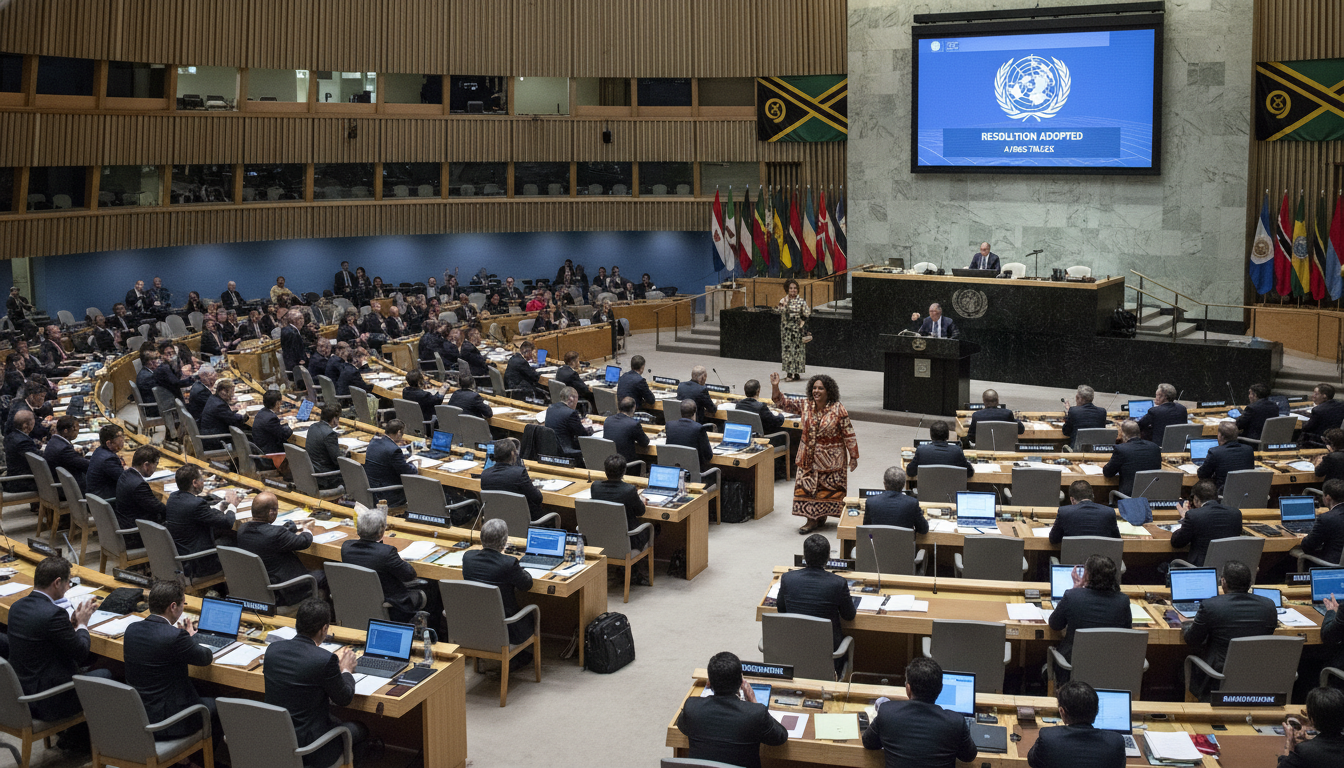
UN climate resolution adopted by UN General Assembly after intense negotiations
UN General Assembly adopts compromise UN climate resolution consolidating state obligations under international law, citing CIJ advisory opinion and urging action.
The United Nations General Assembly on Wednesday adopted a compromise UN climate resolution that consolidates states’ obligations to address climate change under international law. The resolution, championed by the Pacific island state of Vanuatu, cites a 2024 advisory opinion from the International Court of Justice and was approved by 141 votes in favour, with eight against and 28 abstentions. Supporters hailed the text as a milestone for vulnerable states, while opponents and major fossil-fuel producers pressed for changes that weakened parts of the original proposal.
Resolution passage and voting breakdown
The General Assembly approved the compromise text with 141 votes for, eight against and 28 abstentions. Countries voting against included the United States, Israel, Iran, Russia and Saudi Arabia, reflecting deep geopolitical divisions over measures that could imply state liability. Delegates pressed for months to reconcile the Vanuatu-led proposal with the competing priorities of major emitters and producing states.
Court advisory opinion as legal backbone
The resolution explicitly references the International Court of Justice advisory opinion requested by the General Assembly in 2024. That CIJ opinion found that states violating their climate obligations may be committing an internationally wrongful act, and it opened the door to potential reparations for affected countries. Although advisory and non-binding, the Court’s findings are meant to guide national and international courts and informed negotiators drafting the UN text.
Vanuatu’s role and the voices of small island states
Vanuatu, a small Pacific archipelago, led the campaign for an enforceable recognition of state responsibility for climate harms. Delegates and climate activists from low-lying islands argued the resolution responds to real and present damage: lost homes, eroding coastlines, damaged crops and threats to cultural survival. Testimony during the CIJ process and at the UN General Assembly by young activists from Vanuatu and other at-risk states underscored the urgency driving the initiative.
Contents of the adopted text and key concessions
The final resolution commends the CIJ opinion, calls on states to honour their international obligations and urges measures to limit warming to 1.5°C, including a phase-down of fossil fuels consistent with prior international commitments. A central element of the original draft—a proposed international register to collect evidence of climate-related losses and damages—was removed after intense opposition. Negotiators also blurred language on reparations and accountability to secure broader support, producing a text that balances legal recognition with political compromise.
Opposition from major emitters and oil-producing states
Several high-emitting and oil-producing countries pushed back strongly against provisions they said could create political or legal obligations beyond what they accept. The United States expressed that the resolution contained “inappropriate political requirements” related to fossil fuels and did not accept the CIJ opinion as authoritative. Saudi Arabia, Kuwait and other producers submitted amendments and procedural challenges that critics said aimed to weaken the draft, though those attempts ultimately failed to prevent adoption.
Next steps: secretary-general report and prospects for implementation
The resolution tasks the UN secretary-general with presenting suggestions to promote compliance with the obligations highlighted by the CIJ, creating a potential pathway to revisit ideas such as a damages register. Climate advocates hope a forthcoming UN report will reopen debate on mechanisms to document loss and damage and to advance remedies for affected states. Legal experts say national courts and international tribunals may increasingly cite the CIJ opinion and the UN text when considering cases linked to state conduct on climate.
The General Assembly’s decision marks a notable recognition of the legal dimensions of climate responsibility while exposing the limits of global consensus on remedies and enforcement. For small island states and vulnerable communities, the resolution is seen as an important step toward accountability and protection, but the absence of stronger mechanisms underscores how economic and strategic interests continue to shape international climate policy.
