
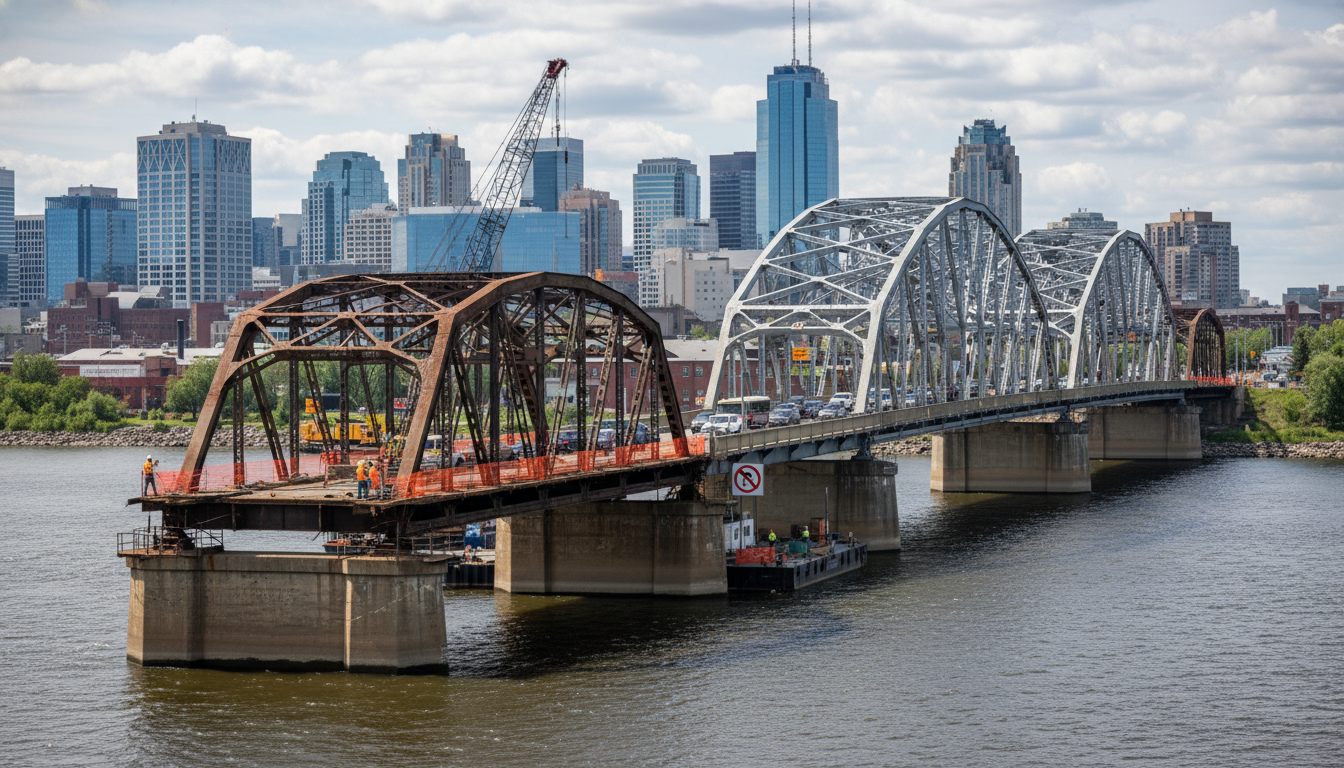
Future uncertain for Low Level Bridge as southbound span set for decommissioning
Low Level Bridge faces an uncertain future after engineering assessments found the southbound lane, built in 1949 and rehabilitated in 2025, will likely be taken out of service. The historic northbound span, completed in 1900, remains comparatively sound and is under review for possible conversion to pedestrian use. The city and stakeholders are weighing preservation, safety and long-term infrastructure planning for both spans of the Low Level Bridge.
Historic northbound span completed in 1900
The northbound side of the Low Level Bridge is a designated historic resource and was finished in 1900. Despite its age, recent inspections show it to be in better structural condition than its younger counterpart.
Experts and preservationists point to original materials and maintenance history as reasons the 1900 span has endured. Its status as a heritage element is central to discussions about whether it should be retained in any future configuration of the river crossing.
Southbound span built in 1949 and rehabilitated in 2025
The southbound lane of the Low Level Bridge was originally constructed in 1949 and underwent a rehabilitation project in 2025. That rehabilitation, while extending service life in the short term, did not remove the prospect that the span will be decommissioned.
Officials have indicated that despite last year’s work, the southbound structure no longer meets long-term operational standards. As a result, planners are treating that span as the primary candidate for removal or replacement.
Engineering assessments recommend decommissioning of southbound lane
Recent engineering reviews concluded the southbound span carries greater risk and higher long-term maintenance costs than the northbound span. Those assessments are informing a timeline that anticipates decommissioning rather than continued investment to restore full vehicular service.
Planners say decommissioning could involve partial removal, full removal, or replacement with a new crossing, depending on budget, regulatory approvals and community input. Safety and lifecycle-cost analysis remain the decisive criteria in the technical reports.
Options include converting northbound span to pedestrian use
One of the leading options under consideration is converting the historic northbound span into a pedestrian and cyclist link. Supporters argue a pedestrian conversion would preserve the heritage structure while providing active-transport connections across the river.
Conversion would require targeted structural modifications, safety upgrades and accessibility improvements, but could avoid the heavier engineering interventions needed to sustain vehicular traffic. Heritage advocates are pressing for a plan that balances preservation with modern use.
Lifespan context and implications for infrastructure planning
Modern bridges are typically designed for service lives of roughly 100 years, a benchmark that frames current decisions about both spans. The northbound span has already exceeded that benchmark, whereas the southbound span is approaching or has passed it depending on maintenance history.
Decision-makers must weigh whether to invest in new construction designed to current standards or to preserve historic elements while building alternative vehicular capacity elsewhere. Lifecycle cost, environmental impact and transportation needs form the core of that calculus.
Next steps, consultation and timelines for the Low Level Bridge
Municipal authorities say a formal review process will set priorities, timelines and funding pathways for the bridge complex. That process is expected to include technical studies, heritage assessments and public consultation to ensure community priorities are reflected.
Any plan to decommission, remove or repurpose parts of the Low Level Bridge will require permits and coordination with multiple agencies, along with an approved budget. Officials have not yet announced a definitive schedule for action.
Public debate over the future of the Low Level Bridge is likely to center on preservation versus replacement, the cost of major repairs, and how best to serve pedestrians, cyclists and motorists. Community groups, historians and engineers will all have roles in shaping the outcome.
The coming months will determine whether the century-old northbound span is adapted for a new role or joins the southbound lane in retirement, and whether a replacement strategy will prioritize heritage, mobility or a combination of both.
