
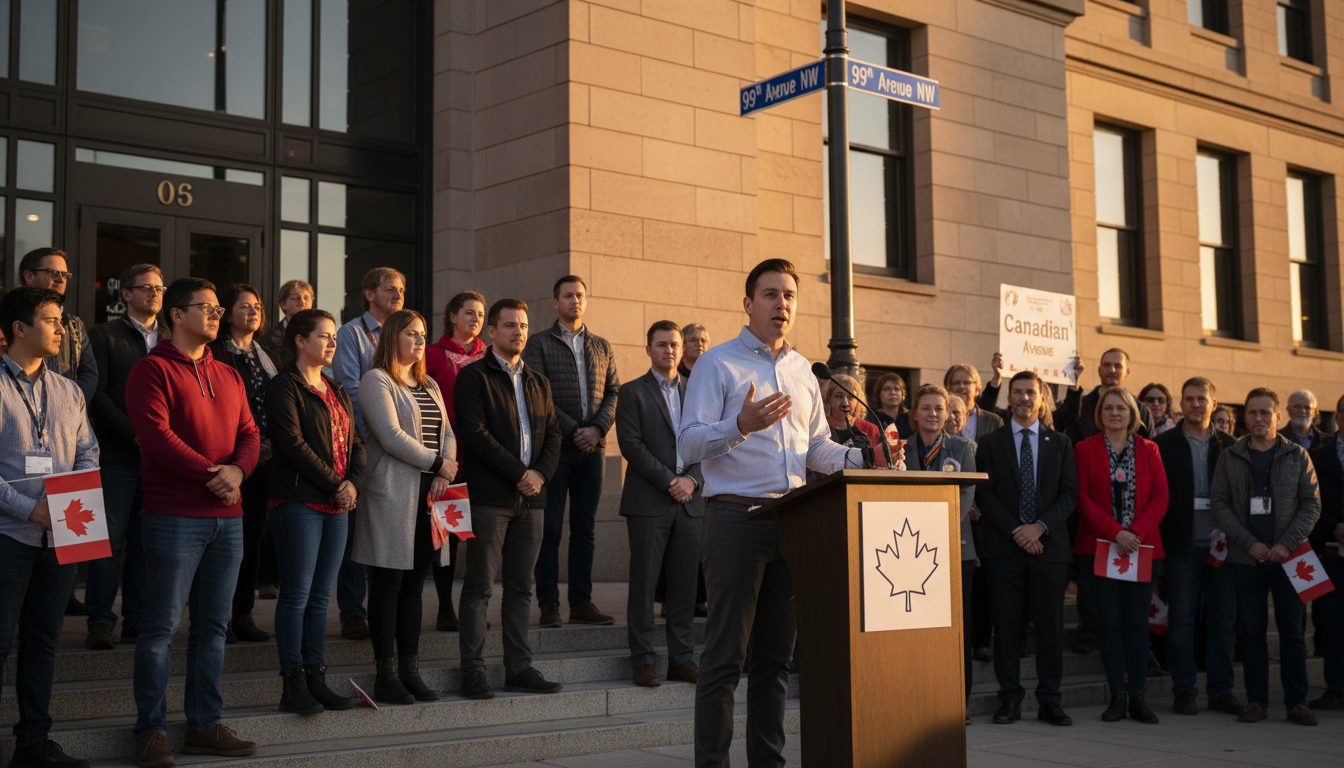
Edmonton councillor seeks to rename 99th Avenue “Forever Canadian Avenue” beside legislature
Edmonton councillor Michael Janz has applied to rename 99th Avenue “Forever Canadian Avenue,” proposing a Canada-themed sign near the legislature ahead of July celebrations.
Coun. Michael Janz announced Sunday that he will submit an application to Edmonton’s Naming Committee to change the name of the stretch of 99th Avenue that runs alongside the Alberta legislature to Forever Canadian Avenue. The move, he said, aims to recognize a province-wide petition supporting Alberta’s continued place within Canada and to create a patriotic landmark for visitors to the legislature grounds. Janz told reporters the proposed renaming is intended to greet school groups, tourists and residents who come to learn about Alberta’s role in Confederation. He said he hopes to have the street in place in time for Canada Day celebrations in July.
Councillor Michael Janz files formal renaming application
Coun. Michael Janz confirmed he will submit the formal paperwork to the city’s Naming Committee in the coming days. He said the request covers the segment of 99th Avenue that borders the legislature grounds in downtown Edmonton. Janz described the proposal as non-partisan, focused on marking a civic moment rather than endorsing any single political actor. He expressed a desire to see visible red-and-white signage that celebrates Albertans who signed a petition affirming their wish for Alberta to remain part of Canada.
The councillor framed the renaming as a local response to a larger public conversation that has been unfolding across the province. Janz said many constituents had asked him to find a way to commemorate the petition and the public support it attracted. He argued the name would be a civic amenity for visitors to the legislature, noting the area’s frequent use by school groups, tour buses and public events. The application will now move through the municipal naming process, which includes review and public consultation before any change is approved.
Location of the proposed Forever Canadian Avenue and its public role
The stretch of 99th Avenue in question runs east-to-west directly adjacent to the Legislative Assembly of Alberta, placing the proposed Forever Canadian Avenue at the heart of provincial government activity. That corridor is a common arrival point for educational visits, ceremonial events and tourist itineraries that focus on the legislature and its grounds. Janz emphasized that a commemorative street name in that location would be highly visible to those seeking to learn about Alberta’s institutions and civic life. He said the signage would serve both a symbolic and practical role by marking a place where Albertans expressed a preference to remain within Canada.
City officials will consider the historical, logistical and navigational implications of any renaming, including emergency-service routing and wayfinding for residents and visitors. The municipal Naming Committee typically examines proposed names for compatibility with existing street naming conventions and for potential conflicts before recommending approval to council. Janz acknowledged those procedural constraints and said his office would work with city staff to address technical concerns. He also noted that a localized street name change would not alter property addresses outside the immediate municipal blocks adjacent to the legislature.
Background: the petition that inspired the renaming push
The renaming proposal is tied to a pro-federal petition known as “Forever Canadian,” which collected hundreds of thousands of signatures and was verified by election officials last December. Supporters of the petition framed it as a demonstration that many Albertans want their province to remain part of Canada and to have that position recognized publicly. Janz told media his office had received inquiries from constituents who signed the petition and volunteered to collect signatures, and he described the petition’s support as a motivating factor for the street-name application.
While supporters portray the petition as an expression of widespread federalist sentiment, opponents of the renaming say the topic is politically charged and could deepen divisions at a time of heightened debate over Alberta’s relationship with Ottawa. The municipal naming process does not evaluate the political merits of a position, but city councillors and public input can influence whether a proposed name is seen as appropriate for a public thoroughfare. Janz has sought to foreground the civic and commemorative aspects of the proposal rather than its political context, citing the desire to create a place of recognition for visitors and residents alike.
Judicial ruling and legal context surrounding separation petitions
The renaming push comes after a court decision that dismissed a separate separatist group’s petition seeking a provincial referendum on independence. A judge ruled that the petition issued by the Stay Free Alberta group should not have been authorized under the provincial referendum law as amended by the current government. The court also found that the province failed to fulfill its duty to consult Indigenous governments in the process, raising questions about the legal path for any provincial referendum on constitutional matters. Those findings have reshaped the immediate legal landscape and prompted statements from both separatist organizers and provincial officials.
Stay Free Alberta and other groups have said they plan to appeal the ruling, creating ongoing legal uncertainty about how questions of provincial separation could be put to voters. The judicial decision does not directly affect a municipal street renaming, but it has widened public attention on expressions of provincial identity and on how political movements seek legitimacy through petitions and referendums. Municipal leaders and residents have responded in varied ways, with some calling for civic commemoration of federalist sentiment and others urging caution in formalizing politically resonant names on public infrastructure.
Premier Danielle Smith’s stance and the provincial political debate
Premier Danielle Smith has publicly said she supports a stronger or more sovereign Alberta within the framework of Canada while also acknowledging widespread frustration in the province with federal policies. Her government made changes to provincial referendum laws earlier in the mandate, a move that became a central issue in the court’s decision regarding the separatist petition. Smith and her allies argue that Albertans deserve a voice on the province’s future and have defended procedural changes intended to facilitate public engagement. Critics contend those same changes have complicated legal standards and raised concerns about proper consultation, including with Indigenous communities.
After the judge’s ruling, both the premier’s office and the groups behind separation efforts indicated they would pursue appeals. The appeals process is expected to be closely watched in Edmonton and Ottawa because it will test how provincial laws interact with constitutional and procedural requirements for referenda on matters that touch Canada’s constitutional order. The political back-and-forth has prompted civic leaders in Edmonton to respond with measures of their own, including initiatives to highlight federalist sentiment and to reaffirm municipal commitments to unity within Canada.
Economic and community concerns cited by proponents of the renaming
Coun. Janz has framed the renaming proposal in part as a response to economic anxiety sparked by the separatist debate. He warned that prolonged uncertainty over Alberta’s political future could deter investment and undermine job growth in Edmonton and across the province. Local business leaders and chambers of commerce have in past months expressed concern that political instability could dim investor confidence and complicate long-term planning. Janz argued a visible affirmation of Alberta’s place in Canada would help counter those perceptions and reassure residents and investors of the city’s commitment to national ties.
Not all civic stakeholders agree on the renaming’s economic logic, and some community members worry that attaching political symbolism to public infrastructure could alienate portions of the population. Advocates of the proposal insist the name Forever Canadian Avenue would be inclusive, celebrating Albertans who signed a petition to remain in the country rather than attacking those who hold different views. Janz said the intention is to foster civic unity and provide a positive focal point for Canada Day activities, educational visits and public gatherings on the legislature grounds.
Next steps: municipal review, public input and Canada Day timeline
Following the submission of a naming application, Edmonton’s Naming Committee and city staff will review the proposal for compliance with municipal policies and technical considerations. The review process typically includes checks for duplicate names, potential conflicts with emergency routing, consultation with impacted stakeholders and an opportunity for public comment. If the committee recommends approval, the matter goes to city council for a final decision, which can be influenced by community feedback and political considerations. Janz acknowledged the timeline is tight but said his office will press for an expedited review to have the signage in place for Canada Day.
Officials have not yet released a specific schedule for the Naming Committee’s deliberations in this case, and city staff will need to confirm whether the proposed timeline is achievable. Any renaming that affects addresses or municipal services could require additional administrative coordination, although Janz’s proposal focuses on the legislative frontage and would have limited impact on private addresses. Should the council approve the change, plans for unveiling and Canada Day programming would be developed in partnership with provincial and municipal event planners.
Final paragraph: The naming proposal has injected a local municipal process into a broader provincial debate about identity and democratic engagement. Whether Forever Canadian Avenue is approved, delayed or amended, the application underscores how symbolic acts at the city level can become focal points for larger political conversations. Edmonton’s Naming Committee and city council will now balance procedural requirements, public sentiment and civic values as they weigh a request that aims to celebrate a constituency’s attachment to Canada.
