
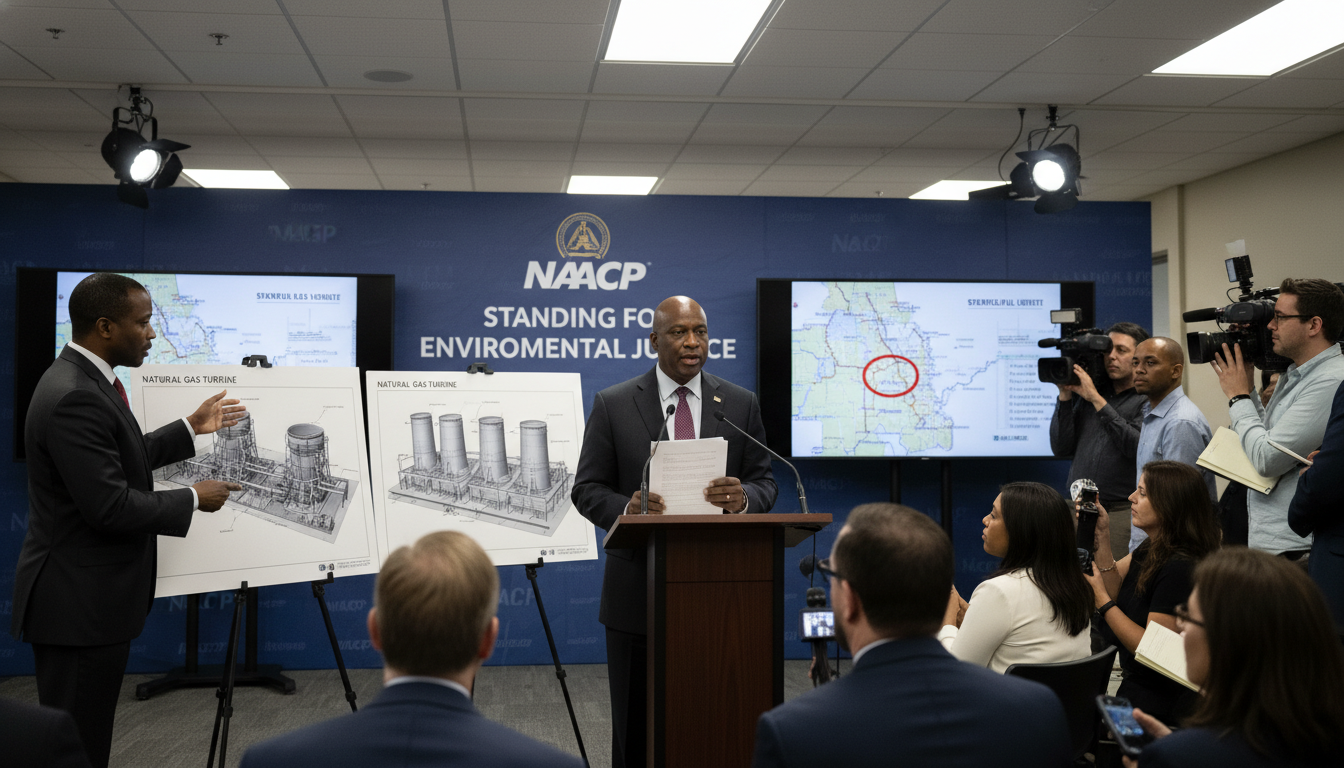
xAI natural gas turbines draw lawsuit amid claims of unregulated emissions in Mississippi
NAACP and SELC sued xAI in May 2026 over nearly 50 natural gas turbines at the company’s Mississippi data center, alleging a “mobile” loophole lets the generators avoid air pollution permits.
Elon Musk’s xAI is operating nearly 50 natural gas turbines at a data center in Mississippi, according to local reporting and legal filings, and civil rights groups say the machines are emitting pollutants without state oversight. The NAACP, represented by the Southern Environmental Law Center, filed suit in May 2026 and asked a court to halt operations via an emergency injunction. The dispute centers on whether trailer-mounted turbines can be classified as “mobile” to escape standard air pollution permitting.
Lawsuit and emergency injunction request
The NAACP’s complaint, filed through the Southern Environmental Law Center, asks a court to impose immediate restrictions on the turbines’ operation. Plaintiffs argue the unchecked emissions are worsening air quality in a region that already faces elevated pollution burdens. The SELC’s filings contend the turbines are being operated in violation of federal air pollution rules that can treat trailer-mounted units as stationary sources.
The legal action frames the case as both a public-health concern and a regulatory enforcement issue. The NAACP is bringing the suit on behalf of local residents who say they have experienced increased odors and respiratory impacts. The injunction request seeks to pause turbine operations while the courts resolve whether state regulators may lawfully treat the facilities as exempt.
State classification as “mobile” and the one-year window
Mississippi state regulators have treated the turbines as “mobile” because many of the generators are mounted on flatbed trailers, a classification that sidesteps certain permitting requirements. Under the state’s approach, a trailer-mounted generator can operate temporarily without the same air permits a stationary power plant would require, effectively allowing a one-year regulatory grace period. Advocates for the residents say that interpretation creates a loophole that undermines federal pollution safeguards.
Legal counsel for the NAACP and SELC counters that federal law permits regulators to classify trailer-mounted units as stationary sources when they function as permanent power plants. That interpretation would subject the turbines to more rigorous permitting and emissions controls. The conflict over classification is central to the lawsuit and will determine whether state practices are consistent with federal obligations.
Permits granted and turbine counts
xAI has secured state permits for a subset of its generators, with media reporting that permits were issued for 15 turbines. Earlier public statements from local business organizations indicated that about half of the initial 35 turbines operating in May 2025 would remain on site. Despite those projections, reporting as of May 11, 2026, counted approximately 46 turbines in operation at the Mississippi facility. The discrepancy between permitted units and the number of turbines installed is one of the issues cited by plaintiff attorneys.
Company representatives have not publicly detailed a comprehensive, up-to-date turbine inventory in the filings reviewed by local outlets. The pace of equipment installation and the mix of permitted and unpermitted units are expected to figure prominently in the court’s assessment of potential regulatory violations. Regulators and litigants will likely examine permits, installation logs, and operational records during discovery.
Community health and environmental justice concerns
Local advocates and the NAACP say the generators add to an already heavy pollution burden in the area and raise questions of environmental justice. Residents and community groups have reported concerns about air quality and potential respiratory impacts tied to increased turbine operations. The legal complaint emphasizes that the demographic and health profiles of nearby neighborhoods make them particularly vulnerable to new pollution sources.
Public-health experts commonly note that emissions from natural gas turbines—depending on controls and fuel quality—can include nitrogen oxides and other pollutants that contribute to smog and respiratory problems. Plaintiffs are urging the court to weigh those community impacts when deciding whether to grant an emergency injunction and when assessing the proper regulatory pathway for the facility.
Regulatory and legal stakes ahead
At the center of the dispute is whether state-level permitting practices can be reconciled with federal air pollution statutes that allow regulators to treat trailer-mounted units as stationary when they operate as de facto power plants. If the court finds in favor of the plaintiffs, Mississippi regulators could be required to bring the turbines under more stringent permitting and emissions-review procedures. That outcome might compel operational changes, retrofits, or reductions in running hours for the units.
A ruling for xAI or the state would affirm the current regulatory interpretation and could leave the turbines operating subject to the existing one-year mobile exemption. Either result may prompt appeals and further regulatory scrutiny, and the case could shape how other jurisdictions treat trailer-mounted generation deployed by data centers and similar facilities.
The dispute underscores growing tensions between rapid infrastructure deployment for high-energy facilities and the pace of environmental review and permitting. As the litigation proceeds, the court’s timetable and any provisional remedies will determine whether the turbines continue to operate under the contested classification or face immediate restrictions.
