
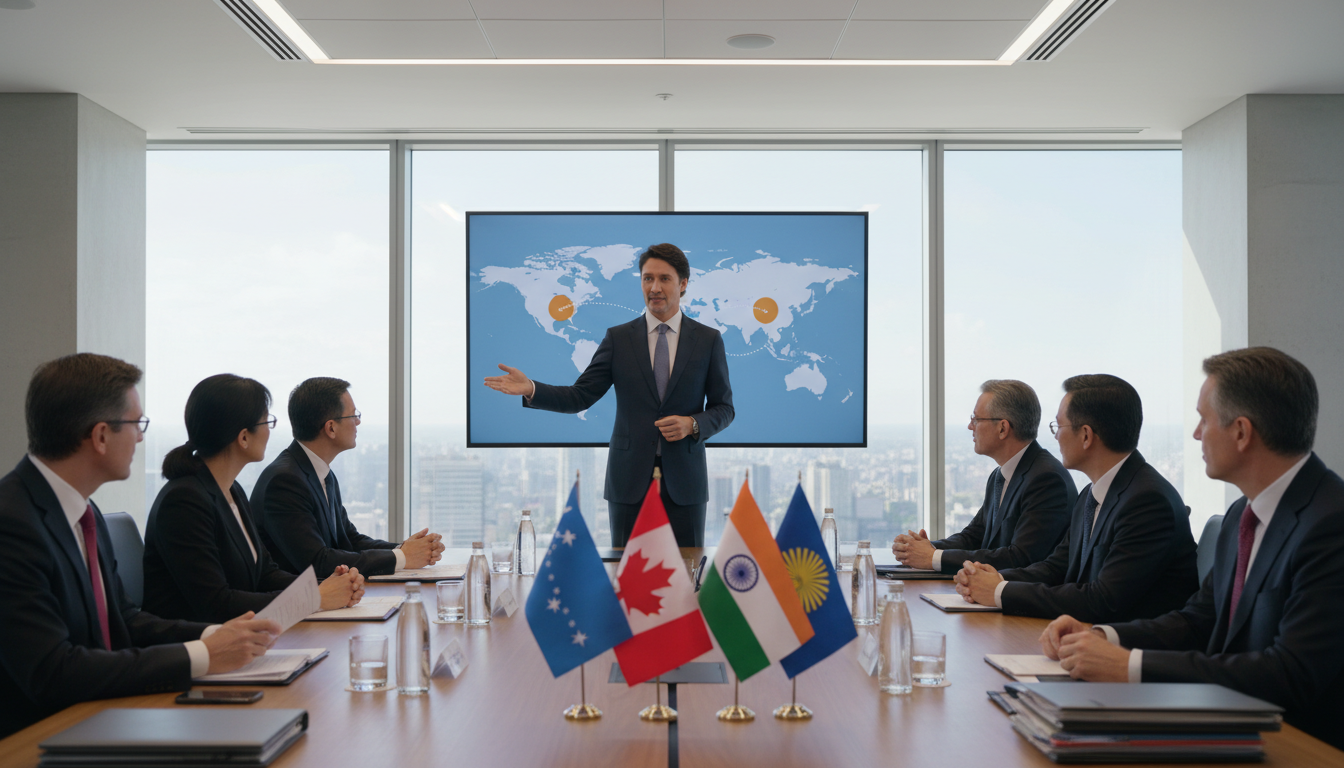
Canada trade agreements: Ottawa aims to seal deals with Mercosur, ASEAN and India this year
Ottawa is racing to finalise three major Canada trade agreements with Mercosur, ASEAN and India in 2026, seeking to diversify exports and attract investment beyond the United States.
Carney government sets ambitious timeline
Prime Minister Mark Carney’s government says it intends to have three major Canada trade agreements in place before the end of the year, targeting Mercosur, the Association of Southeast Asian Nations and India.
International Trade Minister Maninder Sidhu told reporters that Ottawa is dispatching negotiating teams around the world almost weekly as part of an accelerated push to broaden market access.
Sidhu said a Canadian negotiation team travelled to Brazil last week to advance a prospective free-trade pact with Mercosur, the South American bloc that includes Argentina, Brazil, Paraguay and Uruguay.
The minister indicated he is optimistic agreements with India and ASEAN could be concluded within the year, while stressing that Ottawa will seek concrete gains for Canadian workers and firms rather than symbolic signatures.
Mercosur negotiations move forward after Carney-Milei call
Carney and Argentine President Javier Milei recently discussed progress in Canada-Mercosur talks, according to a readout from the prime minister’s office.
The two leaders highlighted momentum in negotiations and explored opportunities to deepen economic ties in mining, critical minerals, energy and broader trade.
Ottawa emphasised Canada’s role as a major mining investor in Argentina and framed the negotiations as a chance to secure supply chains for minerals and energy projects.
Negotiators will need to reconcile tariff, regulatory and rules-of-origin issues across diverse economies before a final deal can be reached.
India visit set to test ambitions
India has emerged as a central pillar of Ottawa’s strategy, with Trade Minister Piyush Goyal scheduled to lead a large delegation to Canada at the end of May.
Sidhu said Prime Minister Narendra Modi is not expected to travel with that delegation, and that the May visit will focus on exploring investment and energy cooperation rather than immediately concluding a treaty.
Canadian officials point to growing Indian interest in energy, uranium and potash, and to long-term Indian forecasts that will require a major expansion of energy supplies.
While Sidhu described the talks as exploratory, he said Canadian negotiators are “ambitious” about the potential outcome and mindful that India has recently struck trade deals with the EU, the U.K. and New Zealand.
ASEAN talks part of broader Indo-Pacific approach
Negotiations with the Association of Southeast Asian Nations form the third pillar of Ottawa’s multilateral push to diversify away from U.S.-centric markets.
Officials say ASEAN discussions will address market access for goods and services, rules on digital trade and protections for investment, reflecting the varied priorities of the bloc’s member states.
The effort is consistent with Prime Minister Carney’s overseas outreach: since taking office in March 2025 he has led 17 foreign trips to 25 countries, including visits to China and India.
Ottawa frames engagement with ASEAN as a strategic complement to ties with India and Mercosur, aimed at bolstering supply-chain resilience and opening new export routes for Canadian producers.
Economic targets and export growth projections
The Liberal government has set a target to double exports beyond the United States over the next decade as part of its trade diversification agenda.
Ottawa’s spring economic update projects that exports of goods and services outside the U.S. rose by about $33 billion in 2025 compared with 2024, a change that Sidhu called “very promising.”
Officials argue that concluding free-trade agreements with large partners will help sustain that momentum, reducing costs for exporters and improving competitiveness abroad.
At the same time, negotiators will face pressure from industry groups and labour representatives to secure provisions on rules-of-origin, dispute resolution and protections for Canadian workers.
Investment, critical minerals and energy in play
Beyond tariff cuts, Canadian ministers are prioritising investment protections and access to critical minerals and energy contracts in talks with Mercosur and India.
Ottawa is pitching Canadian capacity to supply minerals and energy as part of global demand forecasts, noting potential Indian demand for uranium and other resources.
Sidhu has stressed that Ottawa will pursue agreements that deliver “real benefits” for Canadians and not deals concluded for their own sake.
The government plans reciprocal trade missions and business delegations in both directions to convert high-level political momentum into concrete commercial opportunities.
Canada’s negotiating teams now face months of intensive talks on technical rules, procurement, labour standards and investor protections before any final pacts can be signed, and Ottawa acknowledges timelines remain ambitious even as it pushes to meet its year-end objective.
