
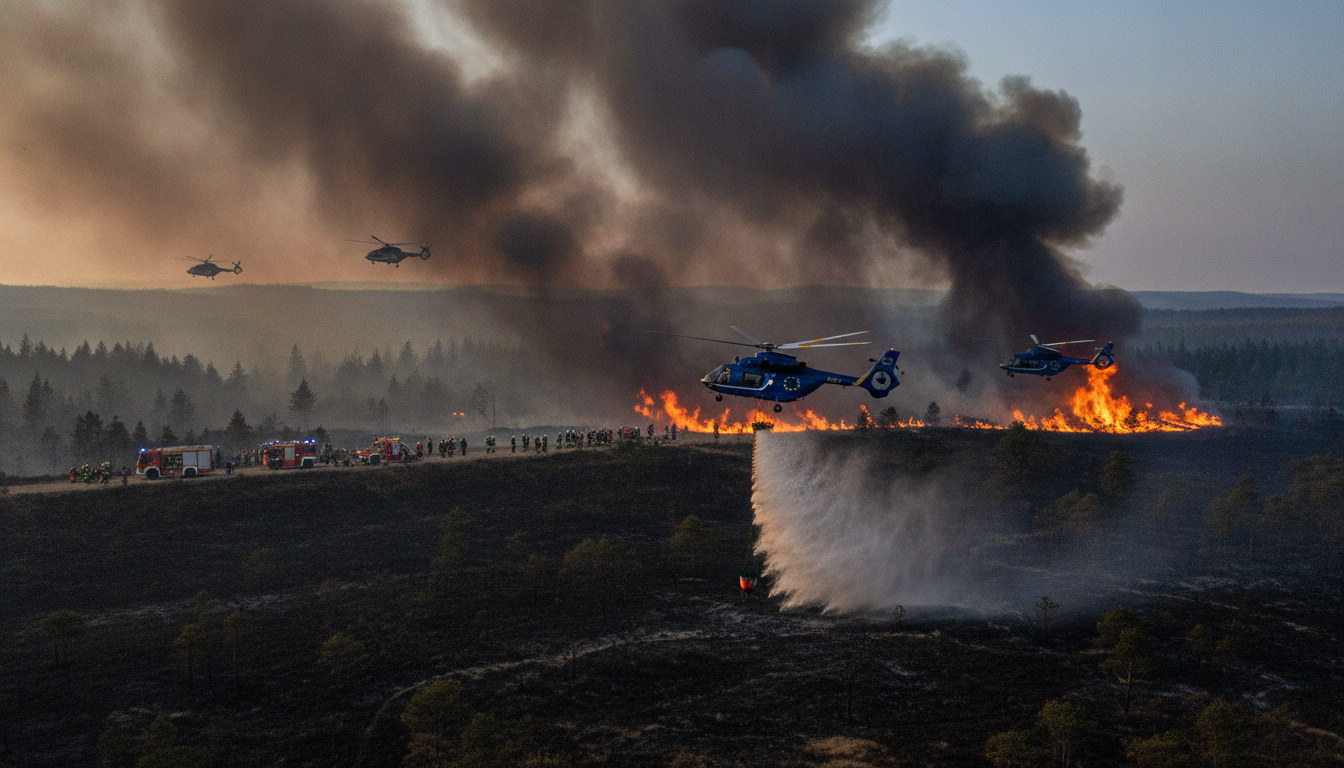
Belgium forest fire devours nearly 3,000 hectares in Hautes Fagnes reserve
Belgium forest fire in Hautes Fagnes has burned about 3,000 hectares; firefighters, farmers and European aircraft battle flames as evacuations and smoke spread.
The largest wildfire in recent Belgian memory swept through the Hautes Fagnes nature reserve on August 15–16, 2026, consuming nearly 3,000 hectares of moorland and forest. Firefighters, local farmers and international aerial reinforcements worked through the weekend to contain multiple active fronts in the rugged, hard-to-reach terrain. The blaze has prompted evacuations in nearby villages and sent a smoke plume that was detected more than 100 kilometres away.
Fire consumes nearly 3,000 hectares in Hautes Fagnes
The fire erupted in the eastern highlands near Waimes and quickly spread across the protected Hautes Fagnes area, a landscape prized by hikers and valued for its biodiversity. Authorities described the scale as one of the worst in the country’s recent history, comparing it to a major blaze recorded in 1911 that also devastated the region. Multiple pockets of flame remained active into Sunday as crews sought to prevent new flare-ups driven by shifting winds.
Local officials said no homes had been destroyed, but several villages were evacuated as a precaution and cross-border authorities in nearby Monschau, Germany, urged residents close to the frontier to leave. The smoke carried by the plume produced yellowish skies over parts of the region and caused air quality alerts in areas downwind.
Evacuations, smoke and air quality impacts
Emergency services ordered residents from two villages closest to the fire to evacuate while setting up reception centres for displaced people and livestock. Authorities reported that the scent of smoke reached Namur, more than 100 kilometres away, and that French officials in the Moselle department activated an air-pollution alert procedure. So far there have been no confirmed civilian fatalities linked to the Hautes Fagnes blaze.
Public-health agencies warned vulnerable groups to avoid outdoor activity in affected zones and to follow instructions from local emergency services. Road and trail closures around the reserve restricted access for tourists and complicated logistics for crews supplying water and equipment to the front lines.
Firefighters and local farmers mount ground response
More than a hundred firefighters from across Belgium and neighbouring Germany rotated on the scene, supported by modern fire engines and mobile pumps. Local farmers played a key role by bringing tractors to fill and carry water; a hotelier near Lake Robertville told AFP that about a dozen tractors queued to refuel and that farmers had moved cattle and opened gates to provide access to a strategic water source. Those community efforts supplemented formal rescue operations and helped sustain the continuous flow of resources needed to fight the blaze.
Crews concentrated on holding containment lines and preventing the flames from reaching populated areas and critical infrastructure. Officials emphasised the gruelling nature of the work on steep, uneven ground where conventional close-attack firefighting is often impossible.
Aerial reinforcements from the Netherlands and Sweden
Belgium deployed its own helicopter fleet and activated the European Civil Protection Mechanism to secure additional air support. Through the mechanism, the country received helicopters from the Netherlands, Chinook helicopters, and water-bombing aircraft from Sweden, which joined Belgian police helicopters in coordinated water drops. European Commissioner Hadja Lahbib sent a liaison to the scene to help coordinate the aerial response and reduce the risk of operational accidents during complex multi-aircraft operations.
Prime Minister Bart De Wever publicly thanked international partners for rapid assistance as authorities emphasised the importance of carefully choreographed flights to avoid midair incidents. Officials said aerial assets were expected to be crucial in dousing hotspots located in the most inaccessible sectors of the reserve.
Terrain, winds and unknown ignition complicate efforts
The topography of the Hautes Fagnes — a mosaic of peatland, forest and steep ravines — prevented teams from mounting a uniform ground assault and made some burned patches unreachable. Fire managers said wind direction was variable and capable of producing new, unpredictable fire fronts, complicating suppression tactics. The initial ignition point remained under investigation, and because crews could not safely access the earliest burned areas, the cause could not be definitively determined.
Authorities cautioned that heat and recent drought had left vegetation unusually dry and receptive to rapid spread, and they urged the public to avoid activities that could spark new blazes while the region remained vulnerable.
Wildfire outbreak grips Europe amid heat and drought
The Hautes Fagnes fire came amid a broader wave of summer wildfires across Europe after several days of intense heat. In Spain, firefighters battled a major blaze in Aragon that had reached more than 16,000 hectares and threatened historic monastic sites, while Andalusian authorities announced the containment of a separate fire that had scorched more than 25,000 hectares. French and Greek services also reported active incidents in the Landes and on islands including Salamina and Skyros, where emergency operations included mass evacuations and, in some cases, reported fatalities.
European emergency services have noted a surge in demand for mutual assistance and increased pressure on firefighting aircraft and crews, prompting cross-border deployments and heightened coordination under EU civil-protection arrangements.
Recovery and assessment efforts in the Hautes Fagnes are expected to continue in the coming days as teams monitor smouldering areas and prepare for cooler, wetter conditions that would aid containment. Local officials urged residents to follow safety directives and remain prepared for further developments as investigators work to determine how the fire began.
