
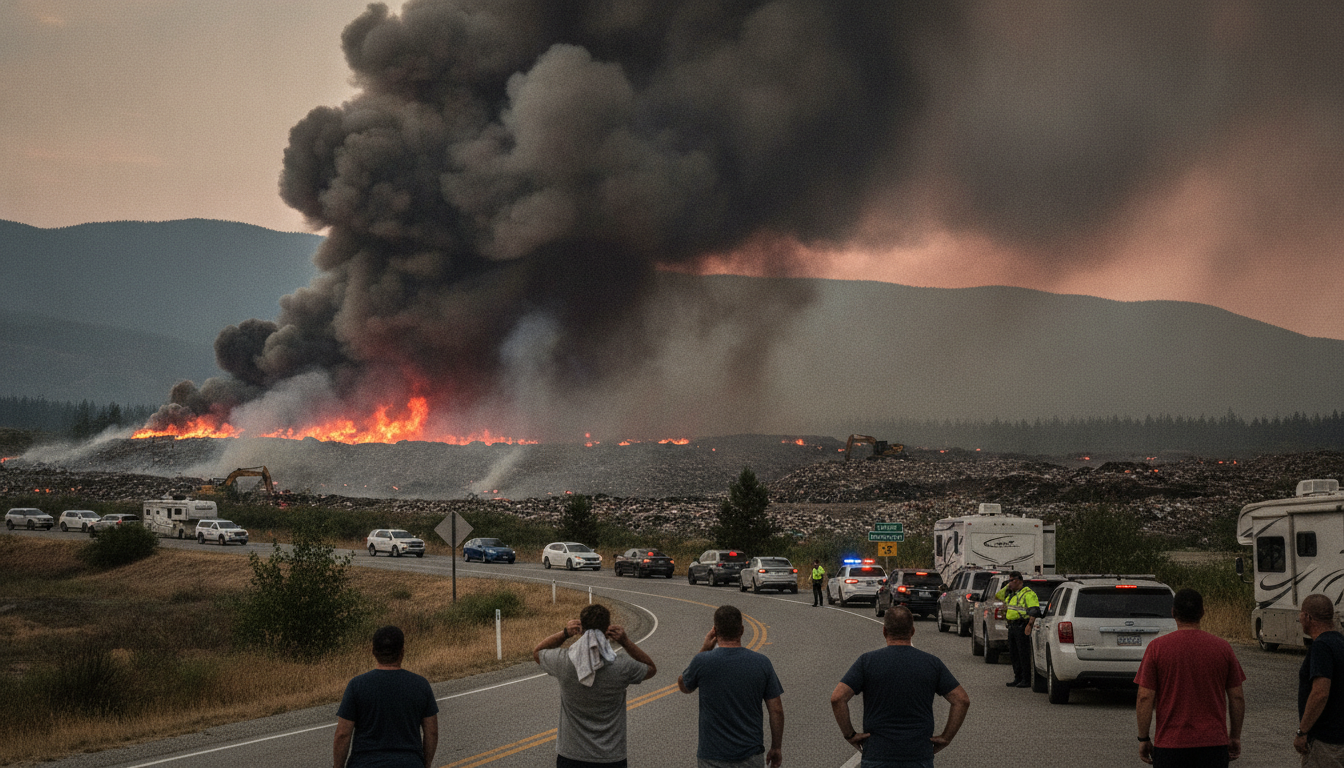
Summerland landfill fire sends toxic smoke over Okanagan, delaying evacuee returns
Summerland landfill fire sends toxic smoke across the Okanagan; municipal crews tackle hazardous emissions while provincial teams fight nearby forest blazes.
The Summerland landfill fire, burning roughly six kilometres west of town, is producing chemically charged smoke that is complicating efforts to allow evacuated residents to return home. Provincial wildfire crews say their protective gear is designed for vegetation fires and lacks the self-contained breathing apparatus needed to address burning household waste and industrial materials. Municipal firefighters, equipped and trained for hazardous emissions, have taken the lead at the dump while BC Wildfire concentrates on forest fire lines. Local officials say the combination of toxic smoke and infrastructure checks means any timeline for re-entry remains uncertain.
Fire scene and operational roles
BC Wildfire officials report that crews are prioritizing active forest lines while municipal fire departments handle the landfill blaze and its hazardous plumes. Spokespeople have explained that the smoke from the landfill is “non-vegetative,” generated by plastics, appliances and other synthetic materials, and therefore presents chemical risks outside the remit of typical wildfire operations. Cliff Chapman of BC Wildfire has described a division of labour: provincial teams suppress wildland fire behaviour and local firefighters, who carry appropriate respirators and hazardous-materials training, manage the dump incident. That split has left the landfill as a focal point for local response and public concern.
Limitations of provincial wildfire equipment
BC Wildfire’s personal protective equipment is optimized for open-vegetation blazes and does not include self-contained breathing apparatuses used for chemical exposures. As a result, provincial crews cannot safely enter the landfill site to extinguish or cool burning waste that emits toxic gases. Those operational limits force reliance on municipal departments that maintain hazardous-materials capabilities, creating a resource and coordination challenge when multiple incidents occur simultaneously. The situation highlights how different types of fires require distinct protective gear and technical training, and how jurisdictions must coordinate when incidents overlap.
Health risks from burning landfill contents
Public-health experts warn that combustion of buried and modern household waste can produce a complex mixture of fine particulates, heavy metals and carcinogenic compounds. Dr. Tim Takaro, an environmental-health specialist, says incomplete combustion at lower temperatures — common in landfill fires — can increase production of highly toxic emissions compared with typical forest fires. Older buried wastes deposited before hazardous-waste standards were in place raise additional concerns about unknown chemicals being released. Those pollutants can irritate and inflame airways, carry long-range health risks, and disproportionately impact children, the elderly and people with pre-existing respiratory conditions.
Air monitoring and interagency coordination
Regional emergency-management officials say they are working with the provincial Ministry of Health and the Ministry of the Environment to deploy air-quality monitoring and hazardous-materials detection around the site. Kevin Dunbar of Emergency Management BC described a coordinated effort to take real-time air samples and to “detect any release of dangerous substances” that would influence public-safety decisions. Dr. Takaro and other specialists stress the need for immediate, continuous sampling so that authorities can characterize gases and particulates before allowing residents to return. Health authorities have also been briefed to watch for and treat symptoms consistent with chemical exposure.
Evacuations, infrastructure checks and waste-collection questions
Mayor Doug Holmes and municipal leaders emphasize that return decisions will depend not only on air quality but also on safety inspections of roads, utilities and buildings affected by smoke and fire operations. Officials say they must also resolve practical issues such as where to divert or process household waste if the landfill remains unsafe for regular operations. The unpredictability of the landfill’s behaviour, combined with ongoing forest-fire pressure in surrounding areas, makes short-term planning difficult for emergency managers and for the hundreds of residents awaiting word on when they can go home. Local authorities are maintaining evacuation centres and information lines while contingency plans are refined.
Local and provincial crews continue to coordinate shifts, resources and monitoring as conditions evolve, and residents are being urged to follow official advisories. The Summerland landfill fire has introduced a complex public-health and logistical dimension to the region’s wildfire response, and officials caution that it may take time to fully assess long-term impacts from smoke and potential chemical releases.
