
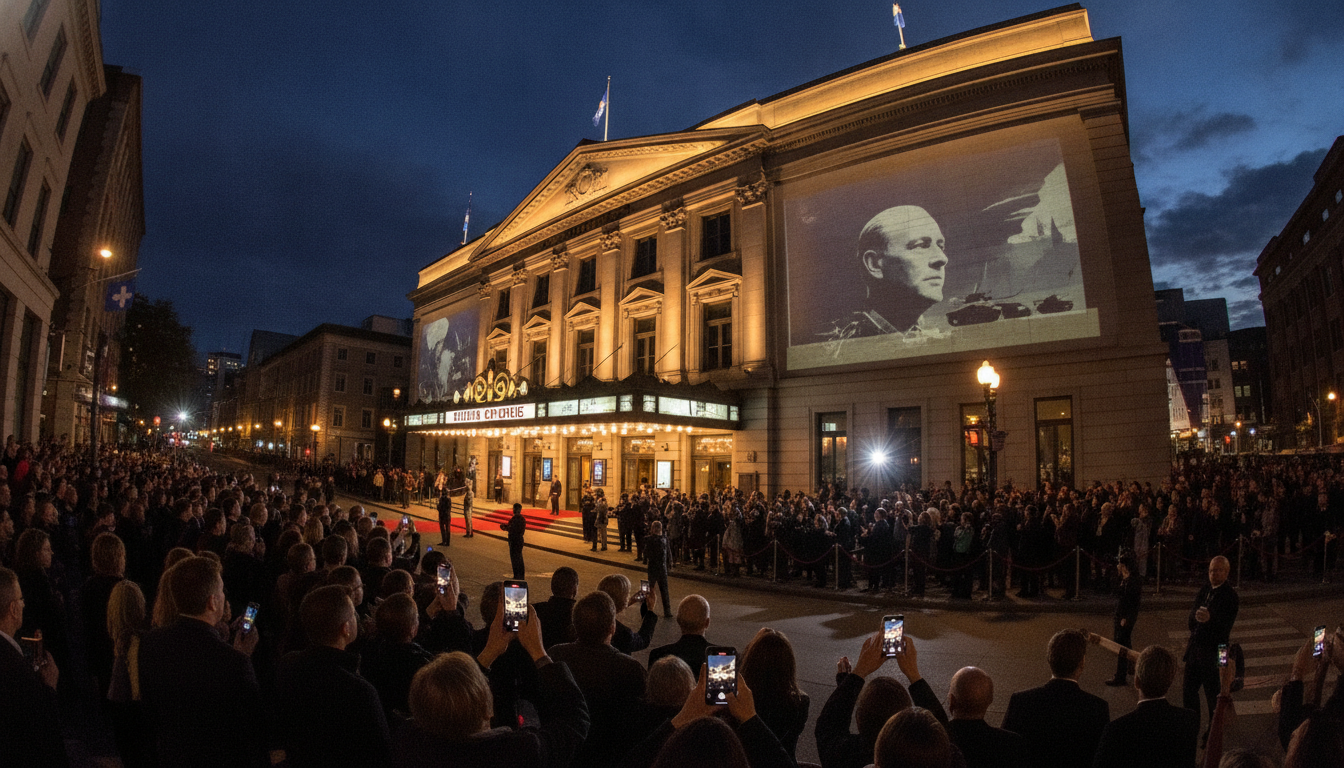
La bataille de Gaulle opens in Quebec with ambitious two-part portrait of the young Charles de Gaulle
La bataille de Gaulle opens in Quebec, tracing Charles de Gaulle’s rise in WWII. The two-part film stars Simon Abkarian and large-scale battle scenes.
The new historical film La bataille de Gaulle: résistance, which opens in Quebec this Friday, presents a sweeping dramatization of Charles de Gaulle’s improbable ascent during the early years of the Second World War. The film places the keyword La bataille de Gaulle at the center of a two-part cinematic project that tracks the period from 1940 to 1942 and sets a high bar for historical recreations. Audiences will see a portrait of a commander who was, at the time, little known to the public but determined to resist occupation.
Opening sequence recreates the Montcornet engagement
The picture opens with a high-stakes sequence near Montcornet that establishes both tone and character, staging a lone car driving directly toward a German tank in an apparently suicidal maneuver. That scene works as shorthand for the film’s thesis: de Gaulle’s audacity was as much a product of necessity as of temperament. The sequence is constructed to convey danger and spectacle while introducing viewers to a leader acting against overwhelming odds.
Director Antonin Baudry frames de Gaulle’s determination as near-madness
Director Antonin Baudry, who co-wrote the screenplay with Bérénice Vila, argues that what propelled de Gaulle was a kind of necessary madness rather than conventional certainty. Baudry and his writers emphasize how isolated de Gaulle was in 1940 — lacking an army, virtually unknown to the French public, and confronted with political opponents who viewed his stance with skepticism. That framing underpins many of the film’s dramatic confrontations and helps explain why the director chose such intimate staging amid vast battle set pieces.
A two-part production built on extensive reconstruction
La bataille de Gaulle is the first instalment of a two-part diptych that covers the early and formative years of de Gaulle’s leadership. The full project reportedly carries an estimated combined budget of 75 million euros, a figure the filmmakers used to stage hundreds of sets and elaborate battle sequences across multiple countries. The production involved more than 190 distinct sets and roughly 150 characters, a scale that allowed the filmmaking team to alternate between close human detail and large troop movements.
The screenplay draws on Julian T. Jackson’s biography De Gaulle: une certaine idée de la France as a foundational text, while adapting events for cinematic rhythm. The film’s scope — with location shoots in several countries and an extended roster of extras — seeks to balance historical fidelity with the demands of a near-three-hour theatrical runtime.
Simon Abkarian portrays an uncommon de Gaulle
Simon Abkarian takes on the role of Charles de Gaulle, channeling the general’s physical presence and formal austerity rather than a facile likeness. Abkarian and the director worked to reproduce de Gaulle’s measured gestures, rigid posture and the sense that he often seemed to regard the present as if through the lens of history. The performance aims less for imitation than for inhabiting a mind driven by honor and an almost solitary sense of mission.
Colleagues in the cast include a portrayal of Winston Churchill that provides a counterpoint to de Gaulle’s isolation, and the film explores the frequent misunderstandings between the free French leader and Britain’s political establishment. Abkarian’s depiction highlights how attributes sometimes read as eccentricity — a distanced gaze, formal restraint — also functioned as political armor during a period of intense uncertainty.
The film foregrounds lesser-known resistance acts and young activists
Beyond the figure of de Gaulle, the film deliberately brings forward episodes of resistance that are rarely central in mass narratives, including public student acts of defiance in 1940. Writers and historians involved in the project wanted to underscore the role of youth and lesser-known militants, portraying characters such as Fernand Bonnier de La Chapelle alongside more familiar military leaders. These vignettes are used to argue that collective action — often beginning with small, seemingly futile gestures — was decisive in altering the course of events.
Director Baudry has said his research uncovered stories that had been obscured over time, and the screenplay integrates those episodes to broaden the film’s historical aperture. The result is a narrative that alternates between high-level strategic debates and intimate scenes of fledgling resistance, suggesting how individual choices aggregated into wider movements.
Release timetable and expectations for the diptych
The first part, La bataille de Gaulle: résistance, opens in Quebec this Friday, with its second installment scheduled to arrive on September 11. The staggered release allows audiences to absorb a complex arc that the filmmakers intend to complete with the follow-up. Industry observers will be watching box-office performance and critical response to assess whether the film’s scale and historical ambition translate into broader popular impact.
Producers have signaled that the two-part structure was chosen to preserve narrative depth while delivering the cinematic spectacle expected of an epic historical drama. Early promotional materials emphasize both the intimate portrait of leadership and the logistical achievement of staging extended battle sequences.
The film’s broader message, as articulated by its creative team, is not only about one man’s rise but about collective resolve in the face of adversity. Baudry and his collaborators frame de Gaulle’s role as catalytic — one voice that helped galvanize a dispersed and youthful resistance.
The film’s arrival in Quebec adds a Canadian chapter to the international conversation about wartime memory and cinematic representation, offering local audiences a chance to see a major European historical production in the provinces. As La bataille de Gaulle reaches theatres, viewers will judge whether its blend of spectacle, scholarship and performance yields a definitive screen portrait of one of the 20th century’s most consequential figures.
