
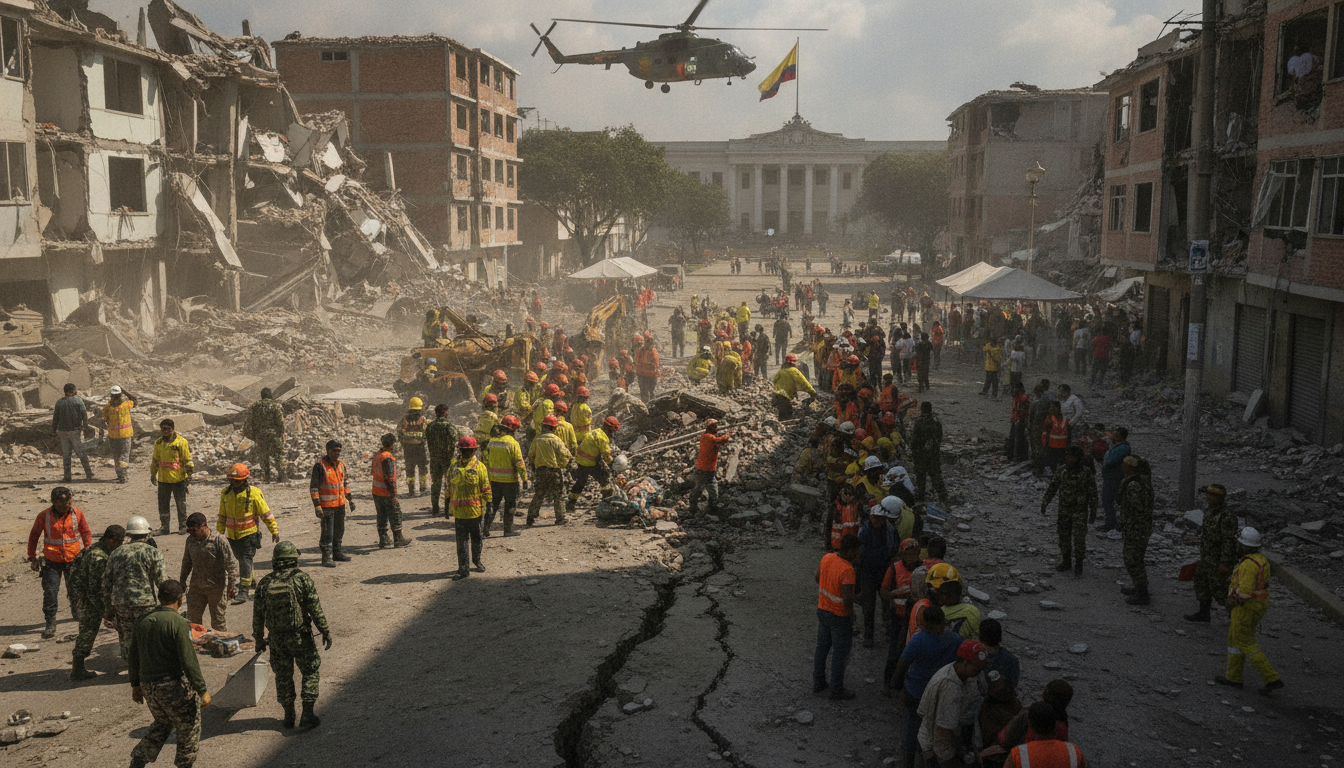
Colombia earthquake kills at least 169, leaves hundreds injured as rescue teams search for survivors
Colombian earthquake on August 10, 2026, left at least 169 dead and more than 600 injured, triggering a state of emergency and widespread international aid.
The Colombia earthquake that struck in the early hours of Monday, August 10, 2026, wreaked heavy damage across the Pacific and Andean regions, killing at least 169 people and injuring more than 600. The magnitude 7.4 quake had its epicentre near San José del Palmar in the poor Chocó department and sent panicked residents into the streets as buildings collapsed across several cities. Authorities and volunteer rescuers worked through the night and into Tuesday clearing rubble by hand in search of survivors while emergency services established triage and shelter operations.
Death toll, injuries and damaged buildings
Official tallies released on Tuesday put the confirmed death toll at 169, with over 600 people reported injured across multiple departments. Municipal authorities reported more than 165 buildings destroyed, including residential blocks, churches and commercial properties in severely affected cities. Local officials warned the casualty figure may rise as crews reach isolated neighbourhoods and stabilize precarious structures.
Search and rescue operations continue
Professional rescue teams and thousands of volunteers formed human chains to sift through concrete and twisted metal, often relying on basic tools, flashlights and sheer manpower. In several cases, rescuers worked into the night at collapsed apartment sites, guided by the hope of finding survivors trapped under rubble. Emergency responders called for additional flashlights, protective eyewear and medical supplies to sustain prolonged search efforts amid heavy dust and unstable debris.
Cities hardest hit and local reactions
Cali, Pereira and Manizales in the southwest coffee-growing region, along with Quibdó, the capital of Chocó, reported the most significant destruction and human loss. Witnesses described scenes of shock and confusion: people ran into streets in nightwear, utility poles swayed and pieces of facades crumbled onto sidewalks. In Manizales, one of the cathedral towers partially detached, underscoring the vulnerability of older structures to severe tremors.
Transport disruptions and airport suspensions
Authorities temporarily suspended operations at seven airports as inspectors assessed runway and terminal damage and checked navigation systems for safety. Road and rail networks also suffered interruptions in some areas, complicating the movement of rescue teams and the delivery of humanitarian aid. Local officials have urged residents to avoid non-essential travel to keep routes clear for emergency vehicles.
Government response and emergency measures
President Abelardo de la Espriella, who took office on August 7, 2026, declared a national state of emergency to mobilize resources and coordinate response efforts across ministries. The declaration allows the government to reallocate funding, deploy military engineers for debris removal and fast-track relief logistics to the worst-affected departments. Municipal officials said temporary shelters and medical posts were being set up to treat the injured and house displaced families.
International aid and messages of solidarity
Countries across Latin America, as well as Israel, Spain and France, offered assistance, while the European Union activated the Copernicus satellite mapping service to help emergency planning and damage assessment. The United States pledged $15.5 million in emergency support, and global figures sent messages of solidarity; Colombian singer Shakira posted words of support for her homeland. Several international football fixtures scheduled in the country were postponed as attention turned to relief operations.
Seismic activity and regional context
Colombian geological authorities recorded at least 47 aftershocks in the hours following the main tremor, keeping residents on edge and complicating rescue work. The quake occurred along the Pacific Rim’s “Ring of Fire,” where the Nazca and Caribbean plates interact with the South American plate, a region prone to large earthquakes and volcanic activity. Seismologists warned that strong aftershocks were likely in the coming days and advised people to stay clear of damaged buildings and slopes at risk of landslides.
Volunteers shared harrowing accounts from the ground, including scenes of families fleeing their homes, people jumping from second-floor windows and frantic calls for help. In one case, a volunteer reported rescuing a wounded baby and family members from the debris of a collapsed five-storey block, an example of the urgent human stories emerging from the catastrophe.
Relief agencies and local governments appealed for donations of food, water, medical supplies and emergency lighting, while shelters expanded capacity to accommodate hundreds of displaced residents. Officials also warned of potential secondary hazards, including ruptured gas lines and unstable structures that require controlled demolition to prevent further collapse.
Recovery and reconstruction will be a long-term undertaking for the affected departments, with immediate priorities centred on search-and-rescue, medical care and restoring basic services. The scale of damage has prompted calls for national and international support to fund rebuilding efforts, repair infrastructure and strengthen seismic resilience in vulnerable urban areas.
As rescue teams continue operations across the hardest-hit regions, authorities urged Colombians to follow official instructions, stay informed through verified channels and report missing persons to local emergency centres to assist tracing and reunification efforts.
