
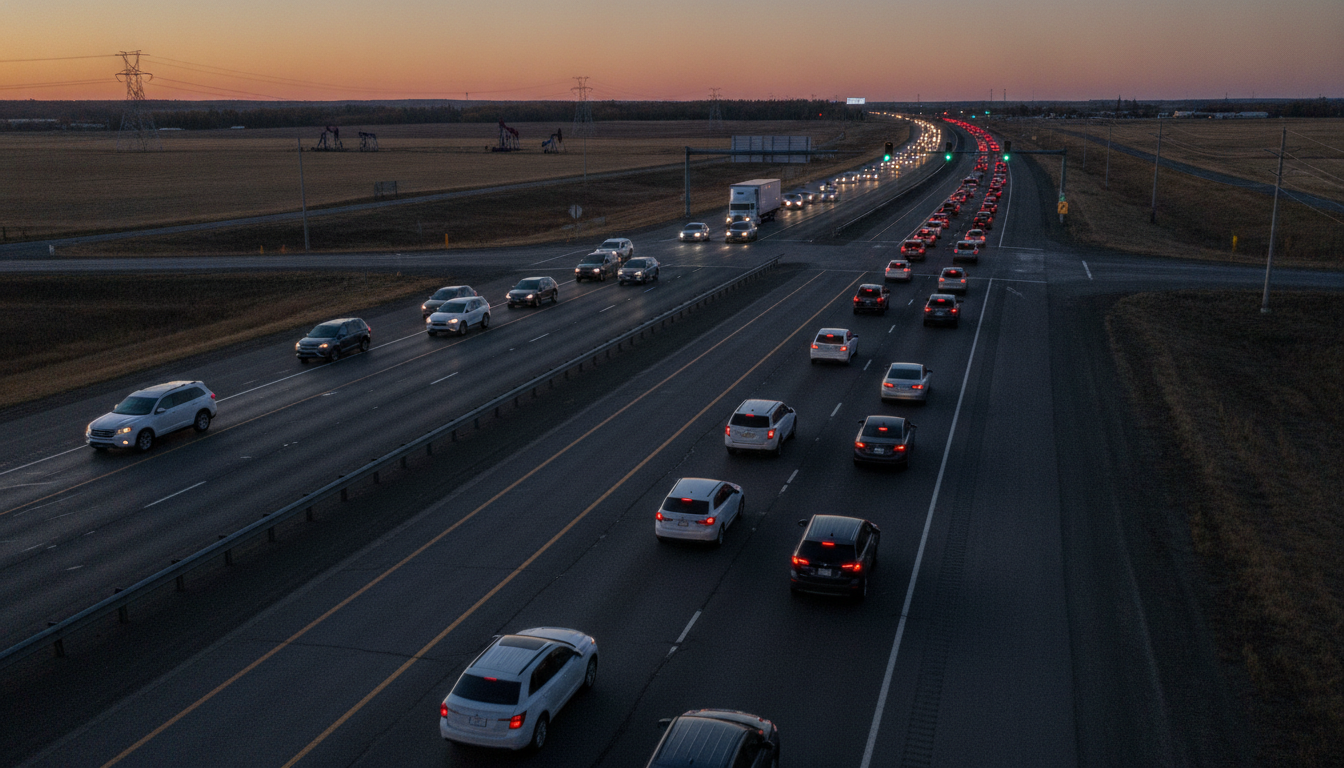
Highway 13–41 intersection draws safety attention as trucks bypass stop sign control
Heavy trucks on Highway 13 and cautious drivers on Highway 41 at the Highway 13–41 intersection raise safety concerns after Sunday observations at the stop sign.
A steady stream of heavy trucks, equipment haulers and tankers passed through the Highway 13–41 intersection on Sunday, while traffic on Highway 41 negotiated a stop sign and flashing red light only after slowing to a cautious crawl. The contrast between the free flow on Highway 13 and the staggered crossing on Highway 41 drew notice from local officials and drivers. Reeve Darryl Motley observed that traffic on Highway 13 routinely travels at speeds around 110 km/h, underscoring the speed differential at the junction.
Traffic patterns at the intersection
Observers reported a near-continuous flow of large commercial vehicles moving along Highway 13, often without significant reduction in speed as they crossed the junction. Those turning or entering from Highway 41 faced five sets of rumble strips, then eased through the stop sign with its small flashing red beacon. The differing volumes and speeds create a situation in which drivers on the lesser road must time their entries carefully to avoid conflict.
The sight of tankers and equipment haulers moving steadily through the crossing highlights how right-of-way on Highway 13 shapes behaviour at the site. Local residents described the movement as a repeated pattern for afternoons and peak usage periods. The result is a persistent imbalance that raises questions about safety margins for smaller vehicles and agricultural equipment attempting to enter or cross Highway 13.
Stop-sign compliance on Highway 41
Drivers on Highway 41 were seen slowing markedly at the stop sign, reacting to rumble strips and the flashing red light before proceeding. The approach from Highway 41 is punctuated by audible cues intended to alert motorists, yet the flow still resembled a cautious, piecemeal crossing rather than a smooth merge. This behaviour suggests drivers prioritize personal judgment of gaps rather than relying solely on the intersection’s control measures.
The small flashing red beacon at the stop sign acts as a supplemental warning but does not alter right-of-way. For many local drivers, the combination of rumble strips and the light produces a careful, yielding posture that contrasts with the steady momentum of Highway 13 traffic. That dynamic contributes to uneven crossing speeds and extended wait times for vehicles on the minor route.
Existing safety features and their limits
Five sets of rumble strips and a flashing red light on the Highway 41 approach are the primary treatments in place to improve driver attention and compliance. Those measures are standard countermeasures used to increase conspicuity of stop-controlled intersections, especially where heavy vehicles are common. In practice, they appear to slow Highway 41 traffic significantly, but they do not change the control status or physical separation at the crossing.
Rumble strips create an acoustic and tactile alert, while the light provides a visual cue during low visibility or when traffic is otherwise inattentive. However, traffic engineers note that treatments like these are most effective when combined with speed-management on the major approach or grade-separated solutions. At this intersection the free-flowing nature of Highway 13 means the existing measures rely heavily on drivers on Highway 41 to yield safely.
Risk factors tied to vehicle mix
The presence of tankers and equipment haulers introduces unique risk factors at the intersection, including longer stopping distances and limited maneuverability for heavy rigs. These vehicles often maintain highway speeds and require more space to slow or stop, which can complicate gap assessments made by drivers on Highway 41. The mixture of passenger cars, agricultural machinery and large commercial transports increases the complexity of safe crossing manoeuvres.
Given the differential in speed and mass, misjudged entries or delayed reactions carry a higher consequence at this junction than on roads with uniform traffic composition. While no specific collisions are reported in the immediate observations, the traffic pattern observed on the Sunday in question illustrates conditions where a small error could produce a serious incident.
Local leadership response and remarks
Reeve Darryl Motley acknowledged the prevailing speeds on Highway 13, saying it is common for drivers to travel at roughly 110 km/h along the route. His comments reflect a municipal recognition of the speed differential and the challenge it poses for motorists attempting to cross from Highway 41. The acknowledgement from local leadership frames the issue as one influenced by existing traffic flow and driver behaviour rather than by a single isolated cause.
Municipal officials and road crews routinely monitor intersections of this type to determine whether additional measures are warranted. Typical next steps in such situations often include compiling traffic counts, speed studies and consultation with provincial highways authorities to evaluate whether upgrades or different control strategies are appropriate.
Possible measures typically considered
Traffic engineers commonly consider a range of options when a stop-controlled intersection shows a persistent mismatch in traffic dynamics. Potential responses include enhanced signage and pavement markings, left- or right-turn lanes to improve staging, speed reduction measures on the major approach, or installing a traffic signal or roundabout where justified by volume and collision history. Each option carries trade-offs in cost, maintenance and driver compliance.
Any decision on upgrades would normally rely on formal data collection to quantify vehicle volumes, speeds and turning movements. Those findings guide whether low-cost countermeasures suffice or if capital investments are needed to address safety and operational concerns at the Highway 13–41 crossing.
The observed pattern of heavy traffic on Highway 13 and cautious, incremental crossings from Highway 41 has drawn attention to this rural junction and underscored the broader challenge of balancing efficient highway movement with safe access for side roads. Continued monitoring, targeted data collection and coordination between municipal and provincial authorities would be the next logical steps to determine if further action is required.
