
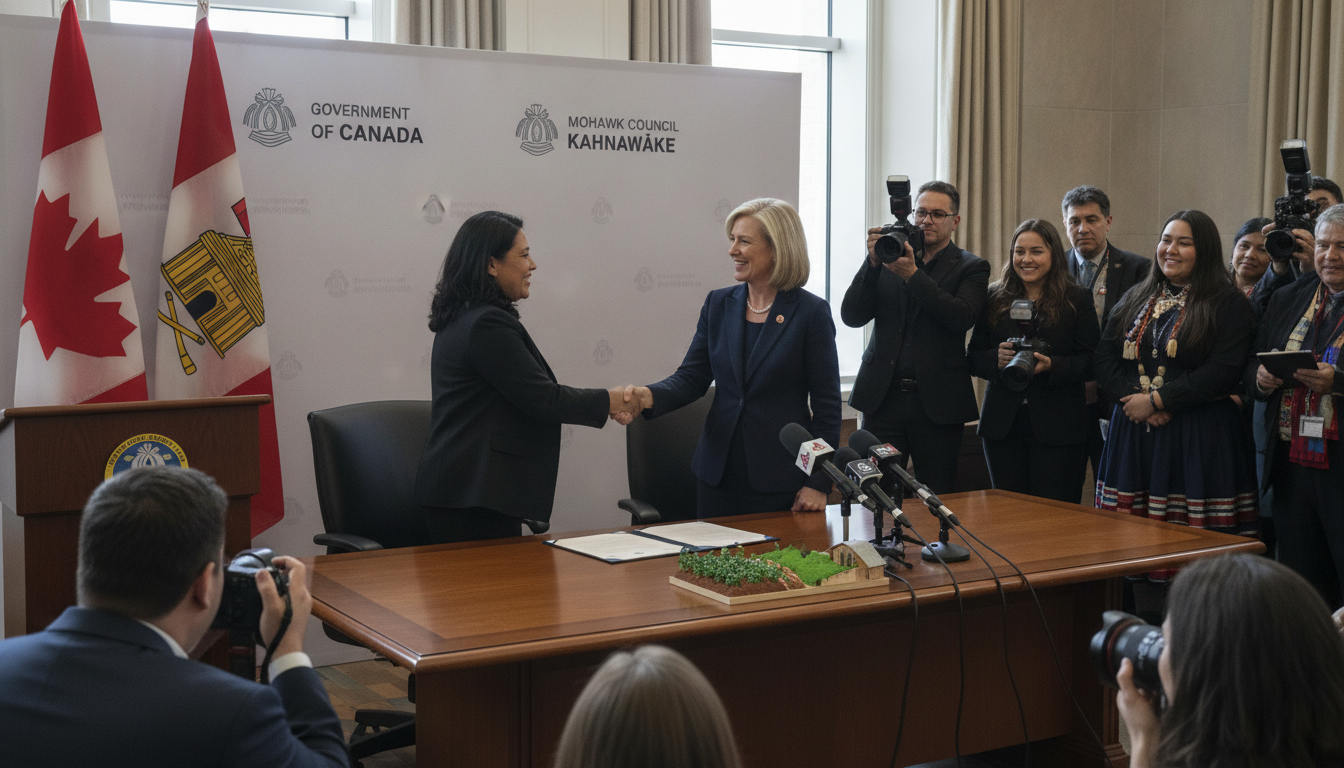
Kahnawà:ke land return advances as Ottawa pledges $1.2M to transfer 162 acres for food sovereignty
Ottawa pledges $1.2 million to clean and transfer 162 acres to Kahnawà:ke — a first step in a 24,000‑acre territorial claim and food‑sovereignty plan.
Kahnawà:ke’s long-running land return effort took a concrete step forward as the federal government announced funding to remediate and transfer a 162‑acre federal site to the Mohawk community. The parcel, located roughly 15 kilometres south of the reserve, is slated to be added to Kahnawake No. 14 through the federal addition‑to‑reserve process, though the transfer has not yet been finalized. Leaders in Kahnawà:ke say the site will be used primarily for agriculture and to strengthen the community’s food sovereignty while remaining a symbol of a much larger 24,000‑acre territorial claim tied to the seigneurie du Sault‑Saint‑Louis.
Transfer of 162 acres moves toward federal addition
The federal government has taken possession of the former communications site and has committed funds for demolition and environmental cleanup. Kahnawà:ke officials say Ottawa’s $1.2‑million pledge covers initial remediation but that the community will manage the project to accelerate work and guard against delays. While the addition‑to‑reserve process is underway, the legal transfer is pending environmental testing, contract awards and final administrative approvals.
The parcel is not part of the 24,000‑acre claim’s tally, Kahnawà:ke leaders emphasize, yet its proximity and size make it strategically important. For the community, securing nearby acreage that can be farmed and connected to the reserve is an early, practical advance in a claim that spans centuries. Officials contend the approach should set a precedent for more timely additions to reserve across Canada.
Contamination, demolition and the $1.2‑million commitment
On site inspections have identified hazardous materials that must be addressed before the land can be used. The abandoned building contains asbestos and lead‑based paint, and there are concerns about a fuel leak that could have contaminated soil, according to community representatives. The federal envelope is intended to cover demolition and initial environmental remediation, though Kahnawà:ke leaders have warned they will seek additional funds if testing reveals higher costs.
Community managers plan to oversee the cleanup directly, arguing Indigenous control over the work will reduce bureaucratic delays and deliver results faster. They say the hands‑on approach also reflects a broader demand from First Nations to receive funds and manage projects rather than rely on protracted federal processes. Neighbouring municipal and policing partners have been notified to support site security as removal and testing proceed.
Historical roots of the seigneurie claim reach back to 1680
The present negotiation is rooted in a seigneurial grant made in 1680 that recognized land for the “Iroquois du Sault,” terminology then used by colonial authorities for the Mohawks of Kahnawà:ke. Over successive decades and under different colonial and Canadian regimes, much of that territory was transferred to settlers, municipal authorities and private owners, the community says. The 24,000‑acre grievance now under discussion represents roughly twice the size of the current reserve.
Talks between Kahnawà:ke and federal officials resumed in earnest from the 1990s and moved to formal negotiation in the early 2000s, according to community sources. The addition of the former federal parcel is portrayed locally not as a settlement of the larger claim but as an incremental step toward redress and the physical reconnection of lands long severed from Mohawk use.
Community plans centre on agriculture and food sovereignty
Leaders have been clear that the immediate goal for the 162 acres is agricultural use rather than residential expansion. The land’s distance from the community core and its arable quality have led planners to focus on food production, food storage and traditional cultivation methods. Kahnawà:ke officials described plans that could include traditional companion planting, greenhouses, small‑scale livestock, seed preservation and a community market to distribute produce to members first.
This strategy is framed as a century‑long investment in resilience rather than a short‑term commercial venture. Community spokespeople point to climate risks, supply‑chain instability and surrounding industrial monocultures as reasons for prioritizing sustainable, regenerative agriculture. While cooperation with neighbouring farmers is possible, officials insist community needs and traditional practices will guide development.
Negotiation stance and calls for Indigenous administration of projects
Kahnawà:ke leaders have also used the file to press for procedural changes in how Ottawa handles additions to reserve. They argue the federal system is too slow and that communities should be able to receive funds directly and manage remediation and construction. The council says faster, community‑led delivery could provide a model for other First Nations that have waited decades for similar outcomes.
At the same time, Kahnawà:ke rejects any idea that returned land is a gift; leaders prefer the term “rematriation” to frame the recovery as a reclaiming of territory inherently theirs. They have signalled they will continue to press for priority notification when surplus federal lands in the region are identified so the community can evaluate options before parcels are offered to other governments or private buyers.
Regional politics and the larger territorial question
The transfer raises questions for provincial and municipal authorities, who say a change in land status will have administrative and planning consequences. Kahnawà:ke has urged Quebec to engage in discussions because municipalities and local services fall under provincial jurisdiction. Community leaders have also linked the matter to broader political debates about sovereignty and jurisdiction in the province, asserting that any future political reconfiguration must still respect outstanding Indigenous titles and grievances.
Local elected officials have generally expressed openness to the agricultural proposal, even as some residents voice concerns about change. Kahnawà:ke officials say they want to build practical partnerships with neighbouring farmers and municipalities while keeping decision‑making and benefits centered on community members.
The federal site’s remediation and the eventual transfer will require demolition, hazardous‑material removal, soil testing and sustained consultation, work that Kahnawà:ke hopes will be completed in time to begin planting in the next suitable season. For the community, the 162 acres are both a practical resource and a test case: modest in the context of a 24,000‑acre historical claim but significant as a demonstration of how land return, environmental work and Indigenous stewardship can move from negotiation to tangible renewal.
