
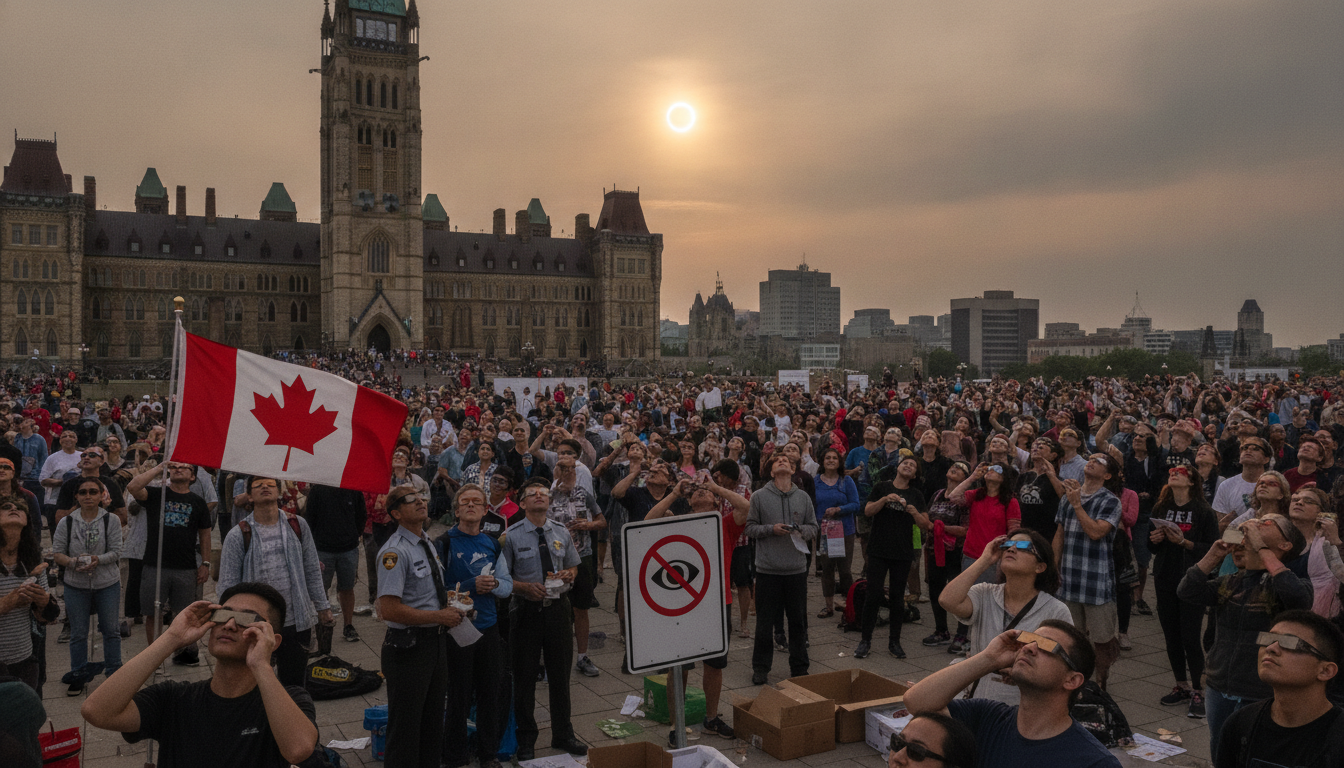
Partial solar eclipse to be visible across most of Canada on Aug. 12, 2026
Partial solar eclipse will cross most of Canada on Aug. 12, 2026; a partial lunar eclipse follows Aug. 27-28. Planetarium viewing times and safety tips.
A partial solar eclipse will be visible across most of Canada on Wednesday, Aug. 12, 2026, offering a modest celestial show for observers in the afternoon. The partial solar eclipse will not reach the dramatic darkness of the April 2024 total eclipse, because the Sun and Moon will not be perfectly aligned. Astronomers warn that protective eyewear is essential while viewing and that regional obscuration rates will vary markedly from coast to coast.
Nationwide visibility and timing
Most Canadian provinces and territories will see at least some portion of the Sun obscured on Aug. 12, with the event occurring during local afternoon hours. Observers should expect only a fraction of the solar disk to be covered in many populated areas, while northern communities will record the largest obscuration. Weather conditions and local horizon will influence the quality of the view, so sky clarity will be decisive for those hoping to watch the partial solar eclipse.
Regional obscuration figures and Montreal schedule
The maximum share of the Sun hidden by the Moon will differ by location, reflecting the geometry of the alignment. In Quebec City the Sun will be about 24 percent obscured at maximum, while Sherbrooke will see roughly 20.4 percent coverage. Communities farther north will experience higher obscuration; in Kuujjuaq the eclipse will reduce the visible solar disk by just over half at its peak.
Montreal’s local timeline is precise: the partial solar eclipse will begin at 12:50 p.m. Eastern Daylight Time, reach its maximum at about 1:45 p.m. EDT when roughly 18.3 percent of the Sun’s surface is hidden, and conclude near 2:38 p.m. EDT. These times are local to the Montreal area and observatories advise confirming the schedule for other time zones across Canada.
Eye safety and public viewing arrangements
As with any solar event, looking directly at the Sun without approved protection can cause serious eye damage. Officials stress the use of certified eclipse glasses or solar filters specifically designed for direct solar viewing, and cautioned against improvised methods such as sunglasses or smoked glass. Telescopes and binoculars require specialized filters that attach to the front of the instrument; improper equipment can concentrate sunlight and create permanent injury.
The Planétarium de Montréal will not host a large public rally like the one held for the 2024 total eclipse, but it will make filtered telescopes available for those attending. The planetarium will also stage two public Perseid meteor-viewing evenings on the nights of Aug. 12 and Aug. 13, pairing the eclipse activity with opportunities to observe the August meteor shower under dark skies. Visitors should check the planetarium’s schedule and arrive early to secure a spot at the viewing stations.
European totality and international interest
While most Canadians will see only a partial solar eclipse, a narrow path of totality will cross parts of northern Russia and sweep across the Arctic before touching land in Greenland and reaching Europe. The total eclipse will travel over the western part of Iceland and continue into northwestern Spain, where observers along the path will experience complete solar obscuration. Astronomers and eclipse chasers commonly travel to these zones to witness totality, which can produce dramatic sky-darkening and rare atmospheric colors.
Olivier Hernandez, director of the Planétarium de Montréal, is among those planning travel to Zaragoza in Spain to observe the total phase near sunset. Hernandez said the low elevation of the Sun at that moment can produce particular hues and visual effects along the horizon, offering contrasts not typically seen during totality at higher solar elevations.
Partial lunar eclipse the night of Aug. 27–28
The series of astronomical events continues later in the month with a partial lunar eclipse stretching from the evening of Aug. 27 into the early hours of Aug. 28. The partial lunar eclipse will begin its observable phase at about 9:23 p.m. local time on Aug. 27 and conclude near 3:01 a.m. on Aug. 28, giving observers ample opportunity to watch the Moon move through Earth’s shadow. During this eclipse only a small fraction of the lunar surface will be affected compared with more dramatic total lunar eclipses.
At maximum, approximately 7 percent of the Moon’s visible surface will lie within Earth’s penumbra, producing a faint shading rather than the deep copper tones seen in total eclipses. Olivier Hernandez described the phenomenon as the result of the Moon passing partially into the shadow cast by Earth, yielding subtle dimming rather than full immersion in umbral darkness. This partial lunar eclipse will be the last lunar eclipse visible from Quebec in 2026.
This partial lunar event is followed on the longer eclipse calendar by a partial lunar eclipse in January 2028 and a total lunar eclipse in June 2029, offering observers additional opportunities in coming years to experience differing eclipse geometries.
Local skywatchers are advised to check weather forecasts, confirm times in their time zone, and consult local observatories or planetariums for viewing guidance. The combination of the Aug. 12 partial solar eclipse and the Aug. 27–28 partial lunar eclipse offers Canadians a series of accessible astronomical events, but safe viewing practices and timely planning will determine whether those events can be enjoyed to the fullest.
