
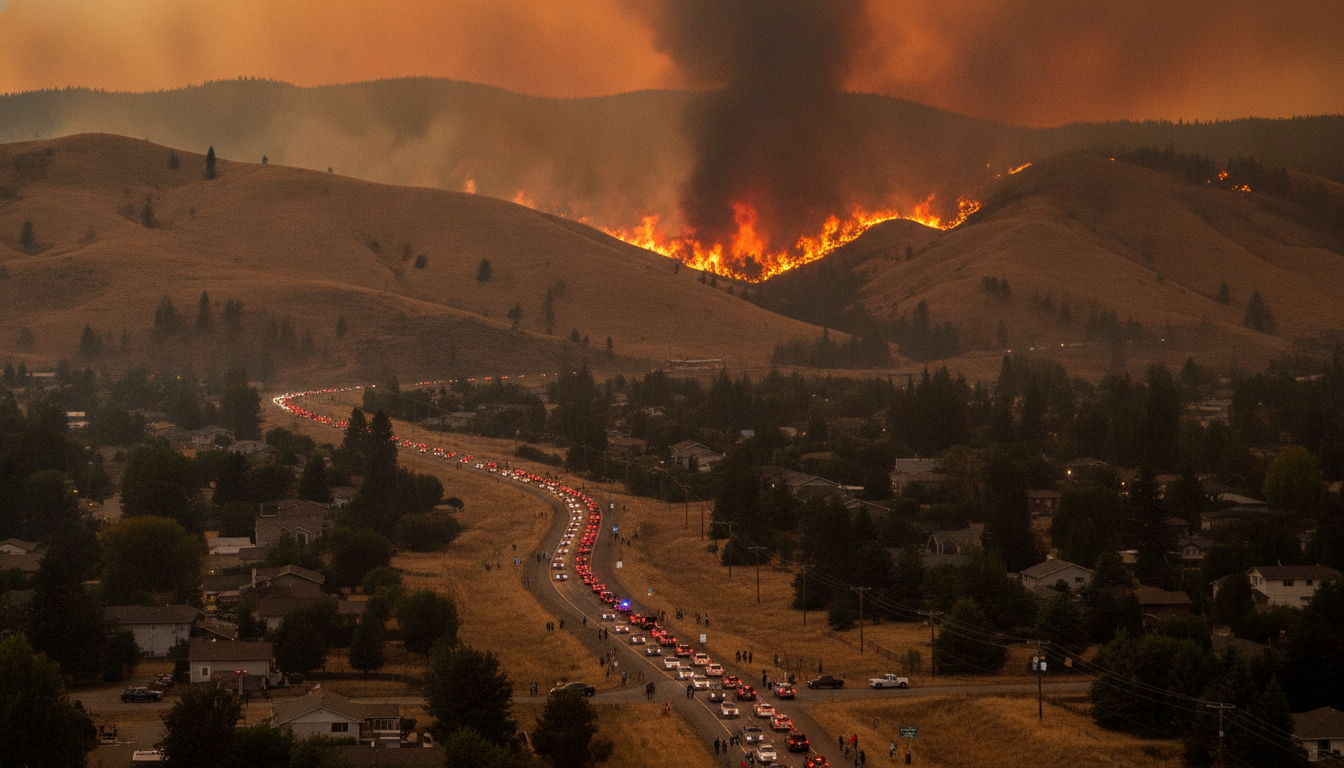
Summerland wildfire forces 12,000 residents to flee as Bald Range blaze grows
Summerland wildfire: Bald Range blaze forces evacuations of thousands in the Okanagan as extreme dryness and strong winds propelled a 5,000-hectare fire toward lakeshore communities.
The Bald Range fire, detected Friday afternoon, expanded to roughly 5,000 hectares within hours and prompted immediate evacuation orders for the town of Summerland and nearby Peachland. Emergency officials said the fire’s rapid growth threatened life and property, forcing roughly 12,000 residents from Summerland and adding thousands more to evacuation notices across the West Okanagan. Local roads became congested as families packed vehicles and emergency centres opened to accommodate those fleeing the advancing flames.
Evacuation orders issued for Summerland and Peachland
Local authorities issued mandatory evacuation orders for the district of Summerland and the town of Peachland on Friday, citing an imminent threat from the Bald Range wildfire. Both communities sit on the west shore of Okanagan Lake and include residential neighbourhoods, orchards and wineries that were placed at immediate risk. Officials said the scale and speed of the fire left little time for some residents to prepare, contributing to frantic departures under smoky skies.
BC Wildfire rates behaviour as ‘level 5’ aggressive fire
BC Wildfire described the Bald Range blaze as exhibiting highly aggressive behaviour driven by extreme dryness and a sustained south–southwest wind. Emergency operations staff characterized the fire’s dynamics as a level 5 on a six-tier scale, indicating a fast-moving flame front with long-range spotting that can ignite new fires well ahead of the main blaze. That rating signalled elevated danger for nearby communities and complicated containment efforts by crews attempting to hold control lines.
Residents recount last-minute escapes and losses
Several residents reported only minutes to flee before flames surrounded their properties, and some have already lost homes to the fire. One resident, who photographed the blaze near Fish Lake Road and Princeton Summerland Road on August 7, said her family left before formal alerts reached them and later found embers on their vehicle. Local accounts underscore the suddenness of the threat and the emotional toll on families who evacuated with few possessions and uncertainty about what remained.
Multiple large fires stretch provincial resources
The Bald Range incident is one of more than 100 wildfires active across British Columbia, with approximately half reported as out of control. Provincial officials highlighted four other major blazes drawing significant resources: Pear Lake, which has burned an estimated 136,000 hectares over about three weeks; Bradley Creek, north of Kelowna, which has destroyed more than 200 properties near Vernon; Brunswick Creek, an 8,000-hectare blaze for which evacuation orders have been largely reduced; and Ainslie Creek, burning roughly 46,000 hectares and prompting new evacuations south of Merritt. Together these incidents have required large-scale mobilization of firefighters, aircraft and support personnel.
Evacuation tallies and provincial impact
By Friday morning, authorities reported roughly 7,000 properties under evacuation orders and another 3,500 properties on alert across the province. The wide geographic spread of fires created logistical challenges for dispatching crews and coordinating sheltering for displaced residents. Local emergency management centres and provincial agencies have been updating orders and advisories as conditions shift, urging residents in threatened zones to follow official directions.
National wildfire season shows persistent destruction
Across Canada this year, about 3.4 million hectares have burned to date, placing 2026 among the more severe fire seasons since 2012. While 2023 remains the most destructive year on record for recent seasons with more than 13 million hectares burned by this point, the current season’s toll continues to strain firefighting capacity and community resilience. Officials noted that climatic factors—extended drought, high temperatures and wind—are consistent drivers of this year’s elevated fire activity.
Authorities continue to monitor the Bald Range fire closely and have prioritized life safety and evacuation compliance as crews work to limit further spread. Emergency centres remain open for displaced residents and officials said updates will be provided as conditions evolve.
