
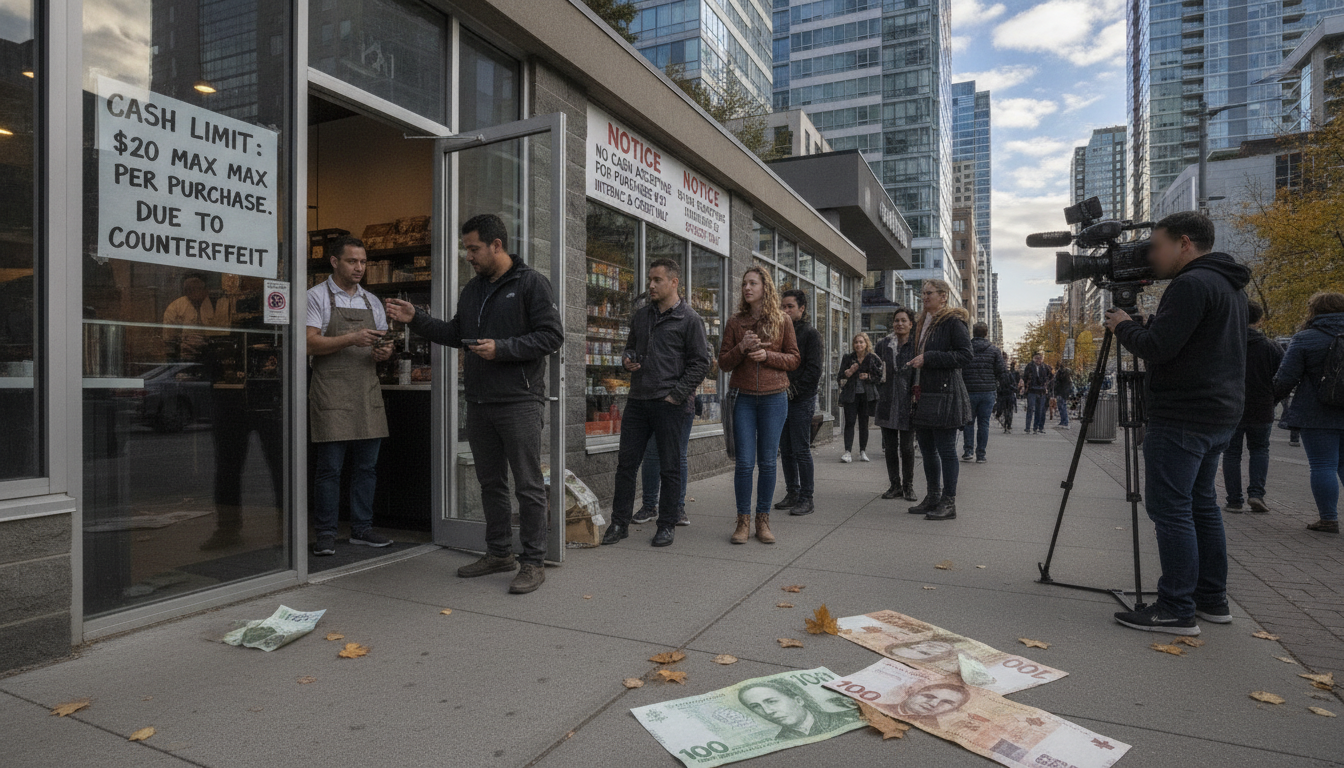
Counterfeit bills prompt Calgary businesses and seniors to rethink cash as machines and policies falter
Calgary merchants and residents face growing anxiety over counterfeit bills after cash-handling machines reject legitimate notes and high-quality fakes circulate, forcing businesses to reconsider accepting cash.
For many Calgarians the discovery that a $100 or $50 bill might be fake has become a routine risk that affects daily life and small business operations. Longtime cash users and frontline retail staff say the problem is compounded by technology meant to secure money, which sometimes refuses genuine tender and leaves stores exposed. Merchants report lost sales and mounting frustration as they balance speed, security and customer relations in an economy that still depends heavily on paper currency.
Machines reject legitimate bills at busy counters
Luigi Romano, a 70-year-old who still uses cash for roughly half his purchases, described multiple attempts to feed valid notes into a cash management safe only to have the machine spit them back. The Tidel Series 4 safe used at the 7‑Eleven on Centre Street N. is designed to reduce theft by keeping cash off the counter, but repeated rejects create delays and open opportunities for theft when staff step away to troubleshoot. Employees and customers both endure slower service and awkward confrontations when a bill is refused, and the malfunction sometimes forces clerks to hold on to cash rather than deposit it promptly.
Store managers say the operational strain is most acute during peak hours when speed matters and thorough inspection is less practical. Workers who must inspect bills manually risk slowing lines or making mistakes, while electronic verification that fails intermittently erodes confidence in the system. The net effect is that technology intended to protect cash is, in some cases, adding a new layer of vulnerability for small retailers.
Merchants report frequent counterfeit $100 and $50 bills
Owners at convenience stores and restaurants across Calgary describe encountering counterfeit bills “all the time,” with $100 notes singled out as the most commonly faked denomination. Circle K operator Naeem Mazhar said staff have stopped handling $100 bills routinely because the risk of accepting a fake outweighs the sale, a practice that has cost his business customers and revenue. At WokBox, owner Robin Panchiwala described teenagers using convincingly realistic fake notes as a prank, placing orders they never collect and forcing the restaurant to discard prepared food.
Calgary Police say reports of counterfeit currency come in cycles, averaging one to three weekly incidents, though the true number is likely higher because businesses often hold onto multiple suspect notes before reporting them. Police also note that counterfeit currency is frequently encountered in transactions arranged via social media marketplaces, where face‑to‑face verification is limited and sellers may suffer losses before realizing a bill is fake.
Bank of Canada pushes new security features and public checks
The Bank of Canada maintains that public confidence in bank notes remains high and is proceeding with upgraded security features to stay ahead of counterfeiters. Officials point to a program of updated designs and materials, including a planned vertical $20 polymer note, to be introduced in the coming years. In the short term the central bank continues to advise consumers and merchants to “feel, look, tilt and flip” notes, checking metallic features, transparent windows and other anti-counterfeiting elements.
Despite that guidance, some counterfeiters have produced high-quality fakes that pass initial inspection by staff and are later flagged by bank tellers or during bank processing. The gap between frontline detection and bank verification means businesses can still be held responsible for losses, creating added administrative and financial burdens for small operators that lack sophisticated verification tools.
Small business calculus: fees, fraud risk and going cashless
Operators weigh several competing pressures as they decide whether to accept cash, with merchant fees for card and mobile payments forming one side of the ledger. Melissa Martin of SAIT’s entrepreneurship and innovation program said credit and mobile fees may seem small per transaction but add up quickly for low-margin businesses. At the same time, card payments remove the worry of counterfeit notes and reduce the operational costs and risks associated with storing and transporting cash.
The Canadian Federation of Independent Business says many small firms are choosing card‑only payment approaches for ease of bookkeeping and perceived safety, especially at night or in high‑theft environments. Those choices, however, come with trade-offs: fees, dependence on digital infrastructure and the potential to exclude customers who rely on cash.
Vulnerable populations face exclusion as cash declines
Consumer advocates warn that the gradual shift away from cash disproportionately impacts seniors, low-income people and those who are unbanked or underbanked. Alexandre Plourde of Option Consommateurs argues for legislative protections that would require merchants to accept cash, citing examples from jurisdictions that have maintained legal tender access. Plourde also highlights a systemic risk: reliance on electronic payments leaves consumers exposed in the event of widespread outages or other disruptions.
Frontline social service workers at Unison Kerby Centre say many seniors prefer cash because it feels tangible and helps with budgeting, and because they fear digital scams or confusing card technology. Those preferences create real equity concerns when businesses restrict cash acceptance or limit it to certain hours, as some convenience stores now do during evening and overnight shifts.
Consumers and businesses are navigating a complicated crossroads where technology, crime and commerce intersect. Some Calgary merchants are investing in verification tools and revised staff procedures, while others push customers toward cards to remove the counterfeit variable entirely. As the Bank of Canada develops new bank notes and awareness campaigns continue, small businesses will still judge decisions on a case‑by‑case basis, balancing cost, customer access and the persistent threat of counterfeit bills.
The coming months will test whether improved security features and better equipment can reduce the flow of fake notes without sidelining cash‑dependent residents, or whether the practical pressures of fraud and convenience will accelerate Calgary’s shift away from paper money.
