
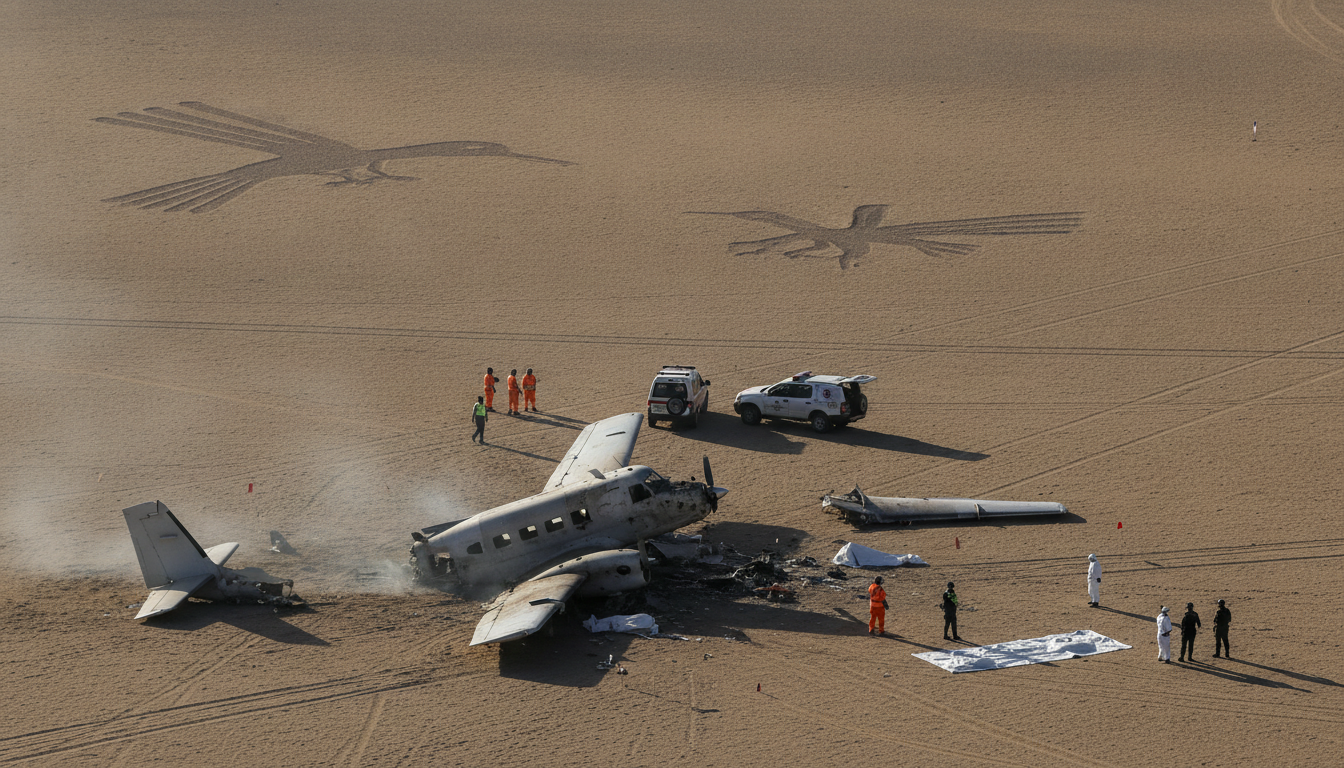
Nazca plane crash kills 13 tourists and crew near Nazca, Peru
A small tourist plane en route to the Nazca Lines crashed near Nazca, Peru, killing 13 people, many of them foreign tourists; authorities opened an investigation.
The Nazca plane crash occurred around 1 p.m. local time when a Cessna Caravan C-208 operated by AeroDiana went down in an agricultural area near Vista Alegre, officials said. Thirteen people aboard — 11 passengers and two crew — were killed, and authorities confirmed the victims included seven Italians, two Germans and two Spaniards. Images from the scene showed wreckage smouldering and emergency crews retrieving bodies, and local and national agencies immediately moved to secure the site.
Thirteen victims identified, ages range reported
Peru’s Ministry of Transport and local police confirmed that all occupants on board died at the scene, and that the victims’ ages ranged from 24 to 78. Police commander Jorge Andrade told reporters from the crash site that there were no survivors, and prosecutors ordered the transfer of the remains to the morgue in the Ica region. The ministry later reiterated that foreign embassies would receive consular support as authorities worked to notify next of kin and share forensic findings.
Aircraft operator and flight details
The aircraft involved was a Cessna Caravan C-208 belonging to AeroDiana, a company that offers 30- to 60-minute sightseeing flights over the Nazca Lines. The flight had departed from the aerodrome at Pisco, roughly 240 kilometres south of Lima, and was conducting a routine tourist sortie when it experienced an in-flight emergency, municipal officials said. Local witnesses reported an explosion on impact, and images from news agencies showed the fuselage heavily damaged and parts still burning when first responders arrived.
On-scene rescue, recovery and public safety actions
Firefighters and police were dispatched to the agricultural fields near Vista Alegre, where they worked among scattered debris and charred wreckage to recover the victims and document the site. Authorities used black body bags to remove remains, and the public prosecutor’s office is coordinating the recovery with regional health and forensic services. The Commission of Inquiry on Air Accidents has begun gathering technical evidence at the crash site, while local officials restricted access to preserve potential material and witness evidence.
Peruvian government response and diplomatic outreach
President Keiko Fujimori, recently sworn in, issued a statement expressing regret over the tragedy and indicating that temporary suspension of operations at the Pisco aerodrome was under consideration. The national government said it would provide support to the embassies of the victims’ home countries and assist in repatriation and consular procedures. Authorities also emphasized they would offer resources to relatives and to local emergency services engaged in the recovery and identification work.
Investigation scope and possible contributing factors
Investigators will examine maintenance records, pilot logs, weight-and-balance calculations, weather information and communications with air traffic services as part of the probe into the Nazca plane crash. The Commission of Inquiry on Air Accidents, together with prosecutors and technical experts, is expected to conduct on-site inspections, review wreckage components and analyze flight data where available. Officials cautioned that it is too early to ascribe a cause and that systematic technical work will be required before conclusions are released.
Safety context for flights over the Nazca Lines
Flights over the Nazca Lines are a cornerstone of tourism in southern Peru, giving visitors an aerial view of the ancient geoglyphs that are not visible from the ground. Small aircraft and local operators routinely serve the route from Pisco and other regional airstrips, a traffic pattern that has prompted recurring scrutiny after past accidents in the area. Authorities and tourism stakeholders will now face renewed pressure to review safety protocols, aircraft maintenance standards and oversight of aerodrome operations in light of this latest crash.
Debris removal, forensic examinations and diplomatic contacts are expected to continue in the coming days as investigators work to piece together what led to the aircraft’s failure and the resulting loss of life.
