
Iran Launches Drones at U.S. Military Targets in Kuwait, Tehran Says
Iran launches drones at U.S. military targets in Kuwait, Tehran says, after a reported U.S. strike on Qeshm; Pakistan seeks mediation to de-escalate now.
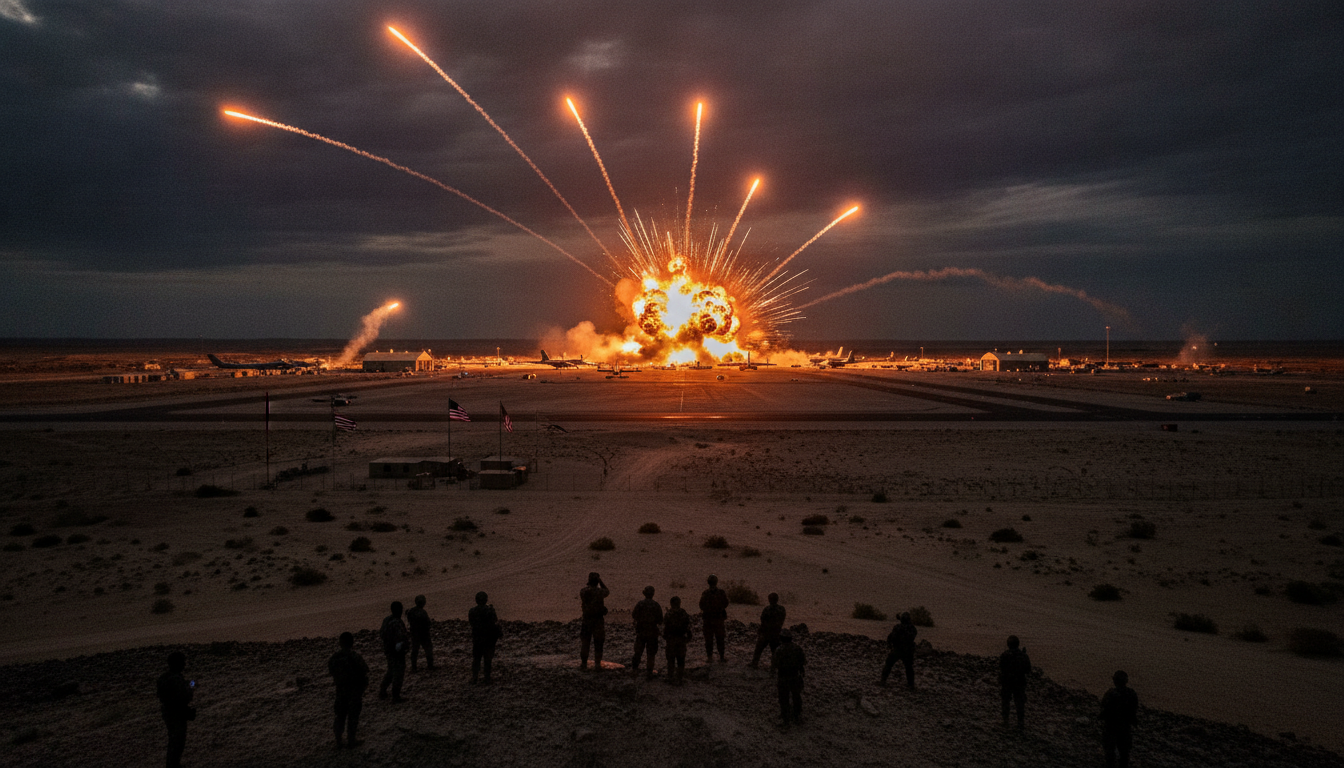
Iran launches drones at U.S. military targets in Kuwait, Tehran’s army said Friday, in a retaliatory strike it described as a response to recent U.S. actions against Iranian territory. The Iranian statement said unmanned aerial vehicles struck hardened aircraft shelters, satellite communication systems and equipment storage areas at Ahmad al-Jaber Air Base in Kuwait. CENTCOM had not issued an immediate response to the claim, leaving key details—damage assessments and any casualties—unconfirmed at the time. The announcement came amid diplomatic efforts led by Pakistan to revive a mid‑June agreement intended to open talks between Washington and Tehran.
Iranian military names targets at Ahmad al-Jaber Air Base
Iran’s armed forces said their drones specifically targeted facilities at the Ahmad al-Jaber installation, including aircraft shelters and communications infrastructure. The statement framed the operation as a measured reprisal for what it described as a “terrorist” U.S. assault on an inhabited area of Qeshm island. Officials did not provide independent evidence in their release, and no international verification was immediately available. Kuwaiti authorities and U.S. Central Command had not publicly corroborated the Iranian account by early Friday evening.
U.S. military central command silent as claims emerge
U.S. Central Command did not immediately comment on Tehran’s claim, a silence that left open several possible scenarios ranging from limited damage to contested attribution. Military spokespeople often withhold operational details pending intelligence confirmation and coordination with regional partners. Analysts say that rapid public claims by each side can complicate verification and increase the risk of miscalculation. The absence of an official CENTCOM statement generated uncertainty among Gulf capitals and defence observers tracking the exchanges.
Qeshm casualties and the trigger for retaliation
Iranian and local media reported that strikes on Qeshm island earlier in the week killed three members of the same family, a development Tehran cited as the trigger for its retaliation. The Iranian army characterized the earlier incident as part of a broader pattern of U.S. aggression and used it to justify the drone operation. Independent confirmation of civilian casualties on Qeshm was difficult to obtain given the restricted access to the site and the speed of events. Humanitarian and diplomatic actors warned that reports of family deaths fuel public outrage and harden political positions on both sides.
Pakistan pushes to revive Islamabad agreement
Pakistan, acting as a mediator between Washington and Tehran, said it was working to restore the Islamabad protocol signed in mid‑June that aimed to pave the way for negotiations. Pakistani diplomats told interlocutors they were making every effort to bring parties back to the talks despite a renewed cycle of reciprocal strikes in July. The mediation effort underscores regional concern that localized exchanges could escalate into broader confrontation. Officials in Islamabad have urged restraint and called for adherence to diplomatic channels to prevent further civilian harm.
Escalation follows weeks of reciprocal strikes
The latest episode is the latest in a series of tit‑for‑tat strikes that resumed after a lull in early July, with Tehran targeting U.S. bases and allied facilities across the Middle East and Washington responding with selective strikes. Analysts note that the pattern of reciprocal attacks has eroded trust and made de‑escalation harder as both sides publicly seek to demonstrate deterrence. Gulf states, which host many foreign military assets, are particularly vulnerable to spillover and have been monitoring the situation closely. The frequency of the exchanges this month has prompted renewed international calls for urgent diplomacy.
Regional security and international implications
Security analysts say attacks on bases in Kuwait or on critical communications nodes risk widening the confrontation beyond the bilateral dispute, drawing in regional partners and complicating maritime and energy security in the Strait of Hormuz. Multinational shipping and energy markets are sensitive to perceived instability in the Gulf, and even unconfirmed strikes can produce immediate market reactions. Diplomats and defence officials from Europe and Asia have urged restraint and emphasized the need for transparent incident investigations. The unfolding events test the capacity of mediators to convert agreements into stable ceasefires.
The sequence of drone and air strikes this week illustrates the fragility of recent diplomatic gains and the speed with which violence can interrupt negotiations. As Pakistani mediators press both capitals to return to the Islamabad framework, independent verification of the latest claims will be central to future discussions. Regional actors and international observers will be watching for official confirmations from U.S. and Kuwaiti authorities, and for any signs that the parties are willing to subordinate immediate tactical objectives to a broader de‑escalation.
