
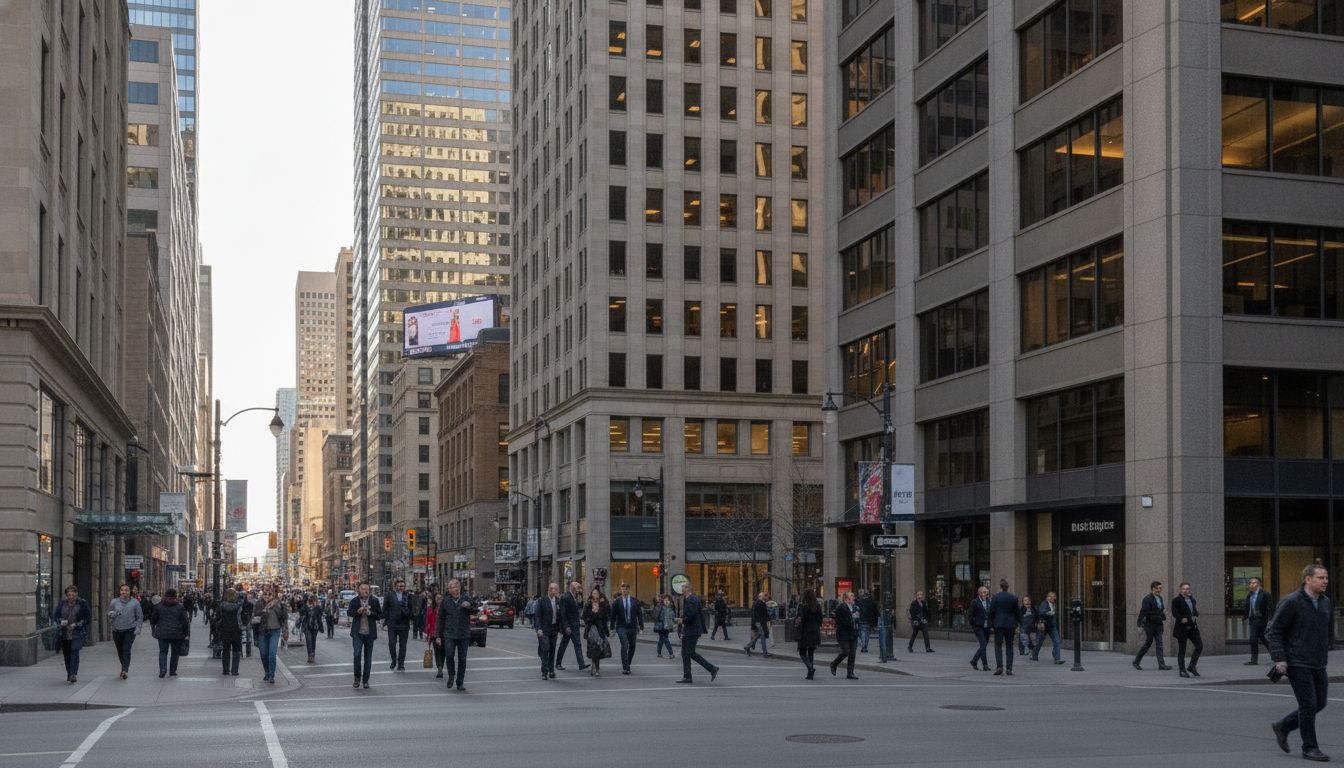
Calgary downtown return to office shows early signs of recovery, city official says
Calgary downtown return to office shows early signs of recovery, a city official says, as businesses and commuters rebuild foot traffic and office occupancy.
Calgary city official Parry said the city is already seeing early signs of a Calgary downtown return to office, and that local downtown activity is beginning to tick upward after the disruptions of the COVID-19 pandemic. He added the city would like to see those downtown numbers — including office use and street-level activity — fall or normalize even more. The comments reflect a broader effort by municipal leaders and businesses to revive the core’s economic and social life.
Parry highlights early return-to-office trend
Parry told reporters that Calgary was among the first Canadian cities to notice a movement of workers back to downtown offices after pandemic closures. He said the trend appears to be continuing, with more employees resuming commutes and employers recalling staff for in-person work. The official framed the uptick as an important step toward restoring daytime energy and supporting downtown services.
Businesses report gradual regain of customers
Local restaurant and retail owners in the downtown core say foot traffic has slowly improved as workers return to desks and meetings. Many businesses described an incremental recovery, with lunchtime and after-work crowds rebuilding on weekdays. Owners noted that while weekends have rebounded earlier, weekday volumes tied to office occupancy remain the most meaningful barometer for long-term stability.
Office occupancy and workspace changes
Employers have shifted to hybrid schedules that blend remote work and office days, affecting how occupancy is measured and experienced. Companies experimenting with staggered schedules or reservation systems report more predictable but still variable office use. Property managers say building services and amenities are adjusting to new patterns, moving from daily peak-demand models to more flexible provisioning.
Transit and commuter patterns adapting
Public transit providers and downtown parking operators are tracking changes as commuting habits evolve with the Calgary downtown return to office. Transit ridership that fell during the pandemic has shown recovery on key routes, although peak-hour surges remain less consistent than pre-pandemic levels. City planners and transit officials continue to evaluate service frequency and capacity to match a patchwork of hybrid schedules.
City initiatives aimed at downtown vitality
Municipal initiatives to support downtown recovery emphasize both short-term activation and long-term planning. Programs focused on events, street-level improvements and partnerships with property owners aim to increase daytime presence and attract varied uses for office spaces. City representatives argue that a mix of policy tools and private investment will be needed to consolidate gains and encourage more sustained returns to office.
Employers balancing productivity with workforce preferences
Human resources leaders and business owners say the Calgary downtown return to office is being guided by a mix of operational needs and employee expectations. Some firms emphasize in-person collaboration for certain functions, while others maintain remote flexibility to retain talent. Employers report that clearer policies and regular communication about office requirements help employees plan and reduce friction around hybrid arrangements.
Analysts warn of uneven recovery across sectors
Economic observers note that recovery is not uniform: professional services and corporate tenants tend to push for more in-person days, while sectors with flexible or remote-friendly work remain dispersed. Retailers, building owners and transit operators feel these sectoral differences in real time, seeing pockets of strong activity alongside quieter blocks. Analysts suggest policy and market responses should account for these uneven patterns when targeting downtown revitalization.
Efforts to measure the Calgary downtown return to office include both quantitative indicators, such as building occupancy and transit ridership, and qualitative signals like visible street activity and meeting-room bookings. Officials say tracking a variety of metrics will provide a fuller picture of recovery and guide future investments. Parry’s remarks underscore municipal optimism that the trend toward more regular downtown presence is gaining momentum.
The city and business community say sustaining the recovery will require continued coordination as hybrid work settles into the urban fabric, and as services and amenities adapt to a new rhythm of downtown life.
