
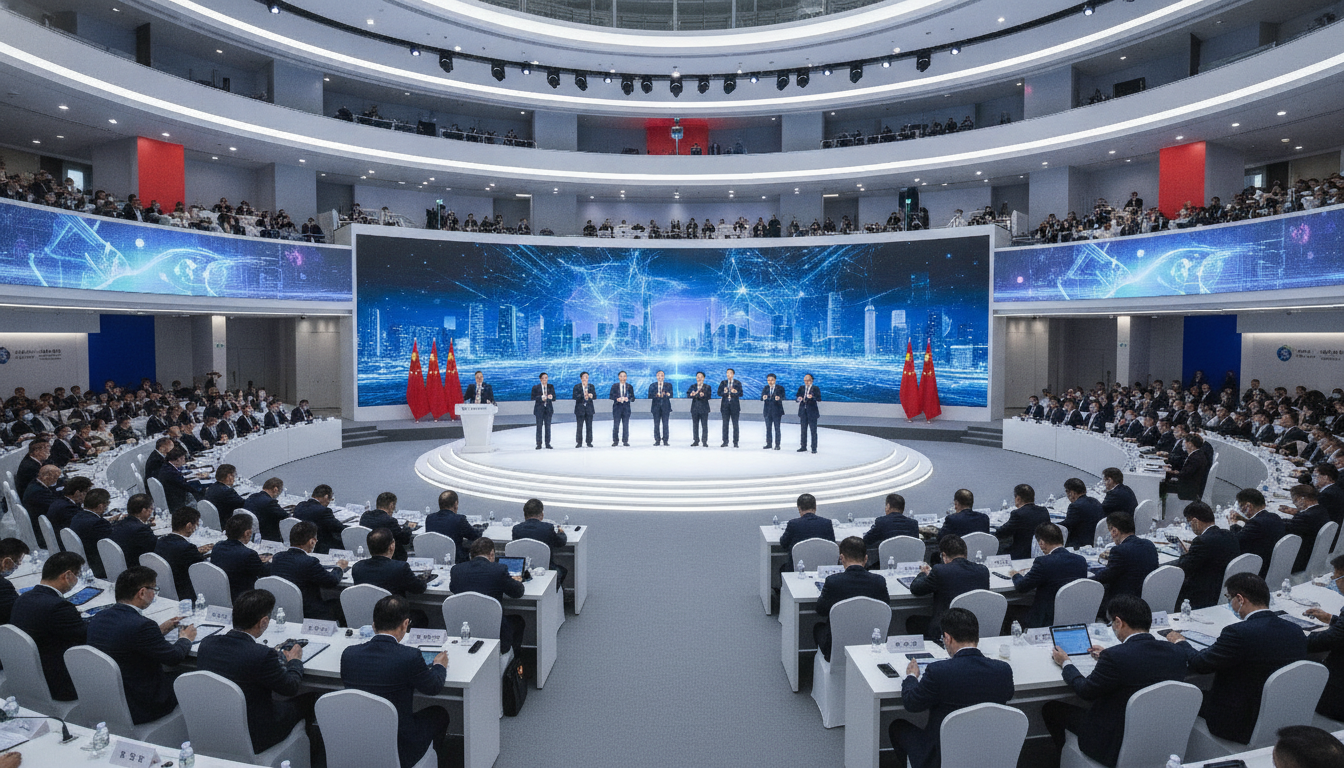
Xi Reinforces China AI Leadership Ahead of Shanghai World AI Conference
Xi Jinping bolsters China AI leadership as startups and tech giants accelerate model deployment and product integration ahead of the Shanghai AI conference.
China AI leadership was publicly reinforced this week when President Xi Jinping used the run-up to the Shanghai World AI Conference to signal state backing for domestic artificial intelligence development. His remarks coincided with a surge of activity among Chinese startups and established tech firms racing to field large language models and consumer-facing AI features. Observers say the timing underscores Beijing’s intent to shape both the technology and the rules that will govern it globally.
Xi Jinping Signals Strategic Support for AI
President Xi’s intervention came at a politically charged moment, days before Shanghai hosts one of the largest international gatherings focused on artificial intelligence. His comments positioned AI as a strategic national priority and framed domestic advances as central to China’s economic and technological ambitions.
Officials in Beijing have increasingly presented AI not only as an industrial upgrade but also as an arena for international influence. The statement is likely to accelerate government coordination with state-owned enterprises and favored private firms.
Startups Close the Gap with US Counterparts
A new wave of Chinese startups is emerging with capabilities that industry analysts say now rival those of leading U.S. companies. Firms such as Moonshot and Baichuan have drawn attention for their language models, while smaller teams in Shanghai and Beijing are iterating rapidly on specialized systems.
Investors and founders point to faster product cycles, abundant data, and close partnerships with device makers as factors narrowing the technological divide. Some high-profile entrepreneurs have also signaled ambitions to scale internationally and pursue public listings to finance expansion.
State and Private Capital Drive Model Development
Funding flows — both from state-backed channels and private venture capital — are fueling model development and infrastructure deployment across China. Accelerated investment in training clusters and cloud capacity has enabled faster iteration on large-scale models and multimodal systems.
At the same time, Beijing’s directed funding priorities are shaping which projects receive priority, favoring applications that align with industrial policy goals. That mix of public and private capital is creating a distinct pathway for Chinese AI firms to commercialize quickly.
Tech Giants Embed AI into Consumer Products
Major Chinese technology companies are moving beyond research prototypes and embedding AI features directly into consumer apps and hardware. ByteDance has rolled out conversational tools within its ecosystem, while Baidu’s Ernie-branded bots and Tencent’s offerings have been integrated into their platforms to varying degrees.
Smartphone makers such as Xiaomi are integrating AI modules into devices to offer on-device assistance and enhanced user experiences. These product-level deployments are expanding everyday exposure to AI among Chinese consumers and creating tangible market advantages for domestic vendors.
Regulatory Priorities and Security Considerations
Beijing has signaled that expansion of AI must be accompanied by tighter oversight on safety, data handling, and ideological alignment. New regulatory guidance has emphasized controllability and alignment with national security concerns, affecting how companies train and distribute powerful models.
Regulators are also scrutinizing export controls, data localization, and the platforms through which models are deployed. That regulatory environment creates both constraints and protective advantages for domestic firms competing in the national market.
International Implications and Competitive Dynamics
China’s intensified push has immediate implications for global competition in AI. Policymakers and corporate leaders abroad are watching whether Chinese models will be adopted internationally and how regulatory differences will affect market access. The interplay of state support, fast-moving startups, and major platform companies could reshape vendor relationships and supply chains.
At the same time, discrepancies in governance approaches — from content controls to security vetting — are likely to influence which foreign partners and markets Chinese firms can realistically enter. The international dimension of AI competition now includes not just technical benchmarks but also geopolitical and regulatory alignment.
China’s public assertion of AI leadership, amplified by Xi Jinping’s high-profile remarks before the Shanghai conference, signals a concerted national effort to close technological gaps and set standards. With startups, tech giants, and state resources aligned behind this push, Beijing aims to convert research momentum into commercial and geopolitical influence in the coming years.
