
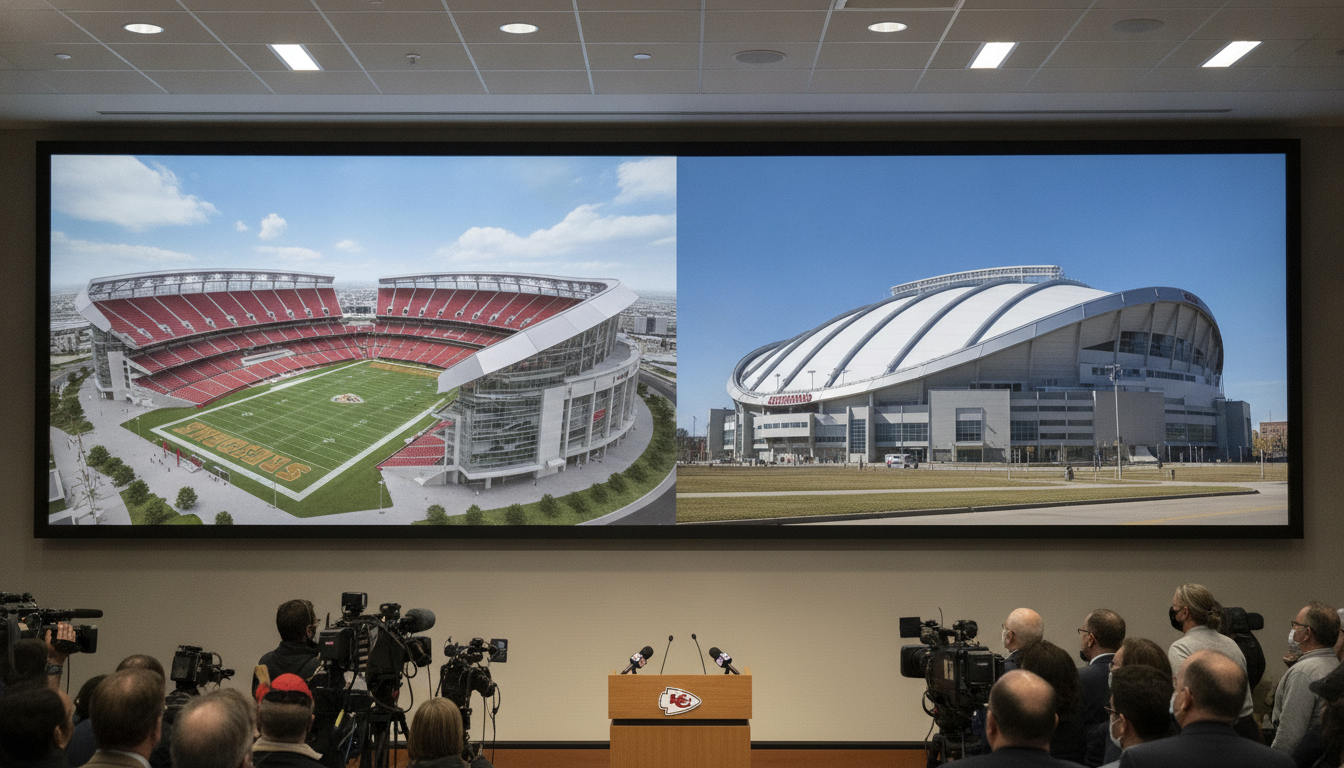
Kansas City Chiefs stadium renderings draw comparisons to Calgary’s Saddledome
Calgary reacts after Kansas City Chiefs stadium renderings draw comparisons to the Scotiabank Saddledome, sparking debate over design, heritage and parking.
Chiefs unveil 2031 stadium renderings
The Kansas City Chiefs released renderings this week of a proposed new stadium they say will open in 2031 and seat about 70,000 spectators. The images, presented as one of six design options, aim to balance a nod to Arrowhead Stadium’s legacy with a modern, multipurpose venue. The phrase Kansas City Chiefs stadium appeared across official materials as the team outlined capacity, timeline and amenities.
The team said the design accommodates large crowds and is intended to support NFL games, concerts and other large events. Officials emphasized tailgating-friendly parking on renderings and in a press release, framing the site as a classic football experience rather than an urban entertainment district.
Calgary viewers spot Saddledome resemblance
Within hours of the release, social media users in Calgary and across Canada noted a strong visual similarity between the proposed Kansas City Chiefs stadium and the Scotiabank Saddledome. Commenters highlighted the sweeping, saddle-like roofline, and images comparing the two buildings circulated widely on X and other platforms. The Saddledome’s official X account even responded with a lighthearted, “Imitation is the sincerest form of flattery.”
Many Calgarians reacted with a mix of amusement and incredulity, given Calgary’s recent decisions to retire the Saddledome after decades as a landmark tied to the city’s Olympic past. The resemblance reignited conversations about civic identity and the architectural footprint left by the saddle-roofed arena.
Local voices: amusement and frustration
Reactions among local residents and fans ranged from bemusement to anger. Calgary resident and Chiefs fan Tienda Sorsdahl called the parallel “weird,” noting the irony that a design the city moved away from seems poised to reappear elsewhere. Longtime Flames supporter Richard Ashton described the rendering as “a squished version of the Saddledome,” and criticized the heavy focus on surface parking rather than integrated amenities.
Concordia University economist and Flames fan Moshe Lander said the similarity left him frustrated rather than amused. Lander argued Calgary could have made bolder design choices for the Saddledome replacement, and that seeing a similar silhouette adopted by another franchise raised questions about lost opportunities to preserve local architectural character.
Design choices and parking criticism
A common thread in the discussion has been the amount of surface parking shown around the proposed Kansas City Chiefs stadium. Critics noted that many new sports venues emphasize compact, mixed-use precincts with retail, dining and transit links, rather than sprawling lots. The Chiefs’ public materials, however, underline tailgating traditions and explicitly show large parking areas to accommodate game-day gatherings.
Architectural observers pointed out that parking decisions reflect differing civic priorities and land availability. Where downtown sites often push teams toward dense, walkable districts, suburban or greenfield sites can produce more vehicle-oriented plans that prioritize pre-game culture and accessibility by car.
Architectural lineage and comparisons
Architects and historians note the Saddledome’s silhouette is not unique to Calgary and traces precedents to mid-20th-century arena design. The Saddledome has been compared to the former Capital Centre in Landover, Maryland, which influenced several domed arenas built in the 1970s and 1980s. That lineage may help explain why independent projects in different cities occasionally produce similar profiles.
Richard White, a columnist and author who writes about regional travel, cautioned against assuming intentional copying. White said it is unlikely the Kansas City designers directly borrowed from Calgary’s arena, and observed that the reaction is partly amplified by timing and local sentiment. Architectural convergence, he suggested, can result from functional demands and engineering solutions rather than deliberate imitation.
Timing intensifies debate over demolition
The release of the Chiefs’ renderings coincides with Calgary preparing for the Saddledome’s final NHL season and eventual demolition, a schedule that sharpened public response. For residents mourning the loss of an Olympic-era landmark, seeing a near-identical silhouette elsewhere has been a provocation for voices calling for stronger preservation of civic symbols.
City officials and venue stakeholders have previously defended the Saddledome’s retirement on operational and functional grounds, arguing that a modern facility better serves fans and event producers. Supporters of the replacement project maintain that new venues can preserve memory through archives and commemorations even as physical structures are retired.
As the online debate continues, both fans and experts are weighing what is gained and lost when iconic forms reappear in new contexts. The Kansas City Chiefs stadium renderings have become a flashpoint that connects local nostalgia in Calgary to broader conversations about design, heritage and the future of sports venues.
The unfolding discussion now shifts to how cities and teams balance legacy and modern needs when planning major facilities, and whether visual echoes across continents will prompt new thinking about preserving cultural landmarks.
