
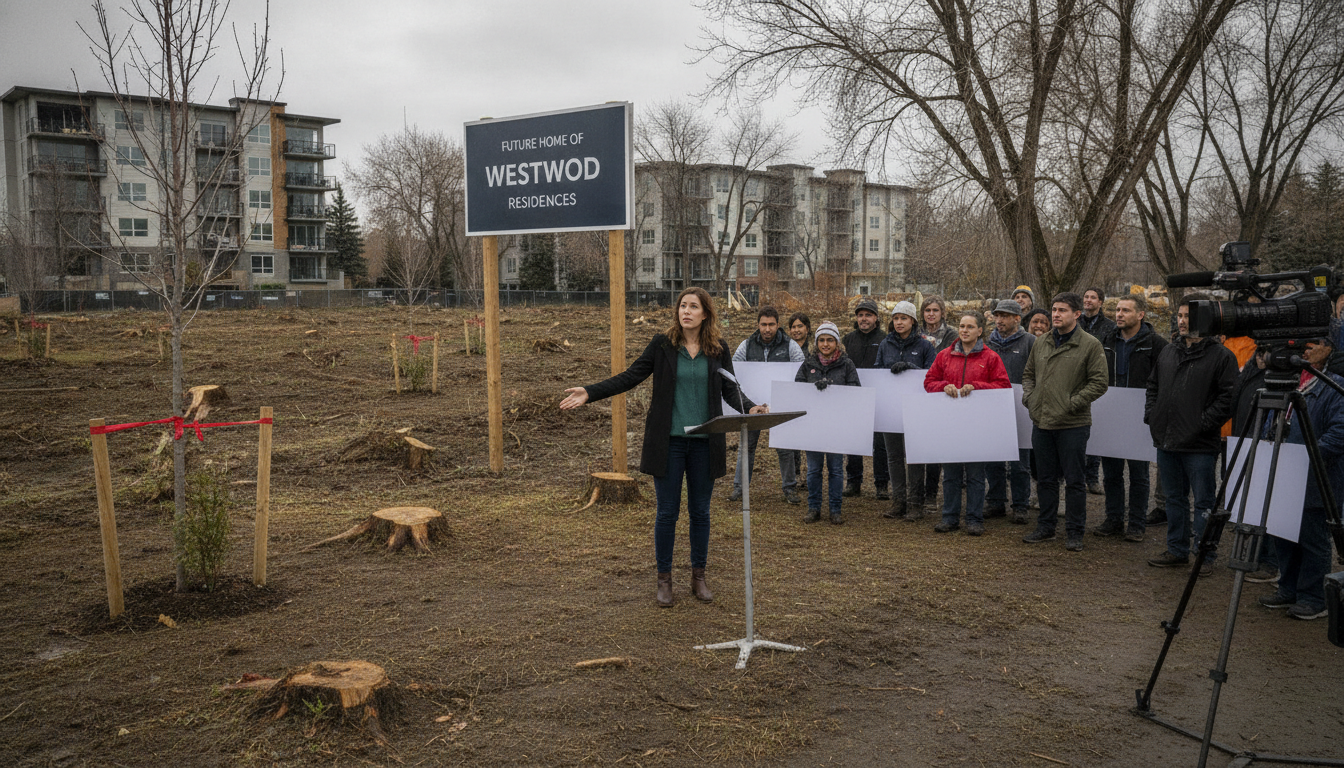
Calgary tree replacement bylaw faces scrutiny as residents say developers fail to replant mature trees
Calgary residents and a city councillor are raising alarm over the Calgary tree replacement bylaw after community groups reported that developers are not replanting mature trees removed during infill and redevelopment. The dispute highlights gaps in enforcement, sapling survival, and whether private land requirements keep pace with accelerated inner-city construction.
Residents document missing replacements
West Hillhurst community volunteers say they have been cataloguing development sites and found many properties where trees removed for construction were not replaced as required. Byron Miller, a member of the community association’s planning committee, said inspections are irregular and promised plantings often never materialize.
The local group says the land-use bylaw requires one to two trees per new unit depending on lot size, and that those trees must be planted within a year of development completion and maintained for at least two years. Neighbours report that the requirement is inconsistently applied across projects, leaving gaps in the neighbourhood canopy.
Coun. Ward warns of long-term canopy loss
Ward 11 Coun. Rob Ward drew attention on July 17 to mature trees bulldozed in the Kingsland area and questioned how short-term redevelopment is affecting long-term canopy goals. He noted city documents estimate meaningful canopy gains occur only 10 to 20 years after planting, and that meeting targets depends on both public and private land.
Ward’s comments underline a policy tension: redevelopment often occurs quickly, but the environmental benefits of mature trees accrue over decades. While removals on private property can be legal, councillors and residents say the city’s commitments to expand canopy should not accept the routine loss of established trees.
City says it relies on reports and permit conditions
A city spokesperson told reporters that development inspectors enforce conditions tied to permits and that builders are expected to complete approved landscaping or seek permit changes when site conditions prevent planting. The spokesperson also confirmed the municipal government does not currently track tree-related non-compliance as a distinct category.
That reliance on public reporting leaves enforcement uneven, critics say. Community groups argue the city’s approach effectively places the burden on neighbours to notice and report missing replacements rather than proactively monitoring developer obligations.
Builders’ group defends industry practices
The Calgary-region builders’ association said its members comply with applicable bylaws and building codes, including tree replacement requirements. Amie Blanchette, CEO of the builders’ group, emphasized in a statement that members endeavour to meet regulatory commitments while navigating complex infill projects.
Builders and developers counter that some sites present physical constraints that make immediate replacement difficult, requiring permit revisions to adjust landscaping plans. Still, residents say such negotiations often lead to fewer or smaller trees being planted than those removed.
Sapling survival and watering responsibilities
Community advocates also point to the high mortality rate of replacement saplings as a major problem. Volunteers with Forest for Calgary and similar initiatives say newly planted trees frequently die because the city lacks the resources to water them consistently and many residents and developers do not assume follow-up care.
A second concern is that one small sapling cannot compensate for the ecosystem services lost when a mature tree is cut down. Shade, stormwater retention, heat mitigation and biodiversity benefits are largely absent until replacements reach maturity, a process that can take decades.
Data and federal funding change the context
Satellite and LiDAR analysis published by environmental groups in 2022 showed Calgary’s urban canopy at roughly 8.1 per cent, well below the more than 20 per cent observed in several other major Canadian cities. That finding, together with observed declines in canopy between 2012 and 2022, has sharpened urgency around renewal efforts.
In November 2024 the city announced nearly $61 million in federal funding from the 2 Billion Trees program to plant roughly 930,000 trees across Calgary over five years. Officials say the infusion targets parks and public land to expand the urban forest and improve equitable access to tree cover, but critics maintain it does not substitute for enforcing private-land replacement rules.
Community associations now urge a combination of measures — improved inspection capacity, a dedicated fund for replacement where developers fail to comply, and clearer requirements for post-planting maintenance — to ensure redevelopment does not produce a long-term deficit of mature trees. They say policy changes should acknowledge that private lot rules are central to preserving canopy as infill accelerates.
City staff have signalled willingness to review options but have not announced a timeline for new monitoring systems or a developer contribution fund. As Calgary continues to densify, residents and elected officials are pressing for better coordination to protect urban canopy while allowing housing growth.
Public debate is expected to intensify as neighbourhood groups compile evidence of non-compliance and councillors weigh policy fixes ahead of future land-use decisions.
