
Labrador-Quebec energy negotiations: Wakeham cautious despite Quebec optimism
Newfoundland and Labrador Premier Tony Wakeham says negotiators are making progress in the Labrador-Quebec energy negotiations, but he warned definitive agreements are not yet guaranteed following talks at the Council of the Federation.
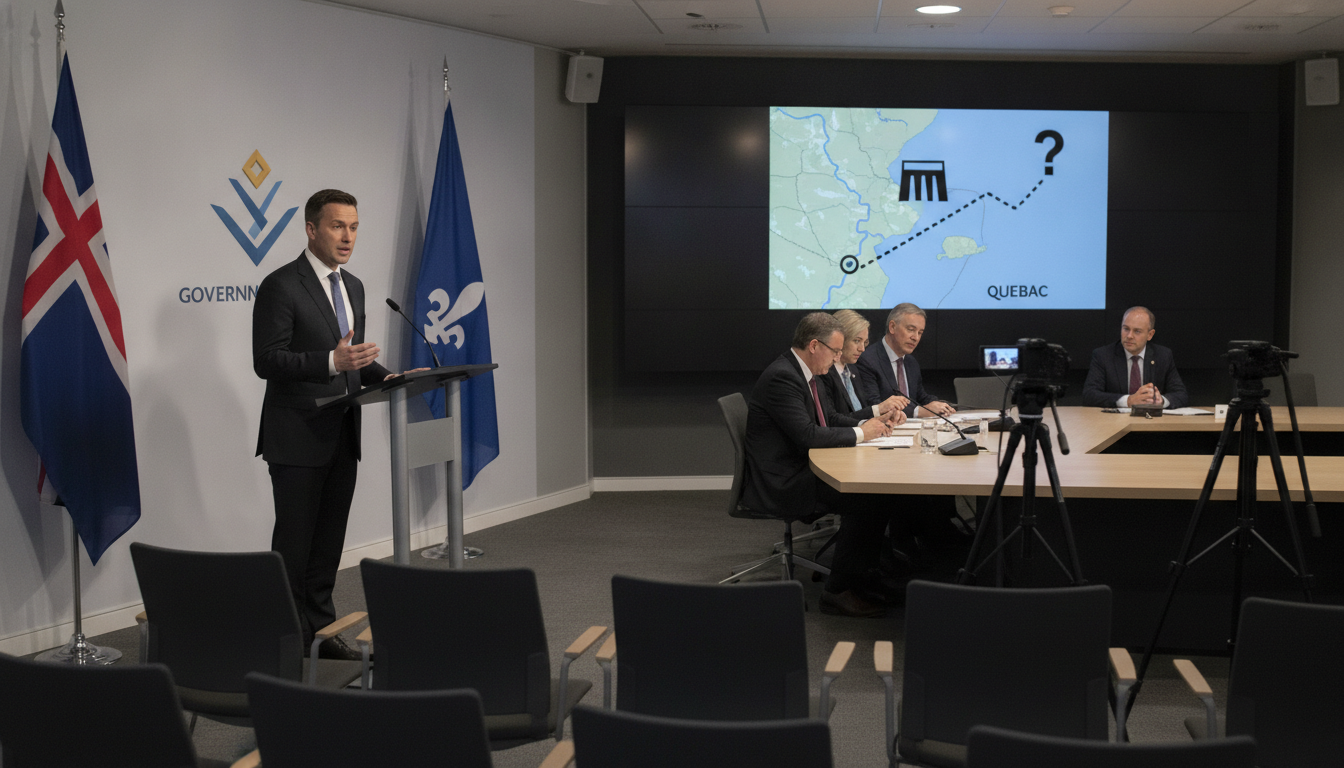
Newfoundland and Labrador Premier Tony Wakeham told reporters Friday that negotiators are moving forward in Labrador-Quebec energy negotiations, but that outstanding issues remain. He spoke at St. John’s International Airport after meeting Quebec Premier Christine Fréchette during the Council of the Federation in Charlottetown on July 21, 2026. Fréchette had earlier expressed optimism that an agreement could be concluded in the coming weeks, a timeline Wakeham declined to endorse.
Wakeham noncommittal at St. John’s press encounter
At the airport, Wakeham described progress in the talks but refused to say whether a final deal was imminent. He emphasized that negotiators still need to resolve specific commercial and transmission questions before any binding agreement can be signed. His measured remarks contrasted with a more upbeat tone from Quebec’s leadership earlier in the week.
Wakeham stressed that while ministers and officials have advanced technical discussions, political sign-off requires further clarity on power allocations and export mechanisms. He said the provinces are “working through” outstanding items rather than announcing a firm timetable for completion.
Fréchette signals hope for rapid conclusion
Quebec Premier Christine Fréchette expressed confidence this week that negotiations could be wrapped up “in the next few weeks,” remarks delivered in Charlottetown on July 21, 2026. Her comments followed bilateral discussions with Wakeham at the Council of the Federation, a forum that gathers provincial premiers to coordinate on intergovernmental matters. Fréchette’s optimism reflects Quebec’s interest in securing additional hydroelectric capacity and export arrangements from Labrador development.
Quebec officials have framed the talks as a way to expand clean power supplies while enabling larger-scale electricity exports to eastern markets. That narrative aligns with Quebec’s broader provincial strategy to capitalize on hydropower assets for economic and climate policy goals.
Reopening the December 2024 Churchill River draft agreement
The current talks are a renegotiation of a draft agreement first unveiled in December 2024 that proposes increasing hydroelectric capacity on the Churchill River in Labrador. The draft envisions expanded generation and new transmission links to move Labrador power to market, but several technical and commercial terms remain under debate. Newfoundland and Labrador are pressing for larger allocations of energy and greater control over how power is routed to export markets.
Officials from both provinces have been examining how capacity expansion, reservoir operations and transmission rights would be governed under any revised deal. Those operational details are central to whether the project can deliver the intended economic benefits to Labrador communities and to provincial coffers.
Boundary and historical claims reappear in negotiations
Wakeham reiterated a sensitive point in his public remarks, saying he would not discuss the question of the border and affirming that Labrador is part of Newfoundland and Labrador. The comment evoked a decades-long dispute over Labrador’s boundaries that has periodically surfaced in interprovincial relations. The sensitivity underscores how non-economic issues can influence technical energy talks when questions of jurisdiction and resource ownership arise.
Observers note that boundary language can be politically charged and may complicate negotiations if either side perceives territorial claims as linked to resource rights. Wakeham’s remark was a reminder that historical grievances remain a backdrop to contemporary deals.
Quebec party conditions and calls for compensation
Pascal Paradis, the Parti Québécois critic on energy, told the National Post that his party would be open to concluding an energy agreement with Wakeham only if it included compensation related to a 1927 Privy Council decision. That 1927 ruling awarded parts of Labrador to Newfoundland in a dispute decided before the island joined Confederation, and Paradis said any deal should acknowledge historical impacts through some form of compensation. His statement introduces another political condition that could factor into provincial negotiation positions.
The inclusion of historical compensation as a bargaining point raises the possibility that partisan and symbolic demands could be woven into what are otherwise technical commercial negotiations. Such conditions may broaden the scope of talks beyond electricity planning and transmission.
Political stakes and regional export ambitions
Both provinces have significant political and economic stakes in the outcome, with Newfoundland and Labrador seeking greater access to export markets and Quebec pursuing additional clean generation to bolster exports and domestic supply. Successful negotiation could mean expanded hydropower output, new transmission corridors and potential revenues for communities and provinces. Failure to reach agreement, conversely, could delay projects and keep contentious issues unresolved.
Municipal leaders, Indigenous communities and industry stakeholders are monitoring the talks closely, as the terms will shape employment, revenue distribution and environmental management across Labrador and adjacent regions. Those local and regional considerations are likely to feature in upcoming discussions.
Next steps will hinge on negotiators ironing out transmission rights, allocation of energy volumes, and any political conditions such as compensation or boundary language. Both premiers signaled willingness to continue talks, but each also left room for further bargaining before any final deal is signed.
The coming weeks will be decisive for the Labrador-Quebec energy negotiations as officials weigh technical feasibility alongside historical and political demands. Observers will watch for updates from provincial negotiators and any joint announcements that clarify timelines, project scope, and how the provinces intend to balance regional interests with broader export opportunities.
