
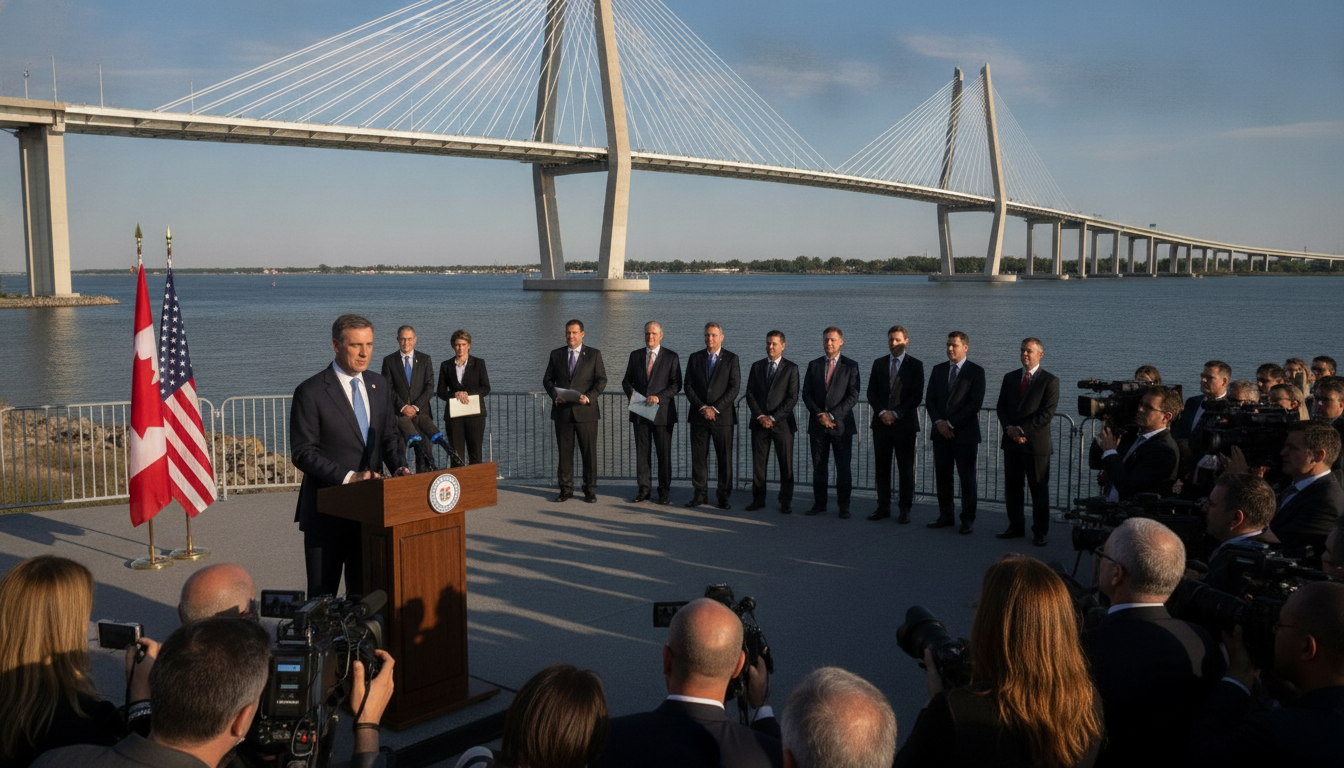
Carney says he could have explained Gordie Howe Bridge toll-sharing deal more clearly as opening nears
Mark Carney concedes confusion over Gordie Howe Bridge toll-sharing deal as the opening is scaled back amid U.S. tariff threats and political scrutiny.
Prime Minister Mark Carney acknowledged on Thursday that he could have been clearer about an agreement governing toll revenues for the Gordie Howe Bridge as the new crossing prepares to open.
The prime minister confirmed a proposed deal would see Canada share half of net toll receipts with U.S. counterparts for the first 15 years.
He said details of how payments will be handled — including routing into a Canada–U.S. economic development fund to be administered by the United States — were not explained well enough to the public.
Prime Minister clarifies nature of earlier statements
Carney said his earlier remarks had referred to the original agreement with Michigan, which remains in place and stipulates that toll revenues would be shared with that state only after Canada has repaid its construction debt.
He acknowledged the two arrangements are distinct: the initial Michigan pact envisages revenue sharing after debt retirement, which could occur decades from now, while the latest outline covers an interim 15-year revenue split.
The prime minister conceded that his public explanations over recent weeks left room for misinterpretation and that he could have provided greater detail from the outset.
Key provisions of the proposed revenue arrangement
Under the principal terms described by the government, Canada would remit half of net toll receipts to the United States for a 15-year period once the bridge opens.
Those transfers are to be channelled into a binational economic development fund managed by the U.S. government, according to the document presented by Ottawa officials.
The agreement does not, according to the government, alter the standing Michigan arrangement that ties longer-term revenue sharing to Canada’s repayment of the bridge-related debt.
Opposition accuses government of misleading Canadians
Conservative MPs seized on the clarification, saying voters were misled about how toll revenues would be handled and accusing the government of yielding to U.S. pressure to secure the bridge opening.
Conservative spokespersons have described the situation as a sequence of concessions and said Canadians deserve straightforward answers about public assets and cross-border deals.
New Democrat members also pressed for transparency, stressing that the Gordie Howe Bridge is critical public infrastructure and that citizens must understand both the financial and operational arrangements.
Parliamentary committee summons to probe the agreement on July 29
Kelly McCauley, chair of the House of Commons Standing Committee on Government Operations, announced he will convene a meeting on July 29 to examine the text and the government’s public statements.
The committee session is intended to provide MPs an opportunity to question ministers and officials directly and to “shed light” on the terms that have provoked criticism.
Opposition members have indicated they will press for documents and witnesses to explain why the newer deal differs in timing and mechanics from the earlier understanding with Michigan.
Opening ceremony scaled back after U.S. trade threats
Ottawa announced it will not hold a joint celebration with the United States to mark the bridge opening after recent tariff threats from Washington, a decision the federal government framed as necessary given the tense trade backdrop.
President Donald Trump last week threatened steep duties — including a cited proposal of 50 per cent on a range of Canadian products — and linked the measures to issues such as provincial alcohol restrictions, supply management and auto-sector rules.
The Canadian government said those threats prompted a recalibration of bilateral public events while negotiations continue to de-escalate trade tensions.
Next steps for the bridge and bilateral talks
A domestic inauguration for the crossing is scheduled for Friday, with full vehicle traffic expected to begin on Monday, and officials say operational preparations are underway to move commercial and private traffic onto the new span.
Carney told reporters he spoke with President Trump earlier this week and that both sides agreed to intensify commercial and diplomatic talks aimed at resolving outstanding trade disputes and facilitating the bridge’s smooth integration into cross-border transport networks.
Parliamentary oversight, ongoing bilateral negotiations and public scrutiny are now likely to shape how toll revenues are administered and how the two countries cooperate on managing the new crossing.
The Gordie Howe Bridge is a major piece of Canada–U.S. infrastructure whose financing and revenue model will have long-term implications for trade, regional economies and taxpayer exposure.
As the crossing moves from construction to operation, the government faces immediate pressure to provide clear documentation and to answer persistent questions from opposition parties and the public.
How Ottawa and Washington reconcile the short-term revenue arrangement with the original Michigan agreement, and how they manage related trade tensions, will determine whether the bridge’s opening is remembered for connecting communities or for political controversy.
