
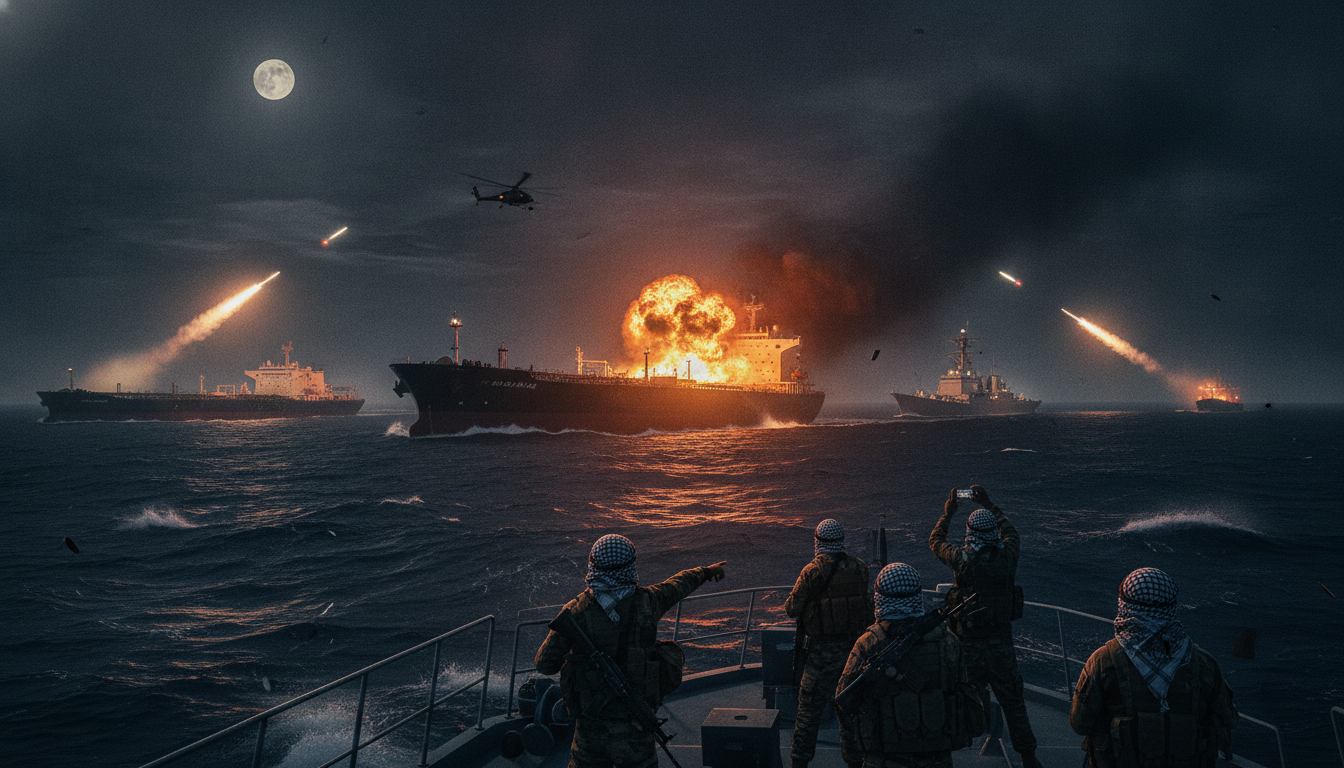
Houthi attacks in the Red Sea strike two Saudi tankers, widening Iran‑US clash
Houthi attacks in the Red Sea on July 22, 2026 targeted two Saudi tankers, escalating the Iran‑US confrontation as shipping lanes and oil markets face growing disruption.
The Houthi movement in Yemen claimed responsibility on Wednesday night, July 22, 2026, for strikes on two Saudi‑linked tankers in the Red Sea, marking a sharp widening of the conflict as U.S. forces continued strikes on Iran. Saudi authorities confirmed that the vessel Encelia—described as owned by a Saudi company—sustained a fire at the bow but that its crew were reported safe. The British maritime reporting body UKMTO separately recorded a ship struck by an unidentified projectile roughly 130 kilometres off the Saudi port of Al Shuqaiq.
Houthi claims and Saudi reaction
The Houthi announcement said the attacks were part of an operation against two Saudi tankers that had violated a maritime blockade the rebels declared earlier in the week. The group named the ships as the Encelia and the Layla and said radio warnings had been issued to vessels attempting to transit contested waters.
A Saudi official source and the state news agency SPA confirmed the Encelia was hit and described the onboard fire, while stressing there were no fatalities among the crew. Maritime authorities have advised heightened caution in the Red Sea after the Houthi threats and reported engagements.
U.S. strikes on Iran and regional escalation
U.S. forces carried out what they described as another series of strikes against Iranian targets, continuing a campaign that the Pentagon said aimed to reduce Tehran’s ability to threaten commercial mariners. U.S. military statements reported actions intended to disrupt Iranian operations in the Strait of Hormuz and to limit threats to international shipping.
Iranian forces and state media reported multiple incidents inside Iran, including missile strikes near the Bushehr region and attacks on sites along the Gulf coast. Iranian statements and allied claims have added to a pattern of daily tit‑for‑tat strikes that officials warn could further destabilize the broader region.
Maritime safety and shipping diversions
Shipping monitors reported increased rerouting and caution among commercial vessels. Data cited by international agencies indicated that at least nine ships had turned back in or near the Bab el‑Mandeb strait and the southern approaches to the Red Sea since Houthi warnings went into effect.
Centres tracking maritime security said one commercial vessel was immobilized and several were diverted to prevent entry to or exit from Iranian ports during recent U.S. operations. The disruptions have prompted insurers and shipping firms to reassess routes and risk premiums for transits through both the Red Sea and the Strait of Hormuz.
Civilian casualties and Iranian domestic strain
Iranian provincial officials and state outlets reported civilian casualties following recent strikes, including two people killed and 11 wounded in Shalamcheh near the Iraqi border. Reports also described explosions and damage in multiple locations, and state media highlighted economic strains at home caused by sanctions and the growing toll of the conflict.
Voices from within Iran described worsening living conditions, with inflation and disrupted services compounding public anxieties as security incidents continue. Humanitarian and economic analysts warn that an intensifying military exchange will deepen hardship for ordinary citizens across the region.
Wider military claims beyond Iran and Kuwait alerts
Tehran has publicly claimed strikes on U.S. military supply and logistics sites in neighbouring states, including allegations of attacks on depots inside Kuwait and the destruction of radar and missile systems in Jordan. Kuwait reported intercepting hostile drones early on Thursday, indicating the potential for spillover across national borders.
U.S. Central Command has described efforts to interdict maritime movements and to impose constraints intended to limit Iran’s ability to resupply or launch further threats. Regional governments and international naval authorities have urged caution as contesting claims and counterclaims complicate verification on the ground.
Oil markets and economic consequences
Markets reacted quickly to the widening of hostilities, with Brent crude trading back above US$95 a barrel on Thursday amid renewed fears about supplies and safe passage through strategic chokepoints. Analysts flagged the potential for higher freight costs and insurance premiums to feed through to refined product prices and global energy markets.
Saudi Arabia’s status as a leading crude exporter and Iran’s control over parts of the Strait of Hormuz underscore why these maritime confrontations carry outsized economic risk. Any sustained disruption to exports or prolonged closure risks pushing energy markets higher and increasing volatility for consumers and businesses worldwide.
The situation remains fluid as international actors assess immediate security steps and diplomatic options to prevent further escalation. Naval authorities and commercial operators are maintaining heightened advisories for ships in and transiting to the Red Sea and Strait of Hormuz while governments call for restraint amid competing military claims.
