
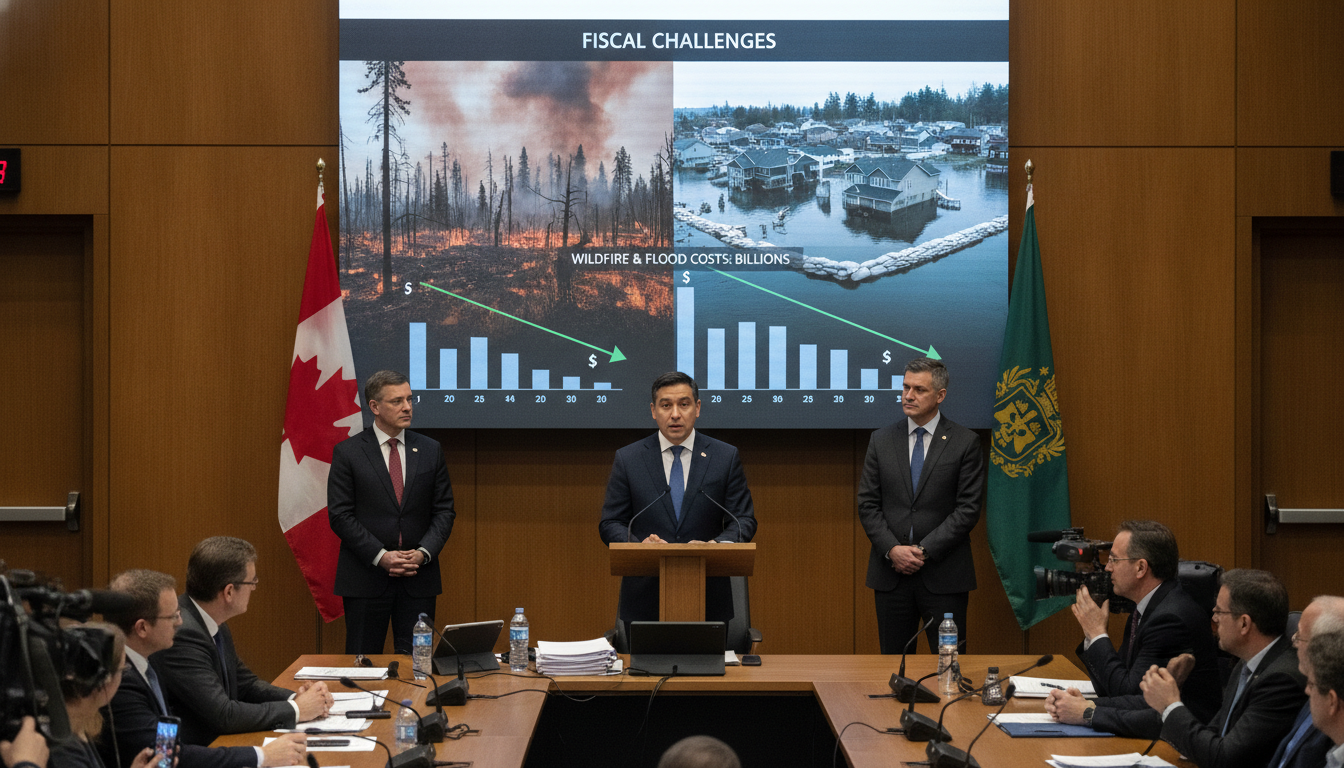
Manitoba’s budget resilience strained as wildfires and floods inflict billions in damage
Manitoba faces mounting repair and relief costs after consecutive wildfires and floods that threaten Manitoba’s budget resilience and force sweeping fiscal re-evaluations.
The provincial government says the back-to-back disasters — intense wildfires in 2025 followed by severe storms and flooding in June 2026 — have pushed costs into the billions and altered planning assumptions for infrastructure and social programs. Officials warn that funds earmarked for routine services and deficit reduction will need to be rerouted to emergency relief, rebuilding and adaptation measures. The scale and frequency of these events are prompting new discussions about how the province budgets for climate risk.
Extent of damage and insurance claims
The wildfire season of 2025 consumed roughly 4 percent of Manitoba’s land area, displacing about 33,000 people and causing two fatalities, according to provincial summaries. Direct public-sector costs from that season ran into the hundreds of millions of dollars, straining immediate relief capacities and emergency services.
In June 2026, consecutive storms and widespread flooding forced 50 municipalities to declare states of emergency, inundated hundreds of homes and businesses, and damaged approximately 30,000 vehicles. Insurers report claims topping $925 million, a figure that does not capture all uninsured losses or long-term infrastructure repairs.
Premier signals shifts in government services
Premier Wab Kinew has acknowledged the need for government operations to change in response to the new climate reality, telling the Legislative Assembly on July 10 that services and infrastructure planning must adapt. He emphasized that the province is learning in real time how extremes will alter demand for emergency response, housing supports and public works.
Kinew’s office says officials are reviewing capital priorities and service delivery models to better accommodate recurring extreme weather, but any major shifts will require difficult trade-offs amid existing fiscal constraints. The premier has prioritized flexibility in near-term spending while seeking longer-term solutions.
Budget projections under pressure
Before the recent disasters, Manitoba’s public accounts projected a $1.6-billion deficit for the 2025–2026 fiscal year, a shortfall that finance officials were already managing. Finance Minister Adrien Sala had expected that a milder wildfire season would help cut that gap to roughly $498 million in 2026–2027, but the exceptional June rains have undermined that outlook.
Officials now say the rerouting of funds toward emergency compensation, infrastructure repair and municipal supports will complicate the path back to balance. That reallocation reduces resources available for programs targeted at reducing the operating deficit, making the government’s stated objective of fiscal equilibrium more difficult to achieve in the near term.
Calls for a large stabilization fund
Academic and economic advisers are urging Manitoba to consider a dedicated stabilization or catastrophic risk fund to smooth fiscal shocks from climate extremes. Phil Cyrenne, an economist at the University of Winnipeg, has argued that broader insurance-like mechanisms or contingency reserves are needed if climate events begin to hit wide geographic areas simultaneously.
Cyrenne cautions, however, that traditional insurance models weaken when risks are correlated across whole regions, leaving governments to weigh whether to expand public buffers, transfer more risk to the private sector, or adopt a hybrid approach. The debate raises questions about premium structures, intergovernmental cost-sharing and the scale of reserves required to be credible.
Economic sectors and tax base implications
The recurring sequence of fires and floods is already disrupting key pillars of Manitoba’s economy, including tourism and agriculture, with cascading effects on provincial revenues. Over the past two decades the province has recorded multiple major floods and several severe wildfire seasons, patterns that reduce seasonal tourism receipts and harm crop yields for large swaths of rural Manitoba.
Lower economic activity and property damage translate into reduced tax collections at a time when public spending needs are rising. Municipalities and businesses facing repeated losses may delay investments, further weakening the tax base and making recovery financing more difficult for both local and provincial governments.
Hydro-Manitoba debt complicates recovery options
The government had hoped that higher water levels in Lake Winnipeg might provide unexpected revenue to Crown utility Hydro-Manitoba, but officials caution that any uptick will be insufficient to cover broader repair and adaptation costs. Hydro-Manitoba is already carrying significant liabilities, with estimates of around $25 billion in debt and an acknowledged need for about $30 billion to modernize aging infrastructure.
Finance experts warn against expecting large dividend streams from the utility at a time when it must prioritize capital renewal and debt management. Redirecting Hydro-Manitoba cash flow toward provincial relief would likely worsen the utility’s fiscal position and undermine long-term service reliability.
As Manitoba moves from immediate emergency response into the reconstruction phase, policymakers face hard choices about the trade-offs between restoring services, protecting vulnerable communities and returning to a sustainable budget path. The twin shocks of 2025 and June 2026 have illustrated how quickly climate-related events can rewrite fiscal assumptions, leaving the province to balance urgent recovery with long-term resilience planning.
