
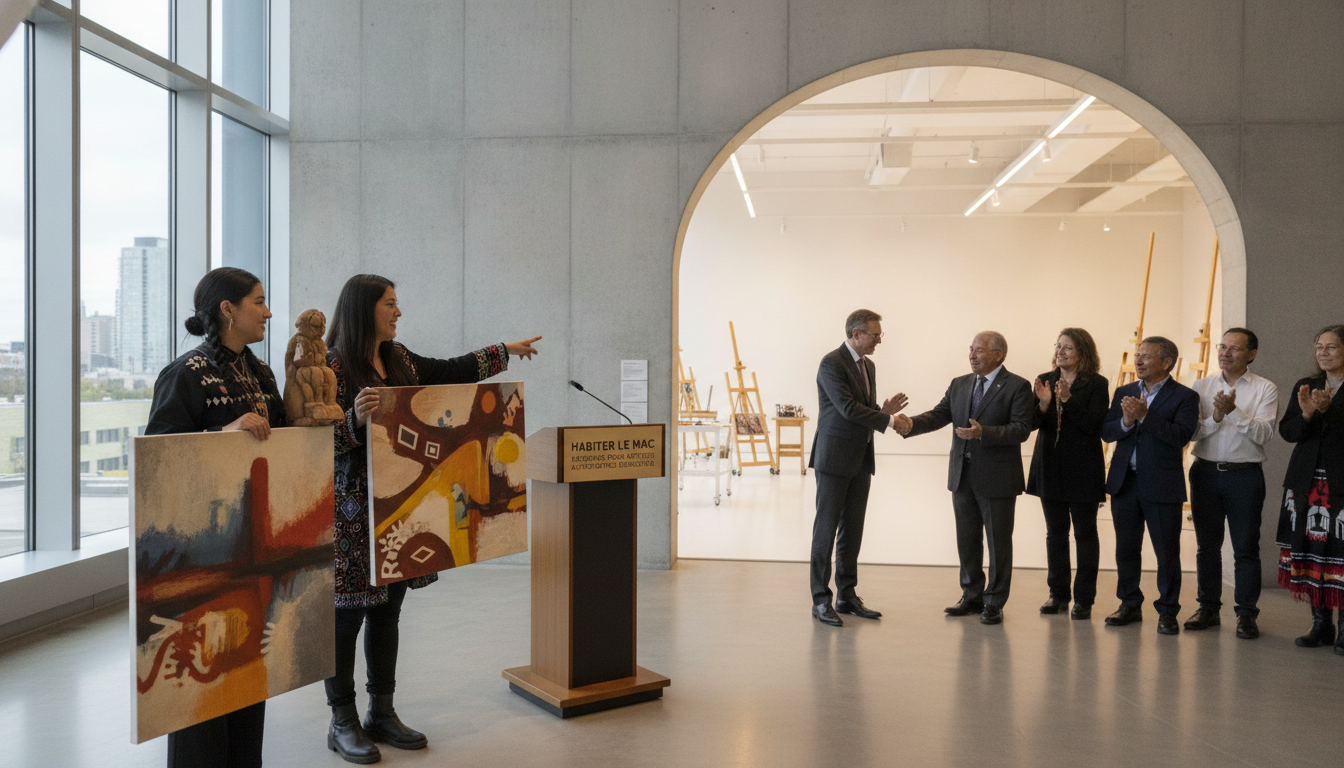
Habiter the MAC residency brings six emerging artists, including Marly Fontaine and Sierra Barber, to MAC Montréal studios
Habiter the MAC residency places six emerging artists at Montreal’s MAC with studio space, mentorship and public programs from July 22 to December 6, 2026.
Marly Fontaine and Sierra Barber are among six early-career artists named to the inaugural Habiter the MAC residency at the Musée d’art contemporain de Montréal.
The program, based at the museum’s temporary site in Place Ville‑Marie, provides studio space, mentorship and professional support through December 2026.
Organizers say the initiative is designed for experimentation rather than a conventional residency model that ends in a curated exhibition.
Six artists announced for inaugural cohort
Six emerging artists were given access to on-site studios and museum resources for an eight-month period that runs through December 2026.
The first cohort will vacate the spaces in December, when a second cohort is scheduled to begin an eight-month term.
The museum emphasizes rotating cohorts to broaden opportunities for early-career practitioners.
Public programming built into the residency
Habiter the MAC residency includes regular public encounters and workshops that invite visitors into artists’ processes.
Program coordinators encourage dialogue between artists and audiences, noting that those conversations are integral to the work being developed.
Attendance details and events are scheduled throughout the residency to make studio practice more visible to the public.
Marly Fontaine centers residential school histories in her studio work
Marly Fontaine, an Innu artist from Uashat mak Mani‑utenam, is using her studio time to continue doctoral research in Innu oral arts and culture at the Université du Québec en Outaouais.
Her practice combines performance, sculptural objects and interventions that address the legacy of residential schools and personal experiences of abuse.
Projects in progress include soap sculptures that reference punitive practices in residential schools and symbolic objects that confront institutional and religious violence.
Sierra Barber weaves Mohawk beading and oil painting
Sierra Barber, a Kanien’kehá:ka artist from Six Nations of the Grand River, is exploring the intersection of beadwork and oil painting in her studio practice.
Her work references 19th‑century beading styles that were traded to tourists at Niagara, and she uses hidden motifs to carry cultural narratives across generations.
Recurring imagery such as strawberries appears in Barber’s paintings as a culturally resonant symbol that anchors memory and identity in her compositions.
Residency model emphasizes experimentation over exhibition
Program curators describe Habiter the MAC as a nontraditional residency that privileges research and risk-taking rather than a finished show.
Artists will receive mentoring and professional development from museum staff to advance individual practices and career pathways.
The program explicitly foregoes a concluding exhibition, allowing participants to test processes without the pressure to present a final product.
Public schedule and museum location information
Members of the public can meet Marly Fontaine at the museum on July 22, 2026, while Sierra Barber is scheduled for a public encounter on December 2, 2026.
Artists will also lead creation workshops this fall and participate in open‑studio days on December 5 and 6, 2026, when the cohort’s work will be accessible to visitors.
The Musée d’art contemporain de Montréal is operating from a temporary location at Place Ville‑Marie, at Mansfield and Cathcart, and has announced plans to reopen its main site in 2028.
The Habiter the MAC residency places a spotlight on Indigenous artists working across mediums while testing a model that foregrounds process, community engagement and professional development.
By embedding public programming into the studio experience, the museum hopes to foster conversation around histories, identity and cultural survival that the artists are addressing in their work.
