
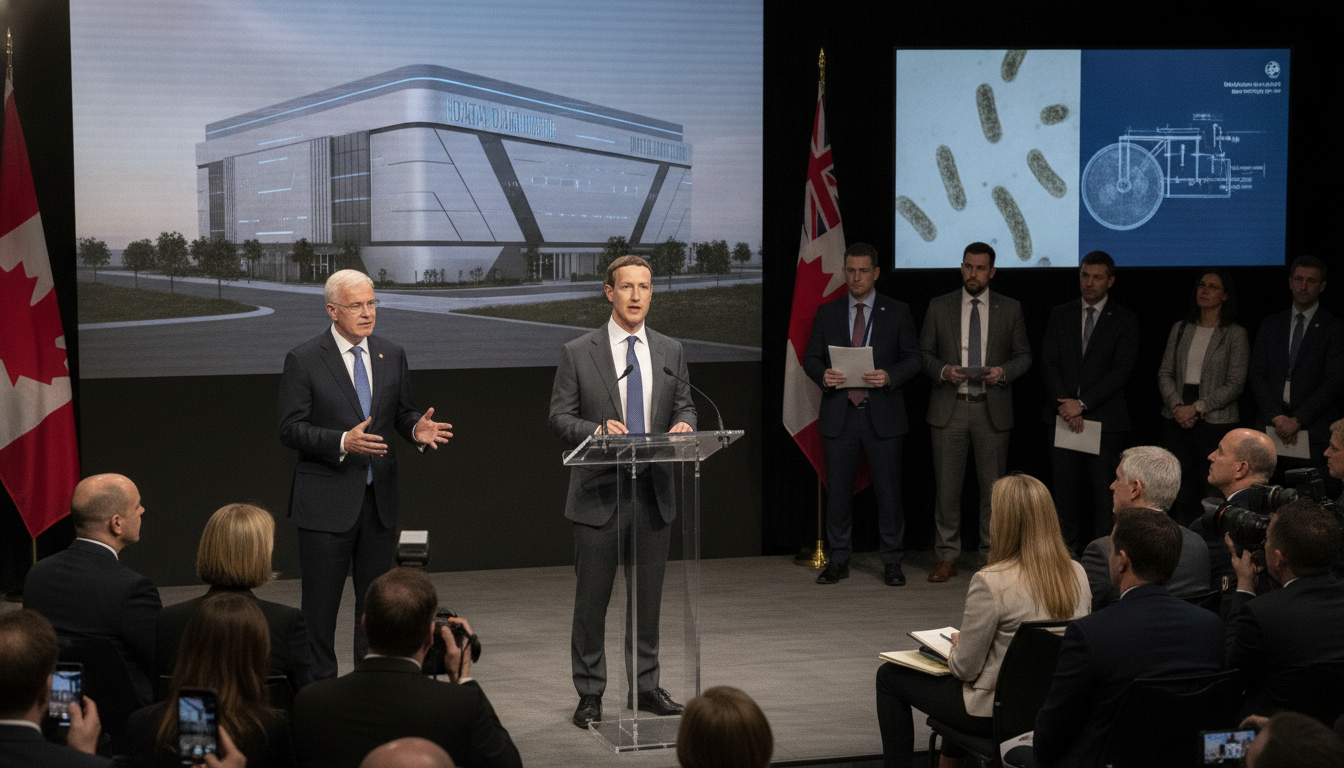
Meta data centre in Sturgeon County advances amid U.S. bacterial scare and Alberta energy debate
Meta data centre in Sturgeon County raises power, water and safety questions after a U.S. wastewater bacteria finding; Alberta and Meta say risks are contained.
Alberta’s announcement that a Meta data centre in Sturgeon County will move forward has reignited debate over energy, water and local safety after a separate Meta construction site in Wyoming recorded a wastewater bacterial finding. Meta has said the Wyoming incident, tied to a contractor, is contained and under investigation, while Premier Danielle Smith and local officials have promoted the Sturgeon County development as an economic win for the region. The proposed $13‑billion hyperscaler and its partners have pledged to work with utilities and municipalities on grid, water and environmental measures as scrutiny intensifies.
Meta outlines response to Wyoming wastewater finding
Meta executives told local media that tests at the Cheyenne site detected Cupriavidus gilardii in wastewater and that the company is cooperating with contractors and community authorities to resolve the issue. Company officials emphasized there are no current positive tests beyond the initial detection and described ongoing investigations into the source and containment. Meta framed its response as responsible corporate stewardship and said it will provide required data and support to local health and utility officials. The company repeated commitments to adhere to local codes and to work closely with contractors to prevent recurrence.
Premier defends project, highlights economic returns
Premier Danielle Smith used a radio address to defend the Meta data centre in Sturgeon County, framing the development as a form of local value‑added industry that will convert Alberta’s gas resources into high‑value digital services. She cited expectations of substantial tax revenue — estimating at least $250 million annually — and argued the facility will support transmission cost reductions for other ratepayers. Smith positioned the project as consistent with Alberta’s economic strategy and rejected criticism that the development would undercut provincial energy stewardship. Her remarks underscore the political importance of the project to the governing United Conservative Party.
Pembina Institute raises energy and emissions concerns
Environmental groups have pushed back, arguing that Alberta’s Bring‑Your‑Own‑Generation (BYOG) framework effectively steers large data centres toward gas‑fired electricity. The Pembina Institute warned that forcing on‑site, fossil‑fuel generation choices could lock in higher emissions and higher consumer energy prices if other jurisdictions increase demand for natural gas. Pembina’s electricity program director said allowing a broader mix of low‑carbon technologies would better serve long‑term climate and market goals. The institute’s criticism is central to broader public scrutiny of how hyperscale facilities are powered in Alberta.
Greenlight plant planned as local generation partner
A gas‑fired combined‑cycle plant known as Greenlight is already under construction near the proposed site, developed by the same joint‑venture partners that assembled land for the data centre. Developers say the plant will produce electricity at scale and feed into the AESO grid, indirectly supporting the Meta facility among other users. Meta has stated it will partner closely with electric utilities and grid operators to ensure upgrades are identified and paid for by the project where required, and that other ratepayers will not shoulder those costs. Local officials say the industrial heartland’s long zoning and infrastructure planning make it suitable for large energy and data investments.
Company details water use and cooling approach
Meta has described a closed‑loop liquid‑cooling system for the facility that it says will limit long‑term water demand, with official figures indicating roughly 60 cubic metres of operational water per day for the system’s makeup needs. The company also noted the use of dry coolers for most thermal management and that daily water use for kitchens, bathrooms and fire protection would be separate. Meta told officials it will work with municipal water utilities to assess impacts and finance any necessary upgrades so that residents and existing ratepayers are not adversely affected. The company stressed compliance with noise, emissions and local regulatory requirements as part of its “good neighbour” policy.
Municipal leaders and local industry express support
Municipal and industry representatives in Sturgeon County have welcomed the project, citing decades of industrial planning and zoning that identified the area for large‑scale development. Local leaders have framed the data centre as compatible with the region’s existing heavy industrial uses and as a source of jobs and municipal revenue. Supporters also point to prior infrastructure investments and the potential for broader economic activity tied to data centre construction and operations. At the same time, community groups and environmental advocates continue to press for transparent reporting and independent oversight of both construction impacts and operational emissions.
As the Meta data centre in Sturgeon County advances through planning and permitting, officials at both provincial and corporate levels face the task of balancing economic promises with environmental and public‑health concerns. Ongoing monitoring, public reporting of water and wastewater practices, and clear utility upgrade plans will be key to maintaining local confidence as the project moves from announcement into construction and eventual operation.
