
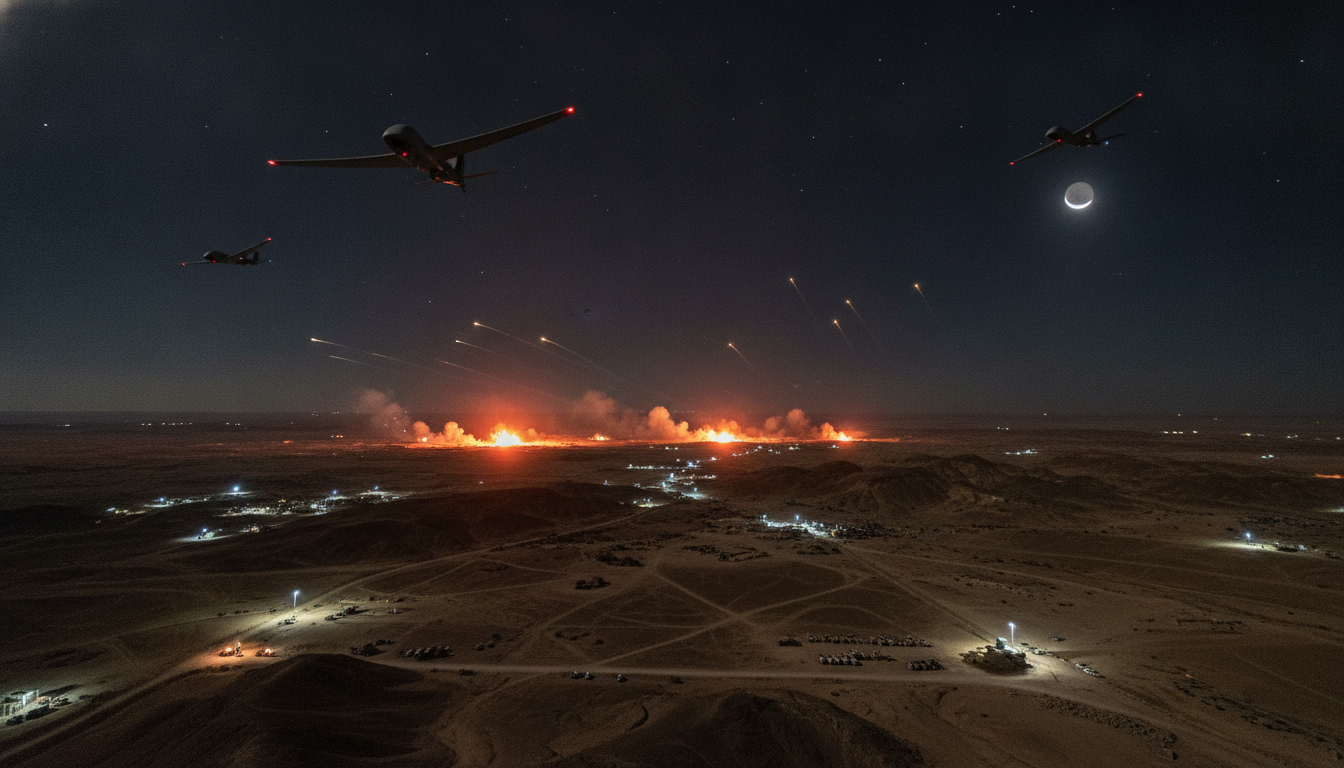
Yemen drone warfare intensifies as government forces deploy drones across key fronts
Yemen drone warfare is shifting as pro-government forces increasingly use armed drones against Houthi positions in Marib, Taiz and al‑Makha, raising concerns of a broader ground confrontation.
Opening summary of recent shifts
The Yemen drone warfare dynamic has changed in recent weeks as forces loyal to the internationally recognised government publicly demonstrated an uptick in armed-drone operations against Houthi positions. Government-aligned units released footage and statements showing strikes in Marib, al-Jawf, Taiz, Hajjah, al-Dhalea and along the western coast. Analysts say the move does not erase the Houthis’ longer-established missile and drone capabilities, but it does signal a potentially meaningful change in battlefield behaviour.
Government strikes visible on multiple fronts
Pro-government forces have claimed responsibility for a series of strikes that appear to be more coordinated than past isolated operations. Drones, supplemented by artillery fire and increased troop activity, have been employed to hit Houthi gatherings, logistics nodes and command sites. These actions suggest a transition from defensive interdiction to a posture aimed at imposing costs and constraining Houthi freedom of movement.
Houthis still hold technical and operational advantages
Despite recent government activity, the Houthis retain years of experience assembling and launching missiles and unmanned systems, as well as an established logistics and command infrastructure. Their offensive operations have continued across the country, including strikes on Marib and Hadramout, recurring attacks on al-Makha and escalations targeting Saudi territory and Red Sea shipping. That advantage, however, may be softened if government strikes force the Houthis to alter deployment patterns or reduce exposed concentrations of forces.
Marib, Taiz and al‑Makha as strategic gateways
The geography of the recent operations gives the developments added significance. Marib remains a political and military centre of gravity for the internationally recognised authorities and a successful campaign there could reveal supply lines and defensive vulnerabilities. Taiz sits at a central coastal junction whose activation can immobilize sizeable forces, while al‑Makha and the western coast stand as gateways to Bab al‑Mandeb and the approaches to Hodeidah. Targeting these axes can be seen as testing the viability of a larger coastal or ground campaign.
Signs of preparation versus episodic testing
Military movement, transfer of ammunition and repositioning of reserves are the clearest indicators that testing may be evolving into preparation for larger operations. Observers note that counting sorties or individual strikes is less instructive than tracking how forces and supplies are being arrayed. If troop concentrations and logistics start to focus on a clear axis, the conflict could move from probing strikes to deliberate front preparation.
Political signals and deterrence posture
Presidential Leadership Council Chair Rashad al‑Alimi has publicly urged the Houthis to lay down arms and join political life while warning that attacks will be met with comprehensive responses. Those statements have been matched by more visible government actions on the ground, lending political weight to the message. Whether those moves will be codified into a sustained operational doctrine — where every Houthi attack incurs a consistent and direct cost — remains the critical test for government strategy.
Regional context elevates the stakes
The broader security picture amplifies the risks of miscalculation. Disruption in the Strait of Hormuz, tensions between the United States and Iran, and the strategic importance of Red Sea maritime routes have increased the value of Bab al‑Mandeb as a lever of influence. Iran’s capacity to pressure Hormuz and the Houthis’ ability to threaten the southern Red Sea create overlapping corridors of vulnerability that Saudi Arabia and international partners are racing to protect.
Possible division of roles among partners
A plausible future trajectory is one in which Yemeni government forces assume primary responsibility for ground operations while Saudi Arabia and external partners focus on deterrence, maritime security and air support. Such a division would reduce the direct footprint of external ground forces but could still produce sustained combat across Yemeni terrain if coordination and supplies are maintained.
The immediate danger is an expanded margin for strategic error: the Houthis testing the limits of pressure on Saudi Arabia and international navigation, government forces trying new tools to regain initiative, and regional powers jockeying for influence amid a tense US‑Iran backdrop. Those overlapping pressures raise the likelihood that limited exchanges could escalate into broader confrontation if movements of forces, ammunition and logistics become concentrated along specific axes.
