
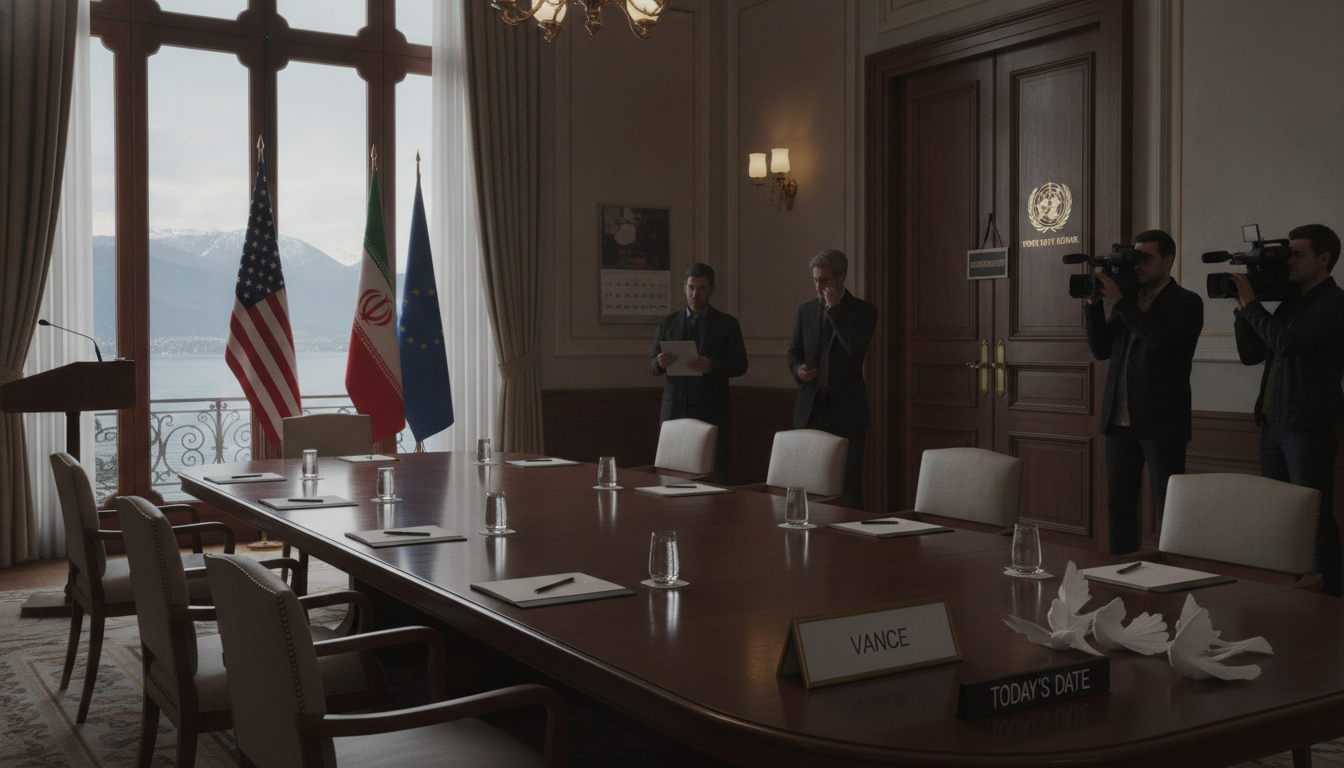
Iran-US talks in Switzerland postponed after U.S. vice-president cancels trip
Meta description: Swiss government says Iran-US talks set for June 19, 2026 at Bürgenstock have been postponed indefinitely after U.S. Vice‑President J.D. Vance cancelled his trip.
The planned Iran-US talks in Switzerland, scheduled to begin on June 19, 2026 at the Bürgenstock resort, were postponed indefinitely on Friday after U.S. Vice‑President J.D. Vance cancelled his trip, Swiss authorities said. The negotiations, intended to advance a framework agreement signed earlier this week, were to include delegations from the United States, Iran, Qatar and Pakistan and focus on Iran’s nuclear programme. Swiss diplomats said preparatory work continues but provided no new date for rescheduling, leaving the future of the Iran‑US talks unclear.
Swiss foreign ministry announces postponement
The Swiss Federal Department of Foreign Affairs issued a brief statement confirming the talks had been deferred sine die and reaffirming Switzerland’s readiness to facilitate future meetings. Officials said technical preparations were ongoing but stopped short of assigning a timeline for renewed talks. The announcement followed uncertainty that mounted after the cancellation of senior delegation travel plans, which disrupted the logistics for an event planned at short notice.
U.S. delegation uncertainty after Vance cancels trip
The White House confirmed that Vice‑President J.D. Vance would not travel to Switzerland on Friday, saying logistical arrangements for the talks had not been finalised and that the U.S. team was prepared to depart at the first opportunity. Mr. Vance’s decision, coupled with the reported postponement of Pakistani Prime Minister Shehbaz Sharif’s trip, removed the presence of two mediators seen as important to bridging differences. U.S. and allied diplomats had described the Bürgenstock meeting as a first step toward implementing a broader framework reached this week.
Framework signed remotely; nuclear agenda central to talks
Leaders of the United States and Iran signed an electronic protocol on June 17, 2026, intended as an interim framework to halt the regional conflict that has driven months of fighting. The proposed Bürgenstock negotiations were to be a renewable 60‑day process centred on detailed arrangements for Iran’s nuclear programme and verification measures. Officials involved in planning had described the session as technical in nature, meant to translate the high‑level protocols into operational steps and timelines.
Iranian leadership voices reservations
Iran’s supreme authority endorsed the protocol but voiced clear reservations, signalling internal scrutiny ahead of any face‑to‑face diplomacy. The country’s supreme leader confirmed written approval while warning that future in‑person negotiations would not mean acceptance of adversarial viewpoints. Iran’s lead negotiator framed the agreement as a diplomatic victory while also warning of decisive responses to any violations, underscoring the fragility of the emerging détente.
Economic and maritime consequences under the accord
One immediate effect of the framework was the partial reopening of the Strait of Hormuz, an artery for global oil shipments, where traffic resumed after weeks of disruption. U.S. forces reportedly allowed more than a dozen vessels to transit, and Tehran announced a new governmental body to manage passage requests, with no transit fees to be charged for a 60‑day period as stipulated by the protocol. Commodity markets reacted quickly; crude oil prices fell on Friday toward pre‑conflict levels and U.S. officials highlighted the economic benefits of reduced hostilities.
Regional reactions and continued violence
Despite the agreement and the cessation measures it prescribes, violence continued along several fronts, complicating prospects for durable peace. Israel has maintained military operations against Hezbollah in southern Lebanon, reporting new strikes and casualties since the framework’s announcement. Israeli leaders warned that security operations would continue where deemed necessary, and critics in both Israel and the United States have criticised the framework for allegedly granting Iran economic relief without demanding the dismantling of its nuclear infrastructure.
The proposed deal also envisages the facilitation of a large post‑conflict reconstruction fund, reportedly up to $300 billion, to be unlocked by regional partners in the event of a final agreement, with the United States pledging diplomatic backing rather than direct financial contributions. That plan has provoked debate among regional capitals and in international media over whether economic incentives are balanced by adequate safeguards.
A string of diplomatic and logistical obstacles underscored how fragile the path to negotiation remains. The postponement at Bürgenstock, coming just days after the remote signing of a protocol in Versailles, demonstrates the gap between rapid high‑level accords and the slower, intricate work needed to translate them into lasting arrangements. With the Swiss government saying it remains willing to host and facilitate, attention will turn to whether the key parties can agree on new dates and technical terms that satisfy security, verification and political concerns.
For now, the Iran‑US talks remain on hold and regional tensions persist even as some commercial activities resume. The coming days will be decisive in determining whether the framework can be converted into concrete steps or whether the pause at Bürgenstock signals a longer stalemate.
