
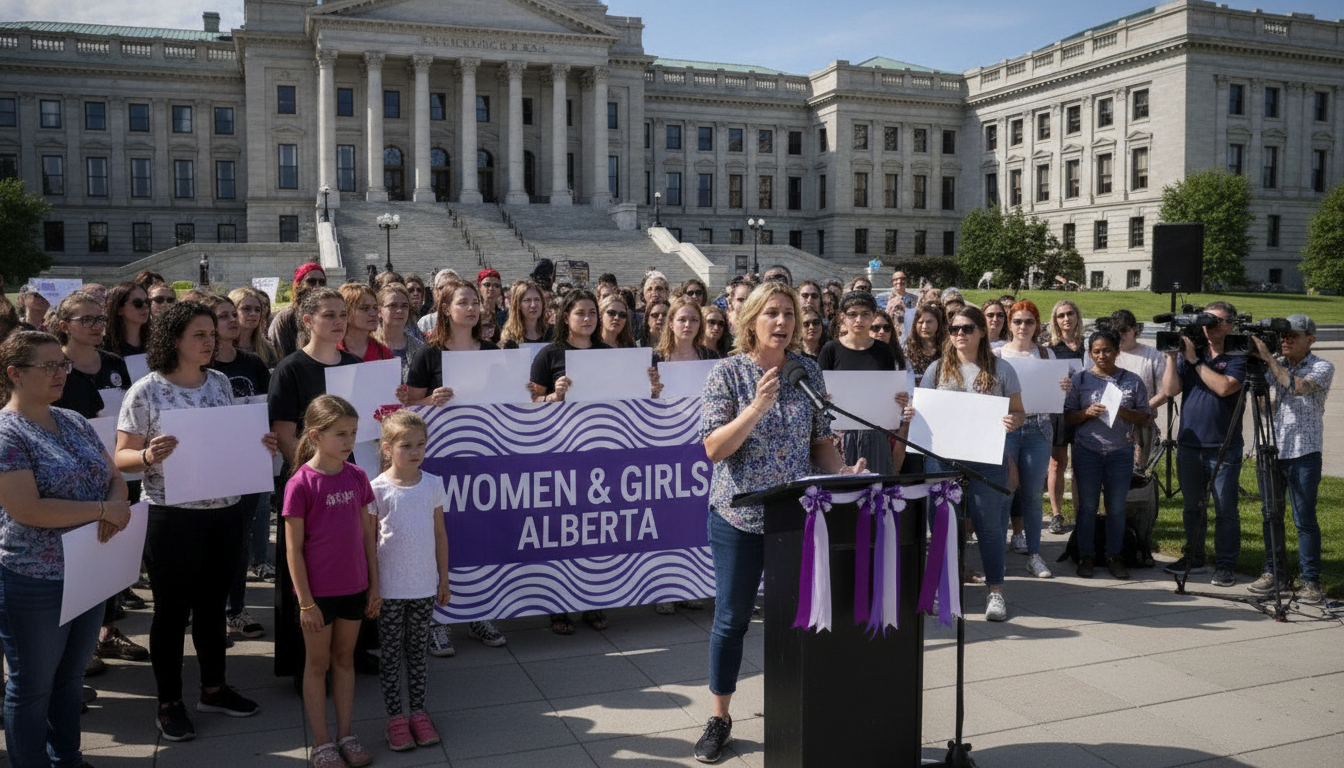
Sex-based rights at centre of debate after Edmonton pool incident and new advocacy group launch
A retired RCMP sergeant says an incident at an Edmonton leisure centre in February 2025 has exposed gaps in protections for sex-based rights, sparking the formation of a provincial advocacy group. The case, which involved a complaint about an adult male present in a women’s change room and a subsequent legal challenge, has reignited debate over how gender identity policies intersect with spaces reserved on the basis of biological sex. Advocates are calling for clearer policy language and legal clarity to reconcile competing rights.
Edmonton pool incident prompts formal complaint
In February 2025 a University of Alberta professor took her 14‑year‑old daughter to the Bonnie Doon Leisure Centre and encountered an adult who appeared male and was nearly undressed in the women’s change room. Staff told the family the person was entitled to be there under the facility’s policy, which grants access on the basis of gender identity rather than sex. Feeling unsafe, the professor contacted police, but the responding officer said no offence had occurred given the centre’s policy.
Human Rights Commission response and court dismissal
The woman filed a complaint with the Alberta Human Rights Commission alleging her sex‑based rights had been violated, but she says forms and responses treated the matter solely as a question of gender. The commission’s intake rejected the complaint without addressing sex as a separate protected ground, and a judicial review filed in the Court of King’s Bench was dismissed on a procedural basis after the City of Edmonton argued it should have been named as a respondent. The dismissal was on a technicality and the merits of the legal question were never heard.
Policy framework creating legal uncertainty
Alberta’s Human Rights Act explicitly includes protections for gender identity and expression, while sex is not listed in the same terms within the commission’s intake procedures, according to the complainant’s account. Critics argue that where policies adopt self‑declaration for access to single‑sex spaces, asking about biological sex becomes legally fraught. The Canadian Charter still guarantees equality on the basis of sex, but advocates say the practical inability to assert sex‑based claims in some institutional settings leaves those rights difficult to defend.
Whistleblower reports raise safety concerns in public settings
Since launching a confidential whistleblower platform, organizers associated with Women and Girls Alberta report multiple accounts from women describing intrusions into female‑only spaces, including alleged indecent behaviour and stalking in change rooms and showers. Staff at the leisure centre reportedly raised concerns with a nearby school whose students use the pool. Organizers say the reports reflect real safety anxieties for women and girls that they feel have been dismissed by officials and policymakers.
Correctional Service Canada findings cited in institutional debate
The group and other commentators have pointed to federal corrections research showing that most inmates who identify as transgender are male‑born, and that approved transfers have moved male‑born inmates into women’s facilities. Those findings have been used to argue that institutional decisions can have concrete consequences for sex‑based safety and that risk assessments and placement policies require transparent scrutiny. Corrections officials and experts say transfers and placements are complex and must balance safety, medical needs, and legal obligations.
Advocates call for policy review and clearer language
The new organization, Women and Girls Alberta, launched public advocacy on June 2, 2026 to press for laws and policies that explicitly account for sex‑based rights alongside protections for gender identity and expression. Its founders, including a retired RCMP sergeant, say managing competing rights requires inclusive consultation and reasonable accommodations rather than sidelining one group. They argue policy language should allow both the recognition of gender identity and the protection of spaces where biological sex distinctions are relevant for safety or privacy.
The dispute has highlighted the difficulty of reconciling overlapping rights in a pluralistic society and underscores the need for clear, workable guidance for front‑line staff, police, and rights bodies. Municipalities, human rights agencies and provincial lawmakers face pressure to produce policies that reduce ambiguity and set out how conflicts between gender identity protections and sex‑based protections will be assessed and resolved.
The unresolved legal questions have left some women and families without a clear route to challenge policies they view as harmful, while proponents of self‑declaration policies say such rules are necessary to protect a vulnerable minority. Both perspectives stress safety and dignity, but they differ on how to operationalize protections in change rooms, shelters, prisons and other single‑sex spaces.
The Edmonton case and subsequent advocacy work have opened a broader public conversation about how laws are drafted and applied. Stakeholders are urging independent reviews, clearer statutory language, and the development of protocols that enable complaints to be heard on their merits. Municipal, provincial and federal authorities will likely face calls to clarify how sex and gender identity are to be balanced within human rights frameworks.
The incident at Bonnie Doon and the group’s launch have made clear that policy choices made in institutions have immediate effects on people’s daily lives, and that resolving competing rights claims will require deliberate public engagement and legal attention.
