
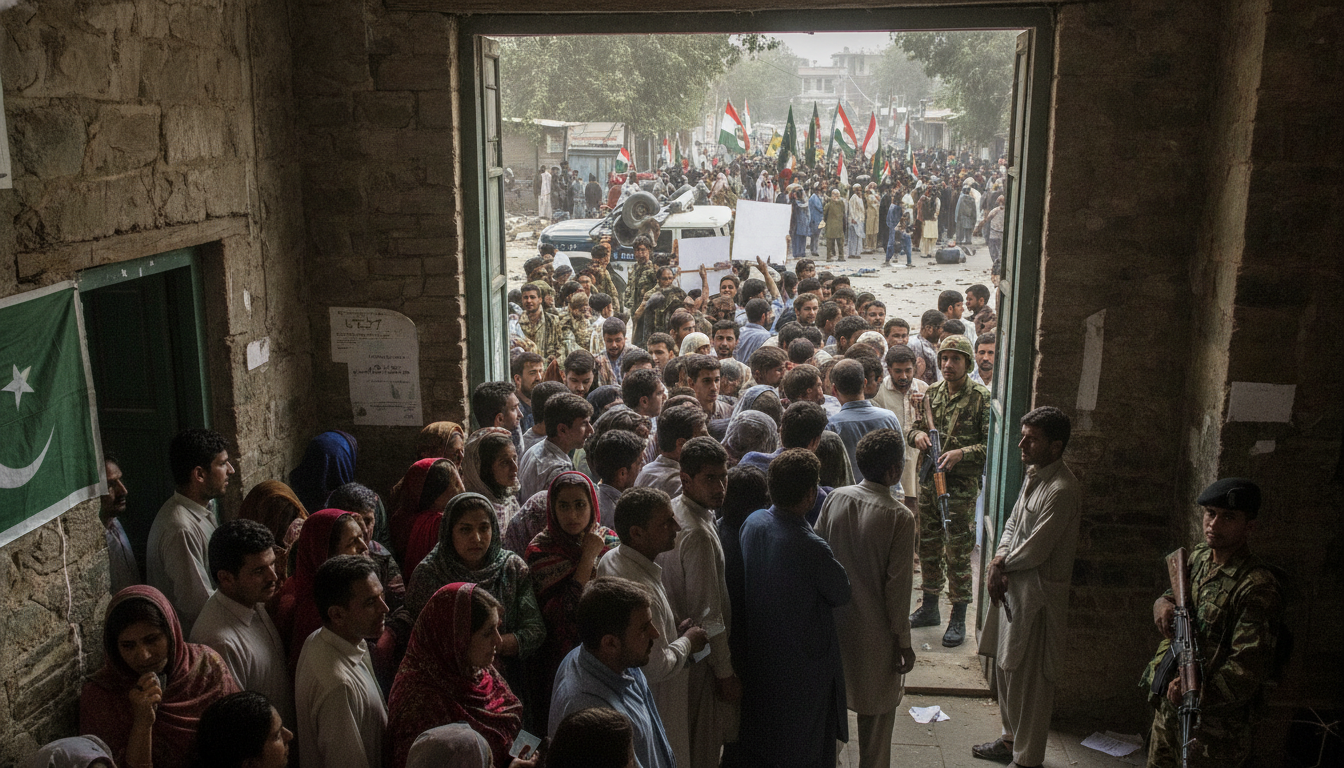
Tensions Rise in Pakistan‑administered Kashmir Over 12 Refugee Seats Ahead of Staggered AJK Elections
Unrest in Pakistan‑administered Kashmir has intensified as protests over the 12 refugee seats and widening economic grievances have disrupted daily life and clouded the territory’s staggered AJK assembly elections. The dispute over the 12 refugee seats — reserved for Kashmiris uprooted from Indian‑administered Kashmir — sits at the centre of a summer of shutdowns, clashes and political uncertainty. Authorities have banned the Jammu Kashmir Joint Awami Action Committee (JAAC), suspended communications across much of the region and split the 45‑seat assembly vote into three dates to try to manage mounting tensions.
Violence and public services disrupted
Since early June, nearly 40 people have died in confrontations between protesters and security forces, with sit‑ins, road blockades and shutter‑down strikes reported across the territory. Banks were ordered closed for two weeks and mobile and internet services remain largely suspended, complicating commerce and daily life for residents. Poonch division, which borders India and has been the epicentre of unrest, was effectively sealed off for weeks, interrupting supplies of flour and other essentials to communities that depend heavily on external deliveries.
JAAC ban and shifting demands
The Jammu Kashmir Joint Awami Action Committee was banned by the local government on June 5, days before a planned demonstration, and its leaders have been arrested, gone underground or continued organising from protest camps in Rawalakot. JAAC’s platform has broadened since it formed, moving from initial demands for subsidised flour and cheaper electricity to a 38‑point charter that includes the abolition of the 12 refugee seats. The movement’s leadership is not contesting the election and has urged supporters to boycott the vote, raising the prospect of further disruption on election days.
History and mechanics of the 12 refugee seats
The 12 assembly seats trace back to electoral arrangements introduced in the 1960s and were enshrined in AJK’s interim constitutional framework, most recently reaffirmed by a constitutional amendment in 2018. Those seats are allocated to refugees from Indian‑administered Kashmir who now live across Pakistan, making the constituencies geographically scattered rather than territorially contiguous within AJK. Election Commission figures show AJK’s electorate has grown from roughly 3.2 million in 2021 to more than 3.8 million this year, with the refugee constituencies accounting for about 439,000 registered voters.
Attempts at compromise and political rejection
JAAC offered compromise proposals in late May, suggesting either symbolic retention of refugee representation until a final settlement on Kashmir, or shifting representation to the Islamabad‑chaired AJK Council and eliminating the assembly seats. Both options were rejected at an All‑Parties Conference in Muzaffarabad on June 3, where local leaders and parties declined to alter the status quo ahead of elections. Government officials and some party leaders urged JAAC to contest the issue at the ballot box rather than seek changes through street pressure.
Legal ruling and constitutional hurdles
The AJK Supreme Court has ruled that the 12 refugee seats are constitutionally protected and can only be abolished through a formal constitutional amendment, not by executive decree or concession under duress. Legal authorities have pointed out that any amendment requires an elected legislature, and with the outgoing assembly’s term ended, no immediate legal route exists until a new house is in place. Former AJK judges and constitutional lawyers have reiterated that the seats have historical and legal roots stretching back to the territory’s founding documents and subsequent statutory changes.
Government posture and the role of Islamabad
Local officials, including the AJK prime minister and former ministers, have defended the refugee seats as part of the territory’s constitutional design and disputed claims that seat‑holders form an unaccountable political bloc. At the same time, observers and some activists argue that Islamabad’s civilian and military institutions exert decisive influence over AJK politics. JAAC leaders have publicly acknowledged communications with Pakistan’s military leadership, and analysts say the refugee seats also serve broader federal objectives by reinforcing Islamabad’s claim that AJK represents the entire former princely state of Jammu and Kashmir.
Electoral timetable and high political stakes
To reduce flashpoints, election authorities split the vote: Mirpur division proceeded on the original date, Muzaffarabad and the 12 refugee constituencies were set for August 2, while Poonch — where tensions remain highest — will vote on August 10. The staggered schedule reflects security and logistical concerns but also leaves open the possibility that unresolved unrest will influence turnout and legitimacy. With JAAC calling for a boycott and many grievances still unaddressed, the vote will be a test of whether electoral processes can proceed amid continuing political fractures.
The dispute over the 12 refugee seats has reopened long‑running questions about representation, constitutional procedure and who has authority to decide AJK’s political arrangements. As the territory moves through its staggered voting schedule, the immediate challenge will be restoring basic services and security, while the deeper contest over the seats will likely require legislative action or a broader political settlement that has so far proved elusive.
