
Magna Backs Yuma with $35M to Scale Battery Swapping in India
Magna increases its stake in Yuma with a $35 million injection to expand battery swapping in India, growing stations, batteries and pushing toward EBITDA break-even.
Canada’s Magna International has committed an additional $35 million to Yuma Energy as it seeks to scale battery swapping in India for electric two- and three-wheelers. The investment raises Magna’s ownership beyond the majority stake it took when the joint venture launched and dilutes Yulu’s holding, Yuma’s managing director Muthu Subramanian confirmed. The move underscores a bet that India’s large delivery and gig-economy fleets can make swapping commercially viable at scale.
Magna increases investment and stake
Magna’s fresh funding follows an earlier strategic commitment to India’s micromobility sector that included a combined $77 million to Yulu and the battery-swapping venture. The new $35 million boosts Magna’s position in Yuma above the 51% it initially held when the joint venture was created in early 2023. Yuma’s leadership declined to disclose the precise post-investment ownership split but said Yulu’s 49% stake will be reduced.
Operational scale and usage milestones
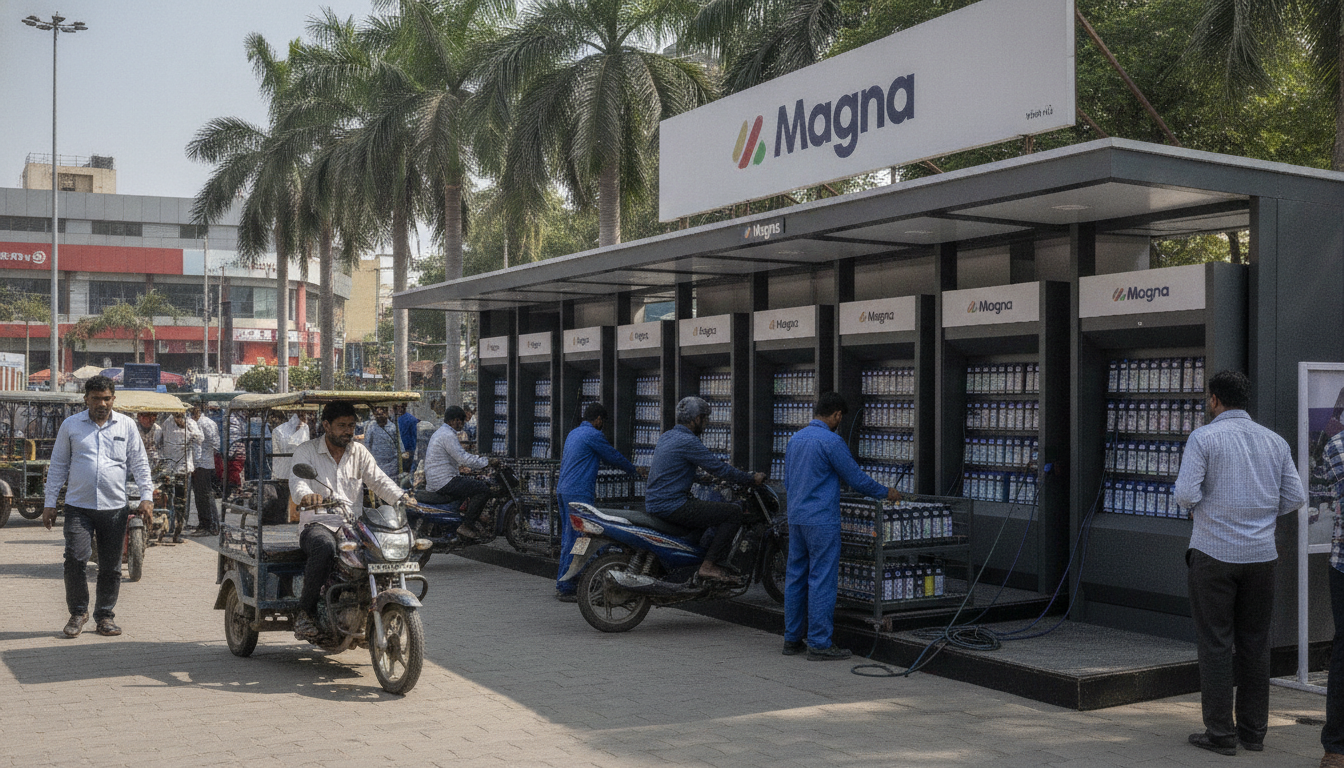
Yuma has completed more than 60 million battery swaps and currently deploys roughly 100,000 battery units across its network. The firm operates more than 400 swapping stations and maintains over 2,500 charging units, covering 18 Indian cities including Bengaluru, Hyderabad, Mumbai and the Delhi region. Those metrics have been key to convincing Magna that the model can reach the scale needed to improve unit economics.
Path to profitability and unit economics
Yuma is not yet profitable but reports that several of its older swapping stations are already EBITDA-positive, reflecting localized economics where utilization is higher. The company recorded about ₹1 billion in revenue for the financial year ending March 2026, roughly $10.5 million, and is targeting EBITDA break-even over the coming quarters. Executives say the business is capital intensive because stations and spare batteries must be provisioned ahead of demand to guarantee the fast turnaround gig riders require.
Customer mix and fleet growth plans
While Yulu remains Yuma’s largest customer, its dominance is easing; about 15–20% of recent swaps came from other fleets. The company now serves more than five distinct fleet operators and has integrated batteries with more than 10 vehicle platforms, including models from Kinetic Green, Motovolt, BGauss and Quantum Energy. Yuma expects non-Yulu customers to represent roughly a quarter of swaps within the next two years, driving the need to expand infrastructure in step with growing fleet demand.
Deployment strategy and geographic expansion
The additional capital will be used primarily to expand swapping infrastructure and to roughly double Yuma’s fleet of batteries over the next 12 to 18 months. New stations are planned for Chennai and Pune, alongside densification in existing cities to support higher utilization rates. Yuma intends to remain focused on the Indian market for at least the next 12 to 18 months while keeping longer-term options open for Southeast Asia and parts of Africa, where two-wheeler markets are large and potentially receptive to swapping networks.
Yuma differentiates itself by designing and manufacturing its own battery packs and charging units, producing packs in Chennai and charging hardware in Bengaluru. That vertical control allows the company to optimize pack form factors and the network software that manages charging, state-of-charge tracking and swap logistics. Executives argue this integration helps maintain service quality and lowers operational friction when scaling across different vehicle types and fleet partners.
The investment reflects a broader industry debate over whether battery swapping or faster public charging will win for short-range, high-utilization vehicles. Yuma’s case rests on the premise that delivery riders and other gig workers value uptime above all, and that a sub-two-minute swap is more attractive than waiting for even a fast charge. Magna’s backing signals confidence that, in markets driven by high daily mileage and dense urban delivery routes, swapping can achieve the utilization and density needed to become profitable.
Longer term, Yuma’s scaling plan depends on both demand growth and capital deployment to build out stations where riders operate most. Success will hinge on converting more gig riders to EVs, maintaining high station utilization, and expanding partnerships with vehicle makers and fleets. With Magna boosting its investment, Yuma has expanded runway to pursue those objectives while preparing to test the model beyond India’s major cities.
