
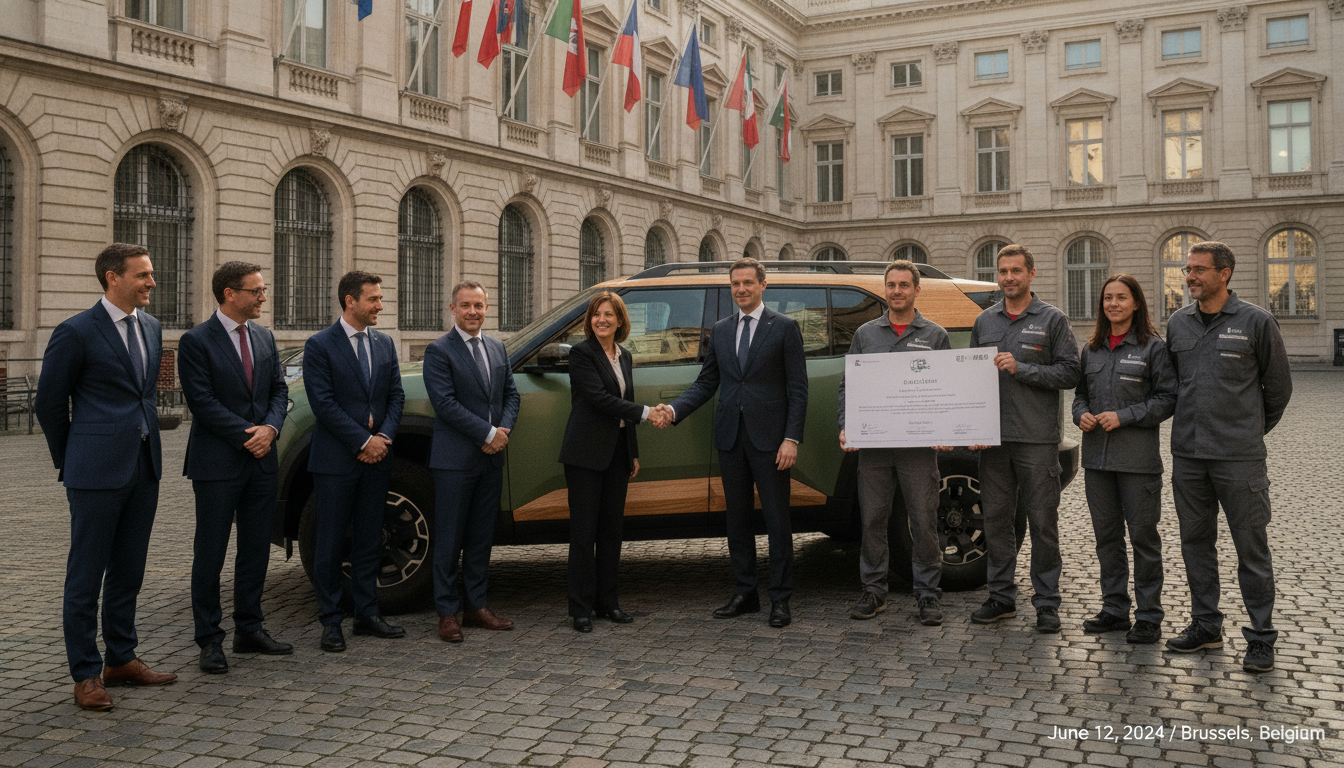
Liux Big: Spanish Startup’s Linen-Composite Microcar Wins Europe-Wide Homologation
Liux Big, a compact electric microcar built with linen-based biocomposite panels and designed in Spain, has won Europe-wide homologation and targets sales in the first half of 2027.
Liux Big arrives as the latest European microcar to challenge Chinese imports and aims to marry sustainability with urban practicality in a space-saving electric vehicle. The company says the Liux Big secured Europe-wide homologation in 2026 and will begin deliveries in the first half of 2027, positioning the model as an affordable, second-car option for city households. The vehicle’s lightweight, linen-derived body, home-charging capability including solar recharge, and a promised price beneath €18,000 before subsidies are central to Liux’s pitch.
Homologation and launch timetable
Liux announced that the Liux Big completed regulatory homologation across the European Union in 2026, allowing the company to sell the model continent-wide. The startup says production preparations are underway and it expects to start customer deliveries in the first half of 2027.
The homologation marks a turning point for Liux after earlier prototypes and follows a strategic shift from a larger SUV concept to a compact, homologation-friendly model. Company executives describe the timeline as achievable thanks to targeted engineering and recent investment rounds.
Sustainable materials and recyclable design
A defining feature of the Liux Big is its use of a linen-based biocomposite for exterior panels, a material the company says can be extracted and recycled at end of life. Liux frames that choice as an attempt to make circularity practical rather than theoretical, emphasizing build methods that preserve material integrity for second-life reuse.
Batteries are sourced outside Europe, but the car is designed for convenient home charging and can integrate with household solar systems. Liux also highlights an interior and component strategy that favors repairability and slower obsolescence cycles compared with many contemporary EVs.
Factory footprint and lean production
Liux opened a small-scale final-assembly plant in Azuqueca de Henares, roughly an hour from central Madrid, where the company performs last-stage assembly using lean manufacturing principles. The facility handles final fitting and quality checks while upstream components are supplied by partners, a model Liux says is necessary given the realities of modern supply chains.
Despite the modest footprint of the Azuqueca line, Liux projects capacity growth and has set an internal target of producing up to 20,000 vehicles annually by 2030 through multiple Spanish sites. The company has grown to about 65 employees and plans to scale output by partnering with regional facilities and dealerships.
Product details and variants
The Liux Big will initially be offered in two battery configurations — a 15 kWh and a 20 kWh pack — and the company also intends to offer a cargo variant for light commercial use. With its L7e homologation, Liux emphasizes the vehicle is engineered to feel like a conventional four-wheeled car rather than a motorcycle-derived quadricycle.
Engineers say the interior and packaging deliver a relatively large 260-liter trunk and driver-focused dynamics within the category’s weight and size constraints. Liux intends to position the Big for short urban trips, commuting and household second-car duties while retaining practical cargo space.
Safety testing and on-road performance
Although European rules for certain microcar categories do not mandate crash testing, Liux has undertaken maneuvers and performance demonstrations to underline stability and occupant protection. Company engineers staged slalom, emergency braking and handling tests during media demonstrations to show the Big’s dynamic competence.
Liux’s engineering team argues that making a compact EV feel and behave like a car is central to consumer acceptance, helping to broaden appeal beyond specialist buyers who accept trade-offs in comfort and safety.
Market strategy and pricing
Liux says more than 7,500 people have joined a no-fee waiting list for the Liux Big, giving the startup early visibility into demand patterns and buyer profiles. Preliminary data suggest a strong interest from older urban residents and households seeking an efficient second vehicle.
The company has secured about €16 million in funding, including European grants, which it plans to use to bring the urban version of the Liux Big to market via dealership partnerships across Europe. Liux indicates the retail price will be below €18,000 before any national or regional EV incentives, a level that places it at the upper end of typical microcar pricing but deliberately aimed at delivering greater perceived value.
Liux is also keeping open options for fleet partnerships, potential autonomous technology integrations and additional models as the brand expands beyond a single product.
The appearance of the Liux Big signals a continuing effort by European startups to reclaim a segment increasingly dominated by small, low-cost Chinese EVs, blending distinct materials and sustainability messaging with practical urban mobility features.
