
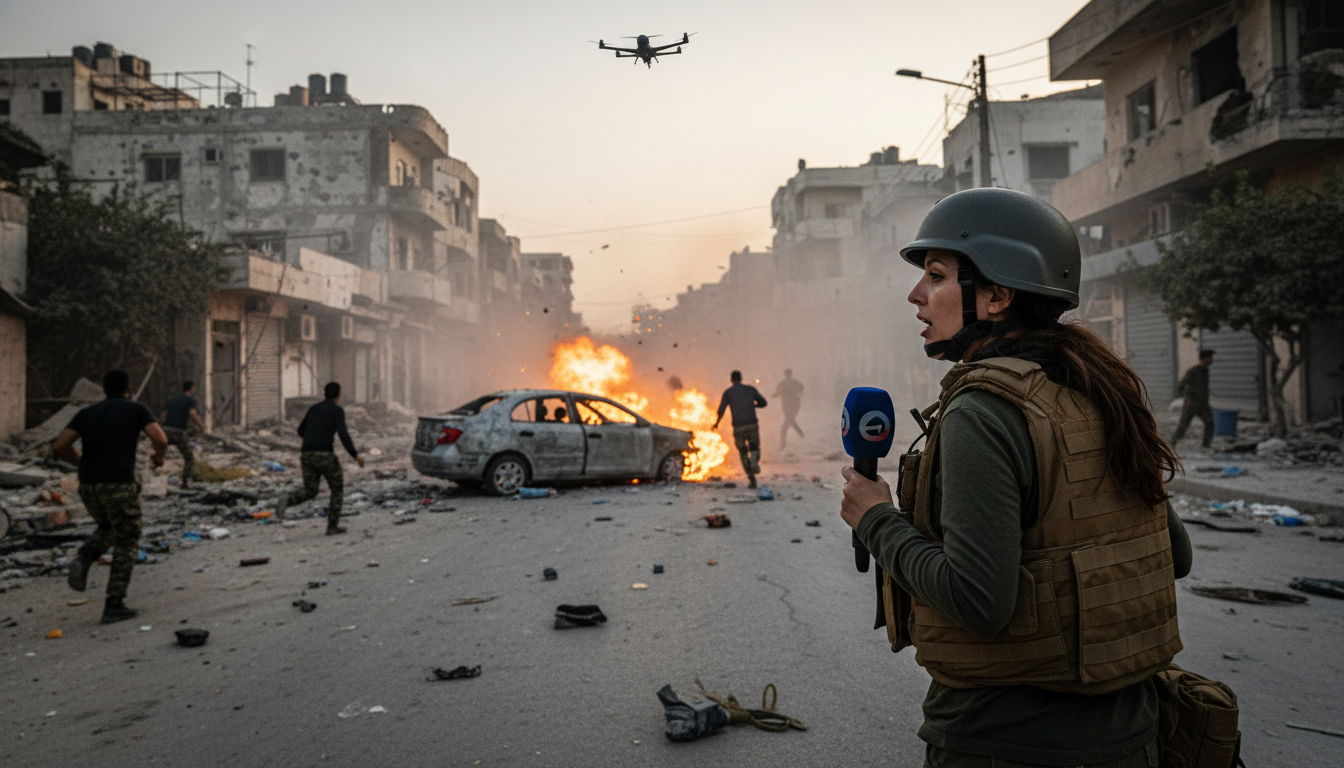
Video Captures Nabatieh Air Strike Striking Car Behind Journalist Abbas Fakih as Truce Frays
A short video circulating from Nabatieh shows a journalist standing on the street reporting when an Israeli air strike struck a vehicle directly behind him, highlighting the danger to media in southern Lebanon as attacks continued despite a new US-brokered ceasefire. The footage names photographer Abbas Fakih as the reporter on the scene and has been widely shared alongside imagery of damaged neighbourhoods in the region. (mtv.com.lb)
Video Footage Shows Near-Miss in Nabatieh
The clip captures a routine field report that is interrupted by a sudden blast and a plume of smoke from the road behind the reporter. Viewers can hear the shock of bystanders as responders rush toward the damaged car, underscoring how quickly a reporting assignment can turn life-threatening. Local broadcasters and independent outlets have posted the footage to social platforms and news feeds, prompting renewed attention to safety for journalists working in active conflict zones. (mtv.com.lb)
Photographer Abbas Fakih Was Reporting in the City
Abbas Fakih, credited in several recent images and video from Nabatieh, is known to have worked in the southern governorate documenting strikes and their aftermath. His photographs have been used widely by international agencies to illustrate damage across Nabatieh and nearby towns, and the footage aligns with other on-the-ground material from the same area. The concentration of journalists in affected neighbourhoods has produced numerous eyewitness recordings of strikes and rescue efforts. (aljazeera.com)
Ceasefire Agreed in Washington, But Fighting Continued
On June 3, 2026, the United States announced that Israel and Lebanon had agreed to implement a ceasefire framework after talks in Washington, though the arrangement was conditional on Hezbollah ending its attacks and withdrawing fighters from southern sectors. The diplomatic announcement was intended to curb cross-border violence, but military activity and strikes were reported in southern Lebanon in the days that followed, raising questions about the truce’s immediate effectiveness. International reporting has since documented both the agreement and multiple alleged violations on the ground. (ca.marketscreener.com)
Nabatieh and Nearby Towns Report New Strikes and Damage
Residents and emergency teams in Nabatieh have reported fresh impacts on roads, homes and infrastructure amid continuing aerial and drone strikes over recent weeks. Local accounts and regional press coverage describe vehicles and buildings damaged by munitions, with first responders working to clear debris and assist the wounded. The pattern of hits in the Jabal Amel area and other southern towns has produced a mounting humanitarian toll and growing internal displacement. (commondreams.org)
Political Responses and Rejection by Armed Groups
Lebanese and Israeli officials framed the Washington talks as a step toward stabilizing the border, while some armed groups publicly rejected terms they viewed as constraining their operations. Lebanese government representatives participated in the US-led negotiations but the deal’s conditions — including pilot security zones and demands for Hezbollah withdrawal from specific sectors — drew immediate pushback from the group and its allies. Observers warn that without buy-in from all armed actors active along the frontier, the ceasefire’s limits are likely to be tested by further exchanges of fire. (rudaw.net)
The striking footage from Nabatieh has renewed calls from press freedom and safety organisations for clearer protections for journalists operating in conflict zones and for immediate measures to prevent civilian casualties. Emergency services on the ground continue to document the human cost of repeated strikes while diplomats press for implementation of the Washington agreement. The sequence recorded behind Abbas Fakih illustrates how volatile front-line reporting remains and how quickly negotiated pauses can be undermined by ongoing military operations.
